
Financial & IP Lawyers in Arizona
Connect with top-rated Arizona financial and IP lawyers to protect your trademarks, navigate fintech regulations, and defend trade secrets across state courts. Engaging skilled intellectual property and financial counsel enables tech enterprises and founders to resolve infringement claims and secure capital structures through negotiated agreements. Explore our verified statewide directory below to consult an experienced Arizona attorney.

Onisile Law Firm, PLLC, Phoenix, AZ
Bold Patents Law Firm - Tucson, AZ

Vondran Legal Business and IP Litigation Law Firm - PHOENIX, AZ

Gust Rosenfeld P.L.C. - Phoenix, AZ

Law Office of Merle L. Stolar, P.L.L.C. - Tucson, AZ

Cactus Blossom Legal - Surprise, AZ

Greeves & Roethler, PLC - Tempe, AZ
Oswalt Law Group - Peoria, AZ

Law Office of D.L. Drain, P.A. - Phoenix, AZ

Knollmiller & Arenofsky, LLP - Mesa, AZ
Law Offices of Jim D. Smith - Yuma, AZ
The Law Firm of Brown & Jensen - Peoria, AZ

Tax Relief Pros Yuma - Yuma, AZ
Asheton B. Call, Attorney at Law - Chandler, AZ
Ken Koenen Law Office - Peoria, AZ

Thomas W. Galvani, P.C. - Phoenix, AZ
Community Legal Services - Yuma, AZ
The Peterson Law Firm - Tempe, AZ

Ronald Ryan, Attorney, Ronald Ryan PC - Tucson, AZ
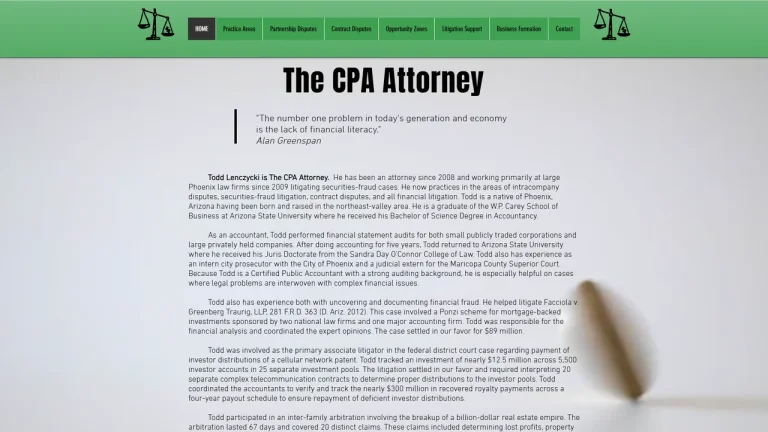
The CPA Attorney - PHOENIX, AZ

Ted Law | Tempe DUI and Criminal Lawyer - AZ

Allen, Jones & Giles, PLC - Phoenix, AZ

Fuller IP Law: Blackman, Burnham and Fuller - PHOENIX, AZ

Navigating Financial and Intellectual Property Law Across Arizona
Intellectual property protection and commercial financial regulation in Arizona are anchored by state business statutes and specialized administrative oversight. The Supreme Court of Arizona and the State Bar of Arizona in Phoenix enforce high standards of legal ethics, while commercial disputes and transactions proceed through statewide courts and dedicated regulatory boards.
Commercial activity centers around major innovation corridors, including the Silicon Desert technology corridor spanning Phoenix, Tempe, Scottsdale, and Chandler, as well as the optics, aerospace, and defense clusters in Tucson and Pima County. Commercial financial entities, fintech developers, and proprietary technology firms frequently operate under the oversight of the Arizona Corporation Commission (ACC) Securities Division in Phoenix, the Arizona Department of Insurance and Financial Institutions (DIFI), and the Office of the Arizona Attorney General, which administers the Arizona FinTech Regulatory Sandbox under A.R.S. § 41-5601.
Litigation involving registered trademarks, trade secrets, software rights, and venture financing agreements is divided between county superior courts and federal venues. While the U.S. District Court for the District of Arizona handles federal copyright, patent, and Lanham Act claims in Phoenix and Tucson, the commercial court divisions of the Maricopa County Superior Court and Pima County Superior Court manage high-stakes financial contract breaches and state trade secret enforcement. Retaining licensed Arizona counsel ensures local compliance and aggressive protection of valuable commercial assets.
Financial & IP Legal Fee Framework in Arizona
| Case Scenario | Fee Structure | Estimated Cost (USD) | Key Cost Determinants |
|---|---|---|---|
| State & Federal Trademark Clearance and Filings | Flat Fee per Class | $1,000 - $2,500 | Number of USPTO classes, Arizona Secretary of State registration scope, and office action response complexity. |
| FinTech Regulatory Compliance & Capital Structuring | Hourly Billing | $350 - $650 / hr ($5,000 - $15,000 retainer) | Arizona Corporation Commission exemptions, state sandbox admissions, and anti-money laundering frameworks. |
| Proprietary IP Licensing & SaaS Master Agreements | Flat Fee or Hourly | $2,500 - $7,500 | Negotiation of indemnification provisions, developer assignment covenants, and data security mandates. |
| Trade Secret Misappropriation & Injunction Litigation | Hourly with Advance Retainer | $400 - $750 / hr ($10,000 - $25,000+ retainer) | Emergency temporary restraining order (TRO) filings, forensic computer discovery, and preliminary injunction hearings. |
Critical Legal Deadlines & Statutes in Arizona
Financial transactions and proprietary rights enforcement in Arizona are governed by rigid statutory deadlines. Under the Arizona Uniform Trade Secrets Act (AUTSA), codified at A.R.S. § 44-401, an action for misappropriation of trade secrets must be commenced within three years after the misappropriation is discovered or should have been discovered through the exercise of reasonable diligence, as mandated by A.R.S. § 44-406.
For financial securities offerings and investor claims, the Arizona Securities Act governs civil liabilities under A.R.S. § 44-1801. Lawsuits alleging securities fraud or misrepresentation must be brought within two years after discovery of the violation or within five years after the underlying transaction occurred pursuant to A.R.S. § 44-2004. State-level trademark registrations filed with the Arizona Secretary of State under A.R.S. § 44-1441 remain effective for five years and must be renewed within the six-month window prior to expiration under A.R.S. § 44-1445. General breach of written financial agreements is subject to a six-year limitations period under A.R.S. § 12-548.
Justice Court Small Claims Limits vs. Superior & Federal Court Jurisdiction
In Arizona, the Small Claims Division of the Justice of the Peace Courts handles minor civil recovery actions capped at a statutory ceiling of $3,500 pursuant to A.R.S. § 22-503. Critically, under A.R.S. § 22-512, attorneys are expressly prohibited from appearing or representing parties in the Small Claims Division unless all parties stipulate in writing, restricting this forum strictly to self-represented individuals.
While regular Justice Courts handle general civil claims up to $10,000 under A.R.S. § 22-201, intellectual property matters, trade secret disputes, and complex commercial financing transactions fall completely outside their authority. Justice Courts lack jurisdiction to issue injunctive relief, enter protective orders for source code, or interpret federal trademark laws. Pursuing intellectual property enforcement or high-stakes financial defense requires representation in the Superior Court of Arizona or the U.S. District Court, where an experienced commercial attorney is essential to prevent corporate asset destruction.
Red Flags & Vetting Standards for Arizona IP & Financial Lawyers
- Practitioners claiming to handle patent prosecution who are not registered patent attorneys admitted before the USPTO.
- Attorneys who draft financing contracts without analyzing private placement exemptions under the Arizona Securities Act.
- Failure to perform comprehensive state and federal trademark clearance searches before advising on corporate branding.
- Refusing to provide a written fee agreement clearly detailing government agency filing fees separate from legal services.
Frequently Asked Questions
What is the statute of limitations for trade secret theft in Arizona?
Under A.R.S. § 44-406, a trade secret misappropriation lawsuit must be filed within three years from the date the misappropriation was discovered or reasonably should have been discovered.
How does the Arizona FinTech Regulatory Sandbox operate?
Administered by the Arizona Attorney General under A.R.S. § 41-5601, the sandbox allows financial technology companies to test innovative products with real consumers under temporary regulatory exemptions.
Can attorneys represent clients in Arizona Small Claims Court?
Under A.R.S. § 22-512, attorneys are prohibited from representing parties in the Small Claims Division unless all parties grant written consent, making it a self-represented venue for disputes up to $3,500.
What is the difference between state and federal trademark registration in Arizona?
State registration through the Arizona Secretary of State under A.R.S. § 44-1441 protects marks strictly within Arizona, whereas federal USPTO registration provides nationwide protection and statutory presumptions.
Where are intellectual property lawsuits litigated in Arizona?
Federal claims for patent and copyright infringement are litigated in the U.S. District Court in Phoenix or Tucson, while state trade secret and breach of contract actions proceed in County Superior Courts.