
Residential Real Estate Lawyers in Phoenix
Resolving residential property disputes in Phoenix requires a deep understanding of Arizona disclosure laws and Maricopa County title standards. Retaining a skilled real estate lawyer protects your home investment and resolves boundary or contract disputes through early mediation. Review our verified directory below to schedule a consultation with Phoenix property attorneys.

Cullimore & Coleman, PLC - Phoenix, AZ

Resolvere Law PLLC - Phoenix, AZ

Platt & Westby, P.C. - PHOENIX, AZ

Gottlieb Law, PLC - Phoenix, AZ

Klauer & Curdie - PHOENIX, AZ
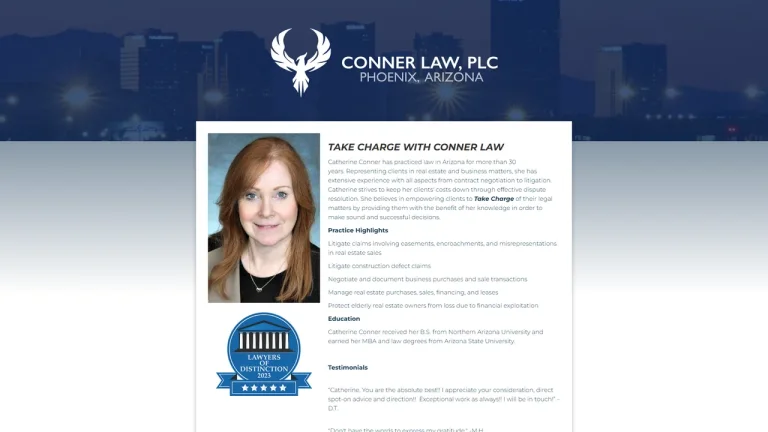
Conner Law, PLC - Phoenix, AZ

Roger M. Stahl - Frazer Ryan Goldberg & Arnold - PHOENIX, AZ

Kadish Associates Law Group - Phoenix, AZ

The Law Office of Nino Abate, PLC - Phoenix, AZ

Martin, Kerrick & Bell - Phoenix, AZ
Nagle Law Group Phoenix, AZ
Fraud Fighters Law Firm - Phoenix, AZ

Dempsey & Fouts - Phoenix, AZ

Hull, Holliday & Holliday PLC - Phoenix, AZ

Law Offices of Scott M. Clark, PC - Phoenix, AZ

Saal and Plaskett, PLLC - PHOENIX, AZ

Protecting Homeowner Rights Across Phoenix & Maricopa County
Residential real estate legal matters in Phoenix involve complex state statutes, local property ordinances, and rigorous recording standards. Property disputes across Maricopa County are filed within the Civil Division of the Maricopa County Superior Court, with regulatory complaints and licensing matters handled through the Arizona Department of Real Estate (ADRE) and the Arizona Registrar of Contractors (ROC).
Homeowners, buyers, and sellers across Phoenix-spanning established historic communities in Midtown and Arcadia, high-value developments in Biltmore, and growing master-planned communities in Ahwatukee and Desert Ridge-routinely face contractual disputes, title encumbrances, and structural defect disclosures. Boundary lines and access easements frequently trigger legal disputes requiring formal deed analysis at the Maricopa County Recorder's Office.
Securing experienced Phoenix residential real estate counsel ensures that purchase contracts, earnest money disputes, and HOA conflicts are resolved effectively. Qualified attorneys leverage pre-suit dispute resolution avenues and mandatory mediation clauses under standard purchase agreements to achieve cost-efficient settlements without entering drawn-out courtroom battles.
Phoenix Residential Real Estate Legal Costs & Fee Structures
| Case Scenario | Fee Structure | Estimated Cost (USD) | Key Cost Determinants |
|---|---|---|---|
| Purchase Agreement & Earnest Money Dispute | Flat Fee or Hourly | $1,500 - $4,500 | Escrow cancellation terms, financing contingency documentation, and AAR mediation clauses. |
| Seller Failure-to-Disclose & Latent Defects | Hourly Retainer ($325 - $500/hr) | $5,500 - $20,000+ | Engineering expert inspections, proof of seller knowledge, and property valuation loss. |
| Quiet Title & Property Boundary Easement Actions | Hourly or Hybrid | $3,500 - $10,000 | Surveyor evidence, historical title chain defects, and neighboring party opposition. |
| HOA Covenant Enforcement & Assessment Defense | Hourly ($300 - $450/hr) | $2,000 - $6,500 | CC&R ambiguity, administrative complaints before ADRE, and preliminary injunctions. |
Critical Legal Deadlines & Statutes in Arizona
Residential property transactions in Phoenix are governed by strict statutory notification and limitation periods. In construction defect disputes, residential homeowners must follow the Arizona Purchaser Dwelling Act codified in A.R.S. § 12-1361 and A.R.S. § 12-1363, which requires delivering formal statutory notice to the builder or contractor before initiating legal proceedings to permit inspection and repair opportunities.
Claims against residential contractors are subject to the Arizona statute of repose under A.R.S. § 12-552, barring any breach of contract or construction defect claim commenced more than eight years after substantial completion of the dwelling, with a limited extension to nine years if the defect was discovered during the eighth year. Adverse possession claims to secure title over disputed residential boundaries require proof of open, notorious, and hostile possession for at least ten years under A.R.S. § 12-526.
Sellers are held to strict disclosure obligations under Arizona common law and statutory standards. When purchasing property in unincorporated Maricopa County areas or wildcat subdivisions, sellers must furnish an Affidavit of Disclosure under A.R.S. § 33-422 at least seven days before closing. Parties seeking attorney fees in property contract actions must substantiate their entitlement under A.R.S. § 12-341.01.
Small Claims Limitations vs. Real Estate Attorney Representation
The Small Claims Division of Maricopa County Justice Courts is restricted to monetary claims of $3,500 or less, and general Justice Courts handle civil claims up to $10,000. However, these municipal divisions possess zero jurisdiction over quiet title actions, easement determinations, or specific performance remedies seeking to compel a seller to convey real property.
Under A.R.S. § 12-1101, actions to quiet title to real estate must be initiated in the Maricopa County Superior Court. Attempting self-representation in title or seller disclosure litigation exposes homeowners to substantial fee-shifting penalties if the opposing party prevails under Arizona contract law. Professional representation ensures accurate lis pendens filings, deed drafting, and title insurer coordination.
Red Flags to Identify When Hiring Phoenix Real Estate Attorneys
- Lawyers who file immediate lawsuits without complying with the mandatory pre-suit notice procedures under the Arizona Purchaser Dwelling Act (A.R.S. § 12-1363).
- Attorneys who advise filing a wrongful lis pendens or fraudulent document on property records, risking severe statutory damages under A.R.S. § 33-420.
- Practitioners who bypass standard Arizona Association of Realtors (AAR) contract mediation requirements before initiating court litigation.
- Firms lacking familiarity with Maricopa County Superior Court quiet title pleading standards and title insurance defense triggers.
Frequently Asked Questions
What is the Seller's Property Disclosure Statement (SPDS) in Phoenix?
The SPDS is a standard Arizona real estate document where the seller formally discloses known material defects regarding structural integrity, plumbing, roof condition, termite history, and environmental factors affecting the residential property.
What are the penalties for filing an invalid property lien in Maricopa County?
Under A.R.S. § 33-420, knowingly recording a false, fraudulent, or invalid document against real property subjects the recording party to liability for $5,000 or treble actual damages, plus mandatory attorney fees.
How are homeowner disputes with Phoenix HOAs legally resolved?
HOA disputes involving CC&R violations or assessment disputes can be litigated in Maricopa County Superior Court or petitioned through an administrative hearing before the Arizona Department of Real Estate under A.R.S. § 32-2199.01.
Can a residential homebuyer sue a seller for hidden defects after closing?
Yes. If a seller had actual knowledge of a latent material defect that was not readily apparent and intentionally failed to disclose it, the buyer can pursue an action for fraud or breach of contract in Maricopa County Superior Court.
What is the statute of repose for home construction defects in Arizona?
Under A.R.S. § 12-552, homeowners generally have up to eight years from the date of substantial completion to bring legal action for construction defects against builders, engineers, or architects.