
Workers' Compensation Lawyers in Phoenix
Navigating a disputed workers' compensation claim in Phoenix requires experienced legal advocacy before the Industrial Commission of Arizona. An attorney protects your medical benefits, challenges unfair disability ratings, and secures lost wage compensation under statutory guidelines. Browse our directory below to connect with top-rated Phoenix workers' compensation attorneys.

Taylor & Associates, PLLC - PHOENIX, AZ

Phillips Law Group - Injury Lawyers - Phoenix, AZ

Larry H. Parker Accident Attorneys - Phoenix, AZ

Ely, Bettini, Ulman, Rosenblatt and Ozer - Phoenix, AZ

Cruz & Associates - PHOENIX, AZ

LHP Law Group - Phoenix, AZ

Diener Law - Phoenix, AZ

Morgan & Morgan - Phoenix, AZ

Arizona Injury Law Group, PLLC Phoenix, AZ

AZ Hometown Law Firm, Phoenix, AZ
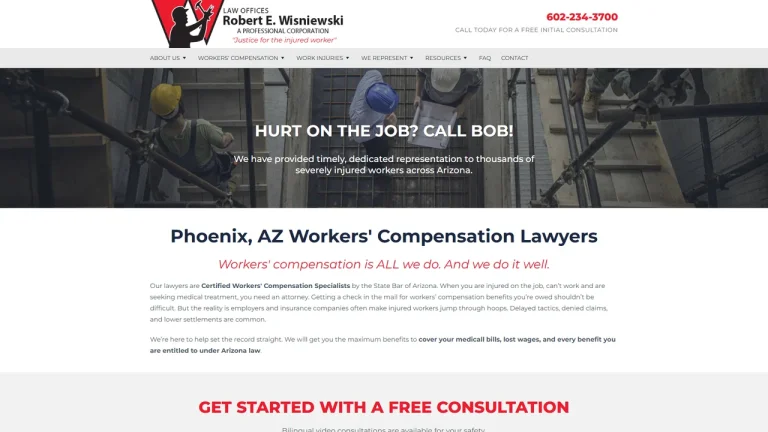
Robert E. Wisniewski, P.C. - Phoenix, AZ

Harris Injury Law Phoenix, AZ

Crossman Law Offices - Phoenix, AZ

Matt Fendon Law Group - PHOENIX, AZ

Alex Law - Phoenix, AZ
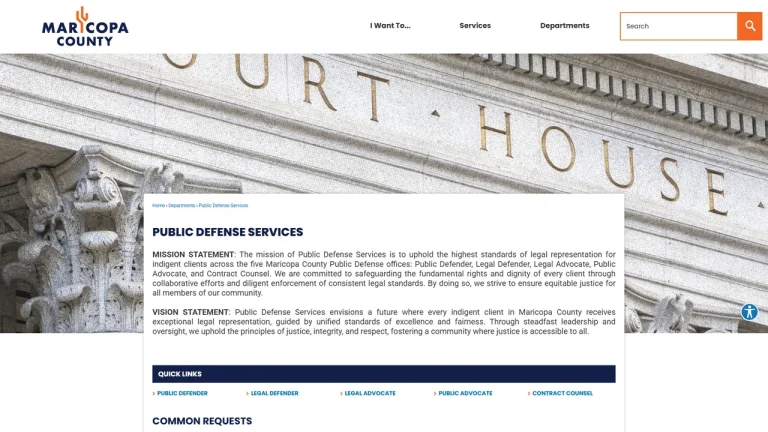
Maricopa County Office of Public Defense Services Phoenix, AZ

The Husband & Wife Law Team - Phoenix, AZ
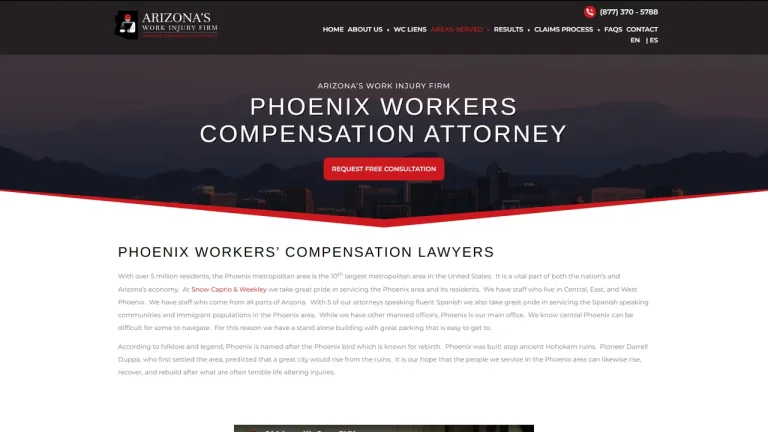
Arizona's Work Injury Firm - Phoenix, AZ

Martin & Bonnett PLLC - Phoenix, AZ

Schiffman Law - PHOENIX, AZ
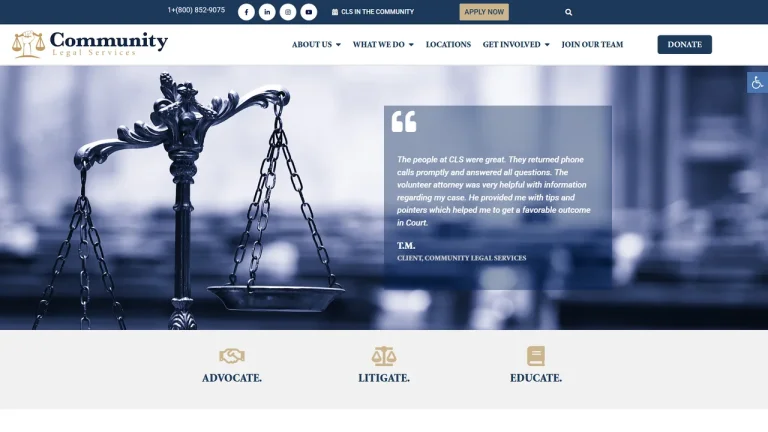
Community Legal Services - PHOENIX, AZ

Sargon Law Group - Phoenix, AZ

Roeschke Law, LLC - Phoenix, AZ

Arizona Workers' Compensation Practice & ICA Jurisdiction
Workplace injuries across the Phoenix metropolitan area span heavy industrial sectors, construction sites across the East Valley and West Valley, warehousing facilities in Southwest Phoenix, and healthcare environments. Unlike civil personal injury torts, employee workplace injury claims in Arizona are administered under a statutory no-fault compensation structure. The overarching regulatory body governing these claims is the Industrial Commission of Arizona, headquartered at 800 West Washington Street in Downtown Phoenix.
The Industrial Commission of Arizona maintains an Administrative Law Judge Division that conducts formal evidentiary hearings when workers' compensation insurance carriers deny claims, terminate medical treatment, or dispute permanent disability impairment ratings. Further appellate review moves directly from the ICA to the Arizona Court of Appeals, Division One, also situated in Phoenix. Retaining a dedicated Phoenix workers' compensation attorney ensures that injured employees are not coerced into premature claim closures by insurance adjusters or biased independent medical examiners.
Arizona Workers' Compensation Scenarios & Statutory Fees
| Case Scenario | Fee Structure | Estimated Cost (USD) | Key Cost Determinants |
|---|---|---|---|
| Contested Claim Denial (Notice of Claim Status) | Statutory Contingency (Max 25%) | $0 Upfront ($1,500 - $4,500 expenses) | Medical causation depositions, employer dispute of accident context, ALJ hearing transcripts |
| Permanent Partial Disability (Scheduled/Unscheduled) | Statutory Contingency (Max 25%) | $0 Upfront ($2,000 - $6,000 expenses) | AMA Guides impairment rating discrepancies, independent medical exams, loss of earning capacity |
| Repetitive Trauma & Occupational Disease Claims | Statutory Contingency (Max 25%) | $0 Upfront ($2,500 - $5,500 expenses) | Ergonomic workplace audits, toxic exposure documentation, treating specialist testimony |
| Lump-Sum Settlement (Full & Final Agreement) | Statutory Contingency (Max 25%) | $0 Upfront ($1,000 - $3,500 expenses) | Projected future medical expense valuation, life expectancy tables, Medicare Set-Aside requirements |
Critical Legal Deadlines & Statutes in Arizona
Strict statutory timelines govern every phase of the Arizona workers' compensation process under the Arizona Workers' Compensation Act. Under A.R.S. § 23-1061, an injured worker must formally file a Worker's Report of Injury with the Industrial Commission of Arizona within exactly one year from the date the accident occurred, or within one year from when the employee discovered or reasonably should have recognized the work-related nature of an occupational disease or repetitive trauma injury.
Once an insurance carrier issues a formal Notice of Claim Status denying liability or terminating medical benefits, the injured employee faces an uncompromising 90-day deadline under A.R.S. § 23-941 to file a formal Request for Hearing before an Industrial Commission Administrative Law Judge; missing this 90-day window renders the carrier denial permanent and unappealable. Attorney fee arrangements in Arizona workers' compensation matters are strictly regulated by statute: under A.R.S. § 23-1069, legal fees are capped at a maximum of 25 percent of the compensation awarded and must receive administrative approval from the ICA. Furthermore, employee rights to benefits are grounded in no-fault liability under A.R.S. § 23-1021, protecting workers even when simple workplace mistakes occur.
Administrative ICA Hearings vs. Self-Representation
Maricopa County Justice Court Small Claims divisions and municipal courts have no legal jurisdiction over workplace injury disputes in Arizona. Exclusive original jurisdiction rests with the Industrial Commission of Arizona under A.R.S. § 23-921. While an injured employee can complete and submit the initial Worker's Report of Injury (ICA Form 0407) independently, self-representation becomes hazardous once the claim is contested or an insurance carrier demands an Independent Medical Examination pursuant to A.R.S. § 23-1026.
During administrative hearings before an ICA Administrative Law Judge, insurance companies are defended by seasoned litigation attorneys who cross-examine medical providers and present expert testimony aimed at reducing disability ratings. Unrepresented workers frequently forfeit permanent disability benefits because they do not understand how to distinguish between scheduled injuries (such as an arm or leg) and unscheduled injuries (such as back, neck, or psychiatric trauma), which determine ongoing loss-of-earning-capacity awards under A.R.S. § 23-1044. Retaining an attorney ensures medical witnesses are deposed effectively, fair impairment percentages are established, and third-party personal injury claims against negligent non-employers are thoroughly examined.
Red Flags When Hiring a Phoenix Workers' Comp Attorney
- Upfront Fee Demands: In Arizona, workers' compensation attorneys cannot charge upfront hourly retainers or consultation fees; all legal compensation is strictly contingent and capped at 25 percent under state law.
- Pushing Premature Full & Final Settlements: Exercise extreme caution if an attorney urges you to accept a quick lump-sum settlement before your treating physicians declare you have reached Maximum Medical Improvement.
- Lack of Direct ICA Trial Experience: Ensure your legal counsel routinely litigates hearings before Administrative Law Judges at the Industrial Commission of Arizona building in Downtown Phoenix.
- Ignoring Third-Party Negligence Claims: If your work injury involved a defective machine, scaffolding failure, or motor vehicle collision caused by a non-coworker, avoid firms that overlook filing a separate civil personal injury lawsuit.
Frequently Asked Questions
What is the maximum attorney fee for workers' compensation in Arizona?
Under A.R.S. § 23-1069, attorney fees in Arizona workers' compensation cases are capped by law at 25 percent of the disability compensation benefits secured, subject to formal review and approval by the Industrial Commission of Arizona.
What is the difference between a scheduled and unscheduled disability injury?
Under A.R.S. § 23-1044, scheduled injuries involve specific extremities such as an arm, leg, eye, or ear and pay statutory compensation for a set number of months. Unscheduled injuries involve the spine, head, or multi-body systems and can provide monthly compensation based on lifetime loss of earning capacity.
Can my Phoenix employer fire me for filing a workers' compensation claim?
No. Under Arizona law, it is unlawful for an employer to retaliate against, discipline, or terminate an employee solely for exercising their statutory right to file a workers' compensation claim.
Where are workers' comp administrative hearings held in Phoenix?
Hearings before Administrative Law Judges are conducted at the Industrial Commission of Arizona headquarters, situated at 800 West Washington Street in Downtown Phoenix.
Can I sue my employer in civil court for a workplace injury in Arizona?
Generally no, because workers' compensation is an exclusive remedy under Arizona law. However, you may sue third parties (such as negligent equipment manufacturers, outside contractors, or non-coworker motorists) in Maricopa County Superior Court through a third-party liability lawsuit.