
Family Immigration Lawyers in Tucson
Retaining an experienced Tucson family immigration lawyer provides vital legal protection when navigating federal green card and visa petitions. Dedicated counsel helps families navigate consular processing and adjustment of status, resolving complex admissibility obstacles without prolonged separations. Explore our directory below to schedule a case review with trusted Pima County immigration attorneys.
Ayala Law Office, P.C. - Tucson, AZ

The Law Offices of Frederick S. Klein - Tucson, AZ

Southern Arizona Legal Aid Inc - Tucson, AZ
Acceso Immigration Law, PLLC - Tucson, AZ
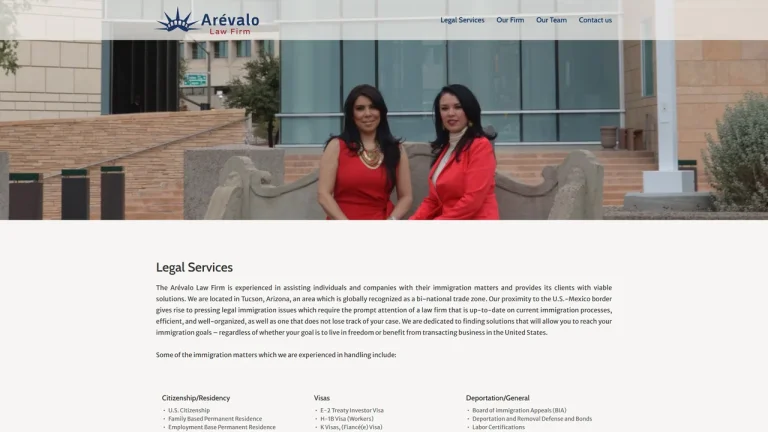
Arévalo Law Firm LLC - Tucson, AZ
Patricia G. Mejía Law Offices - Tucson, AZ

C.R. Wannamaker Law, PLLC - Tucson, AZ

Law Offices of Jennifer Huang, PC - Tucson, AZ
Rachel Wilson Law - Tucson, AZ

Green Evans-Schroeder, PLLC - Tucson, AZ

Goldman & Goldman, P.C. - Tucson, AZ

Navigating Family-Based Immigration in Tucson and Southern Arizona
Family reunification under federal immigration law requires navigating complex statutory procedures and stringent background assessments. In Tucson, where cultural, familial, and economic ties span the nearby international border with Mexico, families frequently encounter unique procedural hurdles. From adjusting status for immediate relatives in South Tucson to sponsoring overseas family members through consular processing, securing lawful permanent residence demands precise evidentiary documentation.
Federal immigration proceedings for Tucson and surrounding communities throughout Pima County are centralized across specialized venues. The United States Citizenship and Immigration Services (USCIS) Tucson Field Office adjudicates affirmative applications and naturalization interviews. For families facing removal proceedings or deportation defense, hearings are held at the Tucson Immigration Court, operated by the Executive Office for Immigration Review (EOIR) on West Congress Street. Formal challenges to agency denials or petitions for writ of mandamus are litigated at the James A. Walsh U.S. Courthouse.
Retaining a Tucson family immigration attorney protects your relatives from severe procedural traps, such as triggering unlawful presence bars. Local legal counsel evaluates prior immigration history, prepares comprehensive adjustment packages, and advocates during formal interviews, mitigating the risk of administrative denial or sudden detention.
Family Immigration Legal Services & Cost Estimates
| Case Scenario | Fee Structure | Estimated Cost (USD) | Key Cost Determinants |
|---|---|---|---|
| Immediate Relative Adjustment of Status (Form I-130 & I-485) | Flat Legal Fee | $2,800 - $6,500 | Lawful entry documentation, public charge financial sponsorship, and prior immigration records. |
| Consular Processing & Provisional Unlawful Presence Waiver (I-601A) | Milestone Flat Fee | $4,500 - $9,500 | Demonstrating extreme hardship to a qualifying relative, foreign consulate scheduling, and entry history. |
| K-1 Fiancé Visa Application & Embassy Preparation | Flat Legal Fee | $2,200 - $4,800 | In-person meeting proof, foreign language translations, and consular interview preparation. |
| Removal Defense & Cancellation of Removal in Tucson Court | Hourly or Staged Retainer ($300 - $550/hr) | $6,000 - $16,000+ | Master calendar hearings, individual merits trial preparation, qualifying relative hardship analysis. |
Critical Legal Deadlines & Statutes in Arizona
Family immigration cases are governed by strict federal statutes under the Immigration and Nationality Act (INA). Under 8 U.S. Code § 1151 and 8 U.S. Code § 1153, family sponsorship is divided between immediate relatives of U.S. citizens, who are exempt from numerical quotas, and preference categories subject to annual statutory limits reflected in the Department of State Visa Bulletin.
For noncitizens seeking lawful permanent residence inside the United States, 8 U.S. Code § 1255 establishes the prerequisites for adjustment of status, requiring proof of lawful inspection and admission. Individuals who accrued more than 180 days of unlawful presence face statutory three-year or ten-year reentry bars under 8 U.S. Code § 1182(a)(9)(B) if they depart the country, necessitating an approved provisional unlawful presence waiver under 8 C.F.R. § 212.7(e) prior to departure. If an adverse decision is rendered by the Tucson Immigration Court, a formal Notice of Appeal to the Board of Immigration Appeals (BIA) must be filed strictly within 30 calendar days pursuant to 8 C.F.R. § 1003.38.
Small Claims Court Exclusions vs. Federal Immigration Counsel
The Pima County Consolidated Justice Court operates a Small Claims Division handling minor civil financial disputes up to $3,500 under A.R.S. § 22-503. However, state justice courts and municipal city courts have zero authority over federal immigration status, deportation proceedings, or visa approvals. Immigration law is strictly an area of federal preemption governed by Title 8 of the United States Code.
Attempting to resolve family immigration filings without licensed legal counsel or relying on unaccredited document preparers frequently causes irreversible harm. An incorrectly filed form or misstatement regarding unlawful presence can trigger mandatory detention, expedited removal, or lifelong inadmissibility. Engaging an immigration attorney admitted to practice federal immigration law guarantees comprehensive legal representation before USCIS and the Department of Justice.
Red Flags When Hiring a Tucson Family Immigration Lawyer
- Reliance on non-attorney 'notarios' or immigration consultants who lack authorization to represent clients before USCIS or the Tucson Immigration Court.
- Guarantees of green card approval or promises of expedited processing that bypass statutory waiting periods set by federal agencies.
- Firms advising applicants to conceal past unauthorized work, border apprehensions, or law enforcement encounters on federal applications.
- Attorneys who fail to provide a written fee agreement clearly detailing filing fees charged by USCIS separately from legal representation costs.
Frequently Asked Questions
What is the difference between Adjustment of Status and Consular Processing?
Adjustment of Status under 8 U.S. Code § 1255 allows an eligible noncitizen currently residing in the United States to apply for lawful permanent residence through USCIS without leaving the country. Consular Processing involves applying for an immigrant visa through a U.S. Embassy or Consulate abroad, such as in Ciudad Juárez, following approval of an underlying petition.
Can a Tucson immigration lawyer help if my relative entered without inspection?
Yes. While entering without inspection generally precludes direct adjustment of status, a lawyer can assess eligibility for humanitarian relief, military Parole in Place, or a provisional unlawful presence waiver under 8 C.F.R. § 212.7(e) to minimize separation during consular processing.
Where are immigration court hearings held in Tucson?
Immigration removal hearings in Tucson are conducted at the Tucson Immigration Court, located within the federal complex at 300 West Congress Street in Downtown Tucson, under the jurisdiction of the Executive Office for Immigration Review.
What qualifies as extreme hardship for an I-601A waiver?
Extreme hardship requires demonstrating that a qualifying U.S. citizen or lawful permanent resident spouse or parent would suffer significant health, financial, personal, or psychological suffering beyond the normal distress caused by family separation under 8 U.S. Code § 1182(a)(9)(B).
How long does a family-based green card take through the Tucson USCIS Field Office?
Processing timelines vary depending on whether the petitioner is a U.S. citizen or permanent resident, background check clearances, and local field office interview backlogs, typically ranging from 8 to 24 months for immediate relatives.