
Car Accident Lawyers in Arkansas
Retaining an experienced Arkansas car accident attorney ensures your rights are protected against aggressive insurance carriers under state fault statutes. Dedicated local counsel investigates crash scenes, proves liability, and negotiates fair settlements to avoid prolonged trials. Explore our verified statewide directory to schedule a consultation today.

Warden Law Firm - Little Rock, AR

Thompson Law Firm, PLLC - Little Rock, AR
Clark Mason Attorneys - Little Rock, AR

Greer Injury Lawyers - Little Rock, AR

NST Law Injury Attorneys - Little Rock, AR
Wren Law Firm - Little Rock, AR
Taylor King Law - Fort Smith, AR

Little Rock Trial Attorneys, PLLC - Little Rock, AR

TopDog Law Personal Injury Lawyers - Little Rock, AR
Cook & Cossio - Little Rock, AR
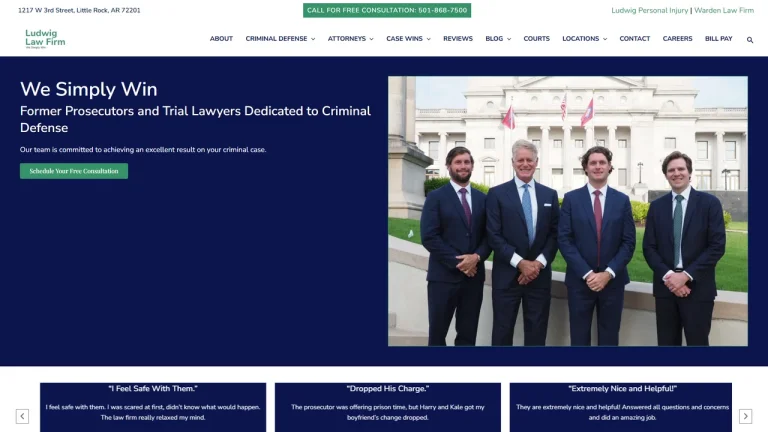
Ludwig Law Firm PLC - Little Rock, AR

Taylor & Taylor Law Firm, P.A. - Little Rock, AR

Reed Firm, P.A. - Little Rock, AR
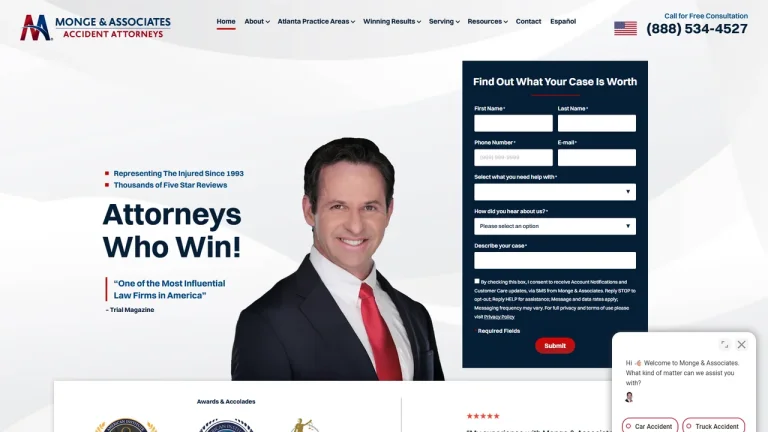
Monge & Associates - Little Rock, AR

Daspit Law Firm – Personal Injury and Accident Lawyers - Little Rock, AR

Law Office of Omar F. Greene - Little Rock, AR
Cortinez Law Firm - Little Rock, AR

Harrelson Law Firm - Little Rock, AR

Sexton and Sanders Law Firm - Fort Smith, AR
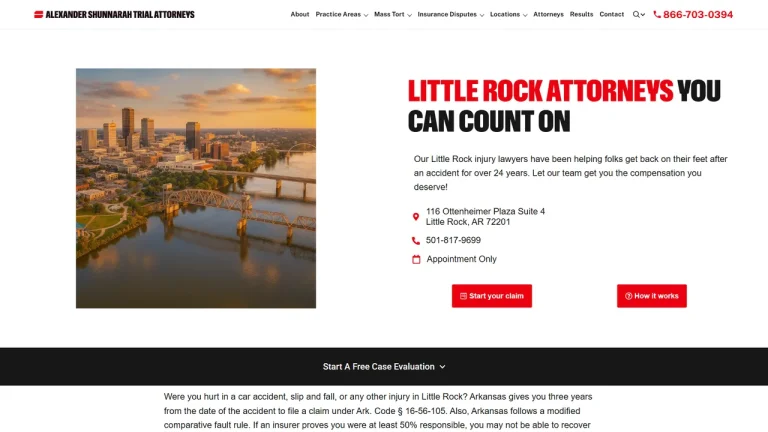
Alexander Shunnarah Trial Attorneys: Accident & Injury Lawyers - Little Rock, AR
Craig L. Cook Law - Fort Smith, AR
Milligan Law Offices - Fort Smith, AR

Matthew Scott Law Firm - Fort Smith, AR
Arkansas Car Accident Litigation & Circuit Court Jurisdictions
Pursuing compensation following a motor vehicle collision in Arkansas requires strict adherence to state tort statutes, insurance disclosure rules, and county court procedures. Personal injury lawsuits arising from traffic crashes are adjudicated within the Civil Division of the Circuit Court, which possesses general jurisdiction across seventy-five counties organized into twenty-eight judicial circuits. High-volume accident litigation is centered in key regional venues, including the Pulaski County Circuit Court in Little Rock, the Benton County Circuit Court in Bentonville, the Washington County Circuit Court in Fayetteville, and the Sebastian County Circuit Court in Fort Smith.
Attorneys representing injured motorists must maintain active licensing in good standing with the Supreme Court of Arkansas, subject to the ethical standards enforced by the Committee on Professional Conduct. Circuit Court dockets, mandatory disclosures, and case pleadings are managed electronically via CourtConnect and the Arkansas Judiciary eFlex filing system. Working with a car accident lawyer who routinely handles dockets in your local judicial circuit ensures familiarity with local standing orders, jury demographics, and pretrial settlement protocols.
Motor vehicle collisions frequently occur along Arkansas major transit arteries, including Interstate 40, Interstate 30, Interstate 49, and rural state highways. Dedicated legal counsel conducts thorough investigations, obtains crash records from the Arkansas State Police, reviews event data recorder information, and coordinates with treating healthcare providers to assemble comprehensive demand packages that resolve claims without prolonged court battles.
Typical Arkansas Car Accident Legal Fees & Cost Benchmarks
| Case Scenario | Fee Structure | Estimated Cost (USD) | Key Cost Determinants |
|---|---|---|---|
| Minor Injury / Soft Tissue Settlement (Pre-Suit) | Contingency Fee Basis | 33.3% of Settlement | Completeness of medical documentation, chiropractic treatment duration, and liability clarity |
| Moderate Fracture or Orthopedic Surgery (Filed Lawsuit) | Contingency Fee Basis | 33.3% - 40% of Recovery | Formal deposition count, defense medical examinations, and medical lien resolutions |
| Catastrophic Collision, TBI, or Wrongful Death | Contingency Fee (Trial / Verdict) | 40% of Total Award | Accident reconstructionists, life-care planners, vocational economic reports, and trial days |
| Uninsured / Underinsured Motorist (UM/UIM) Claim | Contingency Fee Basis | 33.3% - 40% of Settlement | First-party policy language, consent-to-settle compliance, and carrier bad faith posture |
Critical Legal Deadlines & Statutes in Arkansas
Arkansas imposes definitive statutory filing deadlines that extinguish causes of action if lawsuits are delayed. Under Ark. Code Ann. § 16-56-105, the statute of limitations for personal injury and property damage resulting from an automobile accident is three years from the date of the collision. Lawsuits asserting wrongful death must likewise be filed within three years of the date of death pursuant to Ark. Code Ann. § 16-62-102.
Arkansas operates under a modified comparative fault rule with a strict 49% bar codified at Ark. Code Ann. § 16-64-122. Under this statute, an injured plaintiff can recover financial damages only if their responsibility is less than the fault of the party against whom recovery is sought; if the plaintiff is determined to be 50% or more at fault, recovery is completely barred. First-party coverage is governed by Ark. Code Ann. § 23-89-202, which mandates that insurers provide medical and hospital benefits (PIP) unless rejected in writing under Ark. Code Ann. § 23-89-203. Distracted driving rules are reinforced by Ark. Code Ann. § 27-51-1504, prohibiting wireless communication device use while operating a motor vehicle. Claims against municipal vehicles must comply with statutory direct action rules under Ark. Code Ann. § 23-79-210 or state roadway notices via the Arkansas State Claims Commission under Ark. Code Ann. § 19-10-204.
Small Claims Limitations vs. Retaining Auto Accident Counsel
Under Ark. Code Ann. § 16-17-602, the Small Claims Division of the Arkansas District Court has jurisdiction over disputes where the amount claimed does not exceed $5,000, while State District Courts handle civil actions up to $25,000 under Ark. Code Ann. § 16-17-704. For minor property damage controversies, such as repairing a vehicle bumper or recovering an unpaid insurance deductible without bodily injury, pro se resolution in small claims provides a swift, cost-effective remedy.
When an accident causes physical injuries, disc herniations, fractures, or lost wages, damages routinely exceed district court limits, requiring litigation in Circuit Court. Attempting to manage a bodily injury claim without legal counsel creates substantial peril due to the state 49% comparative fault threshold; insurance adjusters routinely assign partial blame to unrepresented claimants to eliminate payouts entirely. Skilled legal counsel counters comparative fault defenses, conducts depositions, resolves hospital liens under the Arkansas Medical, Nursing, and Hospital Lien Act, and ensures that all available policy layers are tapped for full financial recovery.
Red Flags to Avoid When Selecting an Arkansas Car Accident Lawyer
- Unsolicited Direct In-Person Contact: Steer clear of any law firm or runner that contacts you directly at home or in the hospital following a crash, which violates ethical rules.
- Demanding Upfront Non-Refundable Retainers: Reputable Arkansas motor vehicle accident attorneys handle personal injury cases strictly on a contingency basis, advancing all case expenses.
- Guaranteed Recovery Amounts: Ethical lawyers licensed by the Supreme Court of Arkansas cannot guarantee specific financial settlements or jury awards.
- Unverified Licensing Standing: Always confirm that prospective legal counsel holds an active license in good standing with no public disciplinary records through the Arkansas Supreme Court registry.
Frequently Asked Questions
What is the statute of limitations for a car accident lawsuit in Arkansas?
Pursuant to Ark. Code Ann. § 16-56-105, an injured party has three years from the date of the collision to file a personal injury or property damage lawsuit in the appropriate Arkansas Circuit Court.
How does the Arkansas 49% comparative fault rule work?
Under Ark. Code Ann. § 16-64-122, you can recover damages only if your fault is less than the defendant fault (49% or less). If you are found to be 50% or more responsible, you are barred from receiving any compensation.
What is Personal Injury Protection (PIP) in Arkansas?
Under Ark. Code Ann. § 23-89-202, PIP provides minimum first-party coverage of $5,000 for medical bills, accidental death benefits, and lost wages, regardless of fault, unless expressly rejected in writing by the policyholder.
What happens if the at-fault driver has no insurance in Arkansas?
If the liable driver is uninsured or leaves the scene of a crash, you may file an uninsured motorist (UM) claim through your own automobile insurance policy pursuant to Ark. Code Ann. § 23-89-403.
How do medical liens affect an Arkansas personal injury settlement?
Under the Arkansas Medical, Nursing, and Hospital Lien Act, treating facilities can place a statutory lien on third-party settlements; experienced counsel negotiates reductions of these liens to maximize client net recovery.