
Debt Relief Lawyers in Arkansas
Consulting an Arkansas debt relief lawyer protects your financial security against aggressive collections, unlawful garnishments, and predatory creditor actions. Experienced debt defense counsel frequently negotiates substantial balance reductions and structured settlements without filing for bankruptcy. Explore our verified directory below to connect with skilled Arkansas debt relief attorneys.
Burns Bankruptcy Law - Fort Smith, AR

The Stanley Havner Law Firm - Little Rock, AR

Vanessa Cash Adams - Attorney - Little Rock, AR

Turner & Rasch, Attorneys at Law - Little Rock, AR
Neil Deininger & Company - Little Rock, AR

Daniel A. Webb, PA - Little Rock, AR
ALAW - Little Rock, AR

Bond Law Office - Fort Smith, AR
Lambert & Perry Law Firm - Little Rock, AR
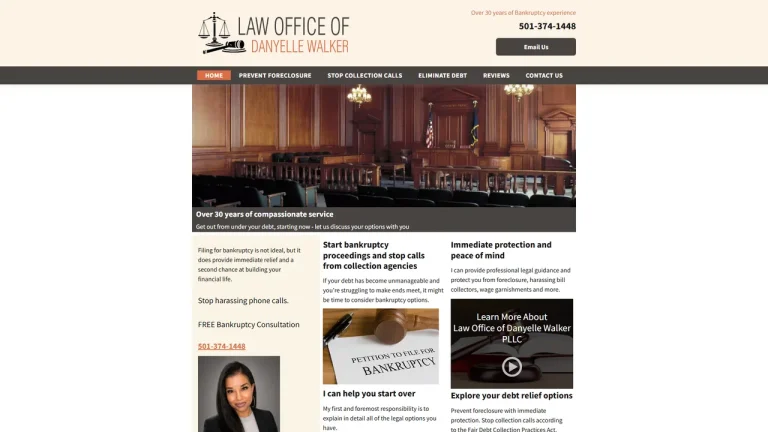
Law Office Of Danyelle Walker Pllc - Little Rock, AR
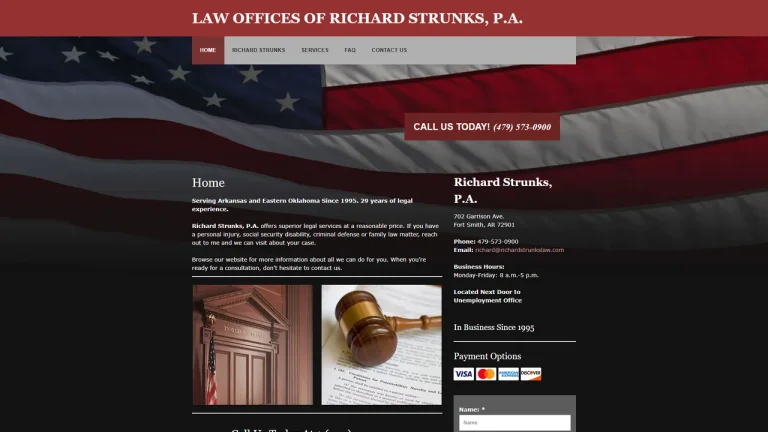
Bankruptcy Clinic - Fort Smith, AR

NIXON, LIGHT & BUZBEE - Little Rock, AR
Lambert & Perry Law Firm, PLLC - Little Rock, AR

Danecki Law Firm, P.L.C. - Little Rock, AR

The Roop Law Firm - Fort Smith, AR
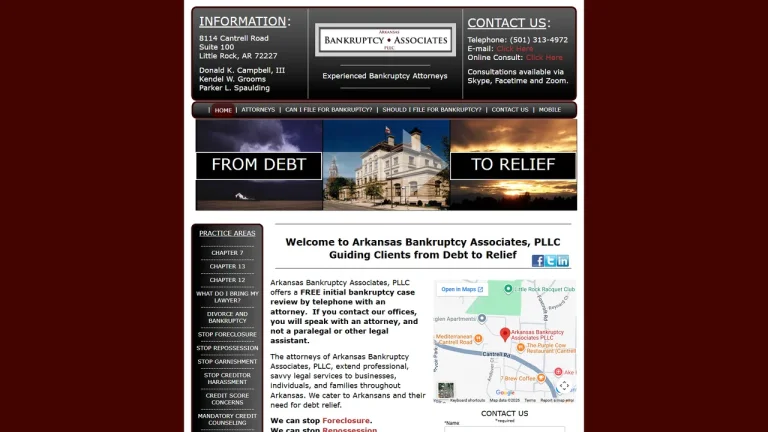
Arkansas Bankruptcy Associates PLLC - Little Rock, AR

Keech Law Firm PA - Little Rock, AR

Dilks Law Firm - Little Rock, AR

Watton Law Group - Little Rock, AR

Protecting Consumer Rights and Financial Solvency in Arkansas
Burdened by mounting credit card balances, medical debts, or commercial loan defaults, Arkansas consumers and business owners require aggressive advocacy against relentless debt buyers. Retaining a debt relief attorney enables individuals to counter unfair collection tactics, verify debt validity, and negotiate private settlements.
Debt collection lawsuits and judgment enforcement proceedings unfold in Arkansas District Courts for limited civil claims or Arkansas Circuit Courts across 28 judicial circuits for higher claims. Regulated under the supervisory authority of the Arkansas Supreme Court, licensed practitioners assert defenses rooted in state statutory consumer protections.
From major financial corridors in Little Rock and North Little Rock to rapidly expanding markets in Bentonville, Springdale, and Jonesboro, debt defense requires tailored strategies. Attorneys evaluate original creditor documentation, challenge predatory interest calculations under Arkansas usury laws, and insulate bank accounts from unlawful writ garnishments.
Legal Fee Benchmarks for Arkansas Debt Relief Services
| Case Scenario | Fee Structure | Estimated Cost (USD) | Key Cost Determinants |
|---|---|---|---|
| Lump-Sum Debt Settlement Negotiation | Percentage of Savings / Flat Fee | 15% - 25% of Enrolled Debt | Creditor identity, age of account, available settlement capital |
| Collection Lawsuit Defense (Circuit Court) | Flat Fee / Hourly | $1,500 - $4,500 | Chain of title documentation, motion to dismiss, formal discovery demands |
| FDCPA Enforcement & Harassment Defense | Contingency / Fee-Shifting | Statutory Recovery (No Upfront) | Severity of collection violations, documented call logs, third-party disclosure |
| Wage & Bank Garnishment Defense | Flat Fee | $750 - $2,000 | Claim of exemption preparation, head of household status, hearing scheduling |
Critical Legal Deadlines & Statutes in Arkansas
Debt collection actions in Arkansas are strictly governed by statutory limitations that bar untimely judicial claims. Under Ark. Code Ann. § 16-56-111, actions founded upon a written contract or promissory note must be commenced within five years, while open accounts including revolving credit card balances carry a three-year deadline under Ark. Code Ann. § 16-56-105.
If a creditor secures a judicial judgment, the judgment remains enforceable for ten years and can be revived prior to expiration pursuant to Ark. Code Ann. § 16-56-114. When a writ of garnishment is served against wages, debtors must timely assert statutory exemptions under Ark. Code Ann. § 16-66-208. Debt collectors violating communication restrictions face liability under the Fair Debt Collection Practices Act, 15 U.S.C. § 1692, which mandates filing a lawsuit within one year of the violation.
Small Claims Limits vs. Professional Representation in Arkansas
The Small Claims Division of the Arkansas District Court exercises jurisdiction over collection actions seeking $5,000 or less under Ark. Code Ann. § 16-17-602. Individuals can appear without an attorney to dispute erroneous billing entries or negotiate payment arrangements directly with an original local merchant.
However, when dealing with national debt collection conglomerates or actions filed in the regular civil division or Circuit Court, self-representation often results in default judgments. Debt buyers frequently lack valid assignments or admissible affidavits of debt. Licensed legal counsel can compel evidentiary production under the Arkansas Rules of Civil Procedure, frequently securing case dismissals with prejudice.
Red Flags When Hiring an Arkansas Debt Relief Lawyer
- Out-of-state debt settlement telemarketers who collect upfront fees before resolving accounts, in direct violation of federal trade regulations.
- Advising clients to ignore court summonses or skip court hearings in Arkansas District or Circuit Courts.
- Failure to examine whether the debt is already time-barred under Arkansas three-year or five-year statutes of limitations.
- Practitioners who do not advise consumers on the potential tax liability associated with forgiven debt cancellation notices.
Frequently Asked Questions
What is the statute of limitations on credit card debt in Arkansas?
Credit card accounts are generally classified as open accounts subject to a three-year statute of limitations from the date of the last payment or default.
Can debt collectors garnish my entire paycheck in Arkansas?
No, federal and Arkansas laws restrict wage garnishments to a maximum of 25 percent of disposable weekly earnings, and constitutional exemptions may further limit garnishments for resident heads of household.
What should I do if I am served with a collection lawsuit in Arkansas?
You must file a written answer within 30 days of service in Arkansas Circuit Court or District Court to avoid a default judgment, and you should consult an attorney to assert statutory defenses.
How does debt settlement differ from debt consolidation?
Debt settlement involves negotiating with creditors to accept a reduced lump-sum payment to satisfy the debt completely, whereas consolidation combines debts into a single loan with monthly interest payments.
Can an attorney stop abusive debt collector calls in Arkansas?
Yes, under federal law, once an attorney notifies a third-party debt collector of representation, the collector must immediately cease contacting you directly.