
Wrongful Termination Lawyers in Arkansas
Find top-rated Arkansas wrongful termination lawyers to fight unlawful discharges, challenge retaliation, and enforce employee rights across state courts. Experienced employment attorneys evaluate public policy violations and statutory whistleblower claims to negotiate fair severance and damages. Explore our verified statewide directory below to schedule a consultation with an Arkansas wrongful termination lawyer.
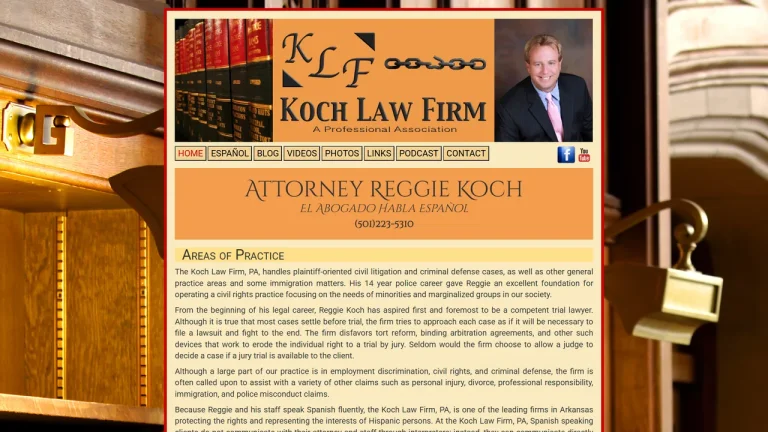
Koch Law Firm - Little Rock, AR

Lavey and Burnett - Little Rock, AR

Holleman and Associates, P.A. - Little Rock, AR

Muskheli Law Firm - Little Rock, AR

Navigating Wrongful Termination Law Across Arkansas
Wrongful termination litigation in Arkansas operates within the framework of the state employment-at-will doctrine, bounded by recognized common law and statutory exceptions. The Supreme Court of Arkansas in Little Rock establishes binding employment precedent, while attorney licensing and professional responsibility are overseen by the Arkansas Supreme Court Office of Professional Conduct.
Employment controversies arise across major economic regions of the state. These include the corporate retail and transportation sectors of Northwest Arkansas in Benton and Washington counties (including Bentonville, Rogers, and Fayetteville), the healthcare, manufacturing, and state government sectors in Little Rock and Pulaski County, the manufacturing facilities in Fort Smith within Sebastian County, and agricultural production centers in Craighead County. Circuit courts across Arkansas sixty-seven counties possess general jurisdiction over wrongful discharge actions.
While employers may generally terminate employment without cause, terminations that violate well-defined Arkansas public policy, breach express contractual provisions, or retaliate against protected worker activities are actionable. Because Arkansas courts interpret exceptions to the at-will rule strictly, retaining an attorney admitted to practice in Arkansas is crucial to substantiate employer liability and pursue recoverable damages.
Wrongful Termination Legal Fee Framework in Arkansas
| Case Scenario | Fee Structure | Estimated Cost (USD) | Key Cost Determinants |
|---|---|---|---|
| Severance Package Review & Separation Negotiations | Flat Fee or Hourly | $1,500 - $4,000 | Review of non-compete covenants, accrued leave calculations, and release of legal claim provisions. |
| Workers' Compensation Retaliation Claims | Contingency Fee (33.3% - 40%) | $25,000 - $120,000 Recovery | Establishing causal proximity between injury filing and discharge, lost wages, and supervisor testimony. |
| Public Policy & Whistleblower Retaliation Litigation | Contingency Fee (33.3% - 40%) | $50,000 - $250,000+ Recovery | Proving refusal to commit unlawful acts, internal reporting records, depositions, and trial length. |
| Breach of Written Employment Contract Litigation | Hourly with Advance Retainer | $300 - $550 / hr ($5,000 - $15,000 retainer) | For-cause termination definitions, executive incentive compensation disputes, and mitigation of damages. |
Critical Legal Deadlines & Statutes in Arkansas
Terminated workers in Arkansas face strict filing deadlines to preserve legal claims. Under the Arkansas Civil Rights Act (ACRA), Ark. Code Ann. § 16-123-107, civil actions alleging discriminatory discharge must be filed within one year of the date of termination pursuant to Ark. Code Ann. § 16-123-107(c)(3), or within ninety days of receiving an EEOC right-to-sue notice.
State law protects injured employees under Ark. Code Ann. § 11-9-107, which makes it unlawful for an employer to discharge or discriminate against a worker for filing a workers' compensation claim. For public employees, the Arkansas Whistleblower Act under Ark. Code Ann. § 21-1-604 requires an employee to file a civil action within 180 days of the retaliatory occurrence. Actions grounded on written employment contracts must be initiated within five years under Ark. Code Ann. § 16-56-111, while oral contracts carry a three-year limitation period under Ark. Code Ann. § 16-56-105. For federal retaliation claims under Title VII, charges must be submitted to the EEOC within 180 days under 42 U.S.C. § 2000e-5(e)(1) because Arkansas lacks a statewide 706 deferral agency.
Small Claims Limitations vs. Circuit Court Representation
The Small Claims Division of the Arkansas District Courts is limited to claims up to $5,000 under Ark. Code Ann. § 16-17-602. Under Ark. Code Ann. § 16-17-605, attorneys are prohibited from appearing in small claims court, making it an informal venue for recovering unpaid final wages or unreturned property.
Small claims courts lack jurisdiction to order reinstatement, award future lost earnings exceeding $5,000, or interpret state civil rights exceptions to the employment-at-will doctrine. Wrongful termination lawsuits require extensive discovery in Arkansas Circuit Courts or federal court, including requests for electronic communications and supervisor depositions. Retaining experienced legal counsel ensures workers overcome corporate pretext and access full compensatory remedies.
Red Flags & Vetting Standards for Arkansas Wrongful Termination Lawyers
- Guaranteeing success without evaluating whether the termination falls within an established exception to the Arkansas at-will doctrine.
- Failing to observe the strict 180-day deadline for public employees under the Arkansas Whistleblower Act or federal EEOC charges.
- Demanding substantial upfront legal retainers from terminated workers when cases can be reviewed on a contingency fee basis.
- Attorneys who lack trial experience before Arkansas Circuit Court judges or the U.S. District Court.
Frequently Asked Questions
What is the employment-at-will doctrine in Arkansas?
Under Arkansas law, employment is presumed at-will, meaning an employer may discharge an employee for any reason, provided it does not violate public policy, an express contract, or statutory law.
Can I sue if fired for filing a workers compensation claim in Arkansas?
Yes, under Ark. Code Ann. § 11-9-107, it is illegal for an employer to fire or discriminate against an employee for asserting their rights under the Arkansas Workers' Compensation Act.
What is the deadline to file a wrongful termination lawsuit in Arkansas?
Claims under the Arkansas Civil Rights Act must be filed within one year under Ark. Code Ann. § 16-123-107(c)(3), while public whistleblower suits must be brought within 180 days under Ark. Code Ann. § 21-1-604.
Can an employee handbook create an enforceable contract in Arkansas?
Yes, under Arkansas case law, if an employee handbook contains an explicit promise that termination will only be for cause, it can modify at-will status and form an enforceable contract.
How long do I have to file an EEOC charge in Arkansas?
Under 42 U.S.C. § 2000e-5(e)(1), employees in Arkansas have 180 days from the date of the unlawful discharge to file a charge of discrimination with the EEOC.