
Patent Attorneys in Walnut Creek
Retaining an experienced patent attorney in Walnut Creek ensures your proprietary inventions are thoroughly protected before the USPTO and under federal patent statutes. Qualified local patent counsel helps inventors navigate prior art searches, provisional filings, and structured licensing agreements to avoid costly infringement litigation. Browse our verified directory below to schedule a consultation with leading intellectual property practitioners in Contra Costa County.
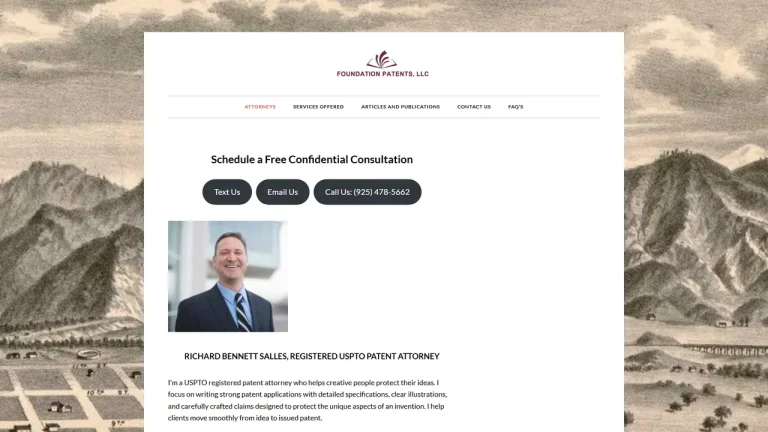
Foundation Patents, LLP - Walnut Creek, CA

Patent Law & IP Protection in Walnut Creek and the East Bay
Walnut Creek sits at the crossroads of Northern California commerce and technological development. From biotech and medical device ventures along North California Boulevard to software and clean-energy enterprises bordering Mount Diablo Boulevard and Shadelands Drive, local inventors require rigorous patent prosecution and enforcement. Inventors in Walnut Creek, Lafayette, Concord, and San Ramon must protect their patent portfolios before the United States Patent and Trademark Office (USPTO).
Because patent rights are purely creatures of federal law, contested patent disputes and infringement lawsuits originating in Contra Costa County fall under the exclusive jurisdiction of the U.S. District Court for the Northern District of California, typically heard in the Oakland or San Francisco federal courthouses. Having an attorney with deep familiarity with both USPTO administrative procedures and the Northern District of California Patent Local Rules is essential for safeguarding your commercial assets.
A qualified Walnut Creek patent attorney drafts robust utility and design claims, executes prior art landscape searches, and negotiates out-of-court patent licensing or coexistence agreements. Working with local legal counsel ensures your inventive disclosures remain legally compliant and shielded from costly public disclosure pitfalls.
Patent Legal Fees & Prosecution Cost Determinants
| Case Scenario | Fee Structure | Estimated Cost (USD) | Key Cost Determinants |
|---|---|---|---|
| Provisional Patent Application Filing | Flat Fee | $3,000 - $6,500 | Technical disclosure complexity, number of engineering schematics, formal claim scoping. |
| Non-Provisional Utility Patent (USPTO) | Flat Fee / Phased Billing | $8,500 - $16,000 | Prior art density, software algorithm architecture vs mechanical apparatus, USPTO examination track. |
| Freedom-to-Operate (FTO) & Patentability Search | Hourly / Fixed Retainer | $4,000 - $10,000 | Number of relevant active competitor patents, international patent database screening, formal opinion letters. |
| Patent Infringement Litigation (NDCA) | Hourly Retainer / Hybrid | $75,000 - $350,000+ | Markman claim construction hearings, technical expert witness retainers, preliminary injunction motions. |
Critical Legal Deadlines & Statutes in California
Patent rights are governed by rigid federal statutory timelines that admit no equitable exceptions. Under 35 U.S. Code § 102, the United States operates under a strict first-inventor-to-file framework. If an inventor publicly discloses, offers for sale, or commercializes an invention, a strict one-year grace period begins. Failure to file a patent application within this one-year window permanently forfeits all patent rights.
For inventors who file a provisional patent application to secure early priority, 35 U.S. Code § 119 establishes an immovable 12-month deadline to file the corresponding non-provisional application claiming priority. Missing this annual deadline results in the total abandonment of the provisional priority date.
In infringement situations, damages are constrained by 35 U.S. Code § 286, which limits recovery to infringements committed up to six years prior to filing the civil complaint. At the California state level, businesses protecting confidential proprietary data before patent filing must adhere to the California Uniform Trade Secrets Act under Cal. Civ. Code § 3426. Furthermore, under Cal. Bus. & Prof. Code § 16600, California strictly prohibits non-compete agreements, making clear patent assignment agreements and proprietary inventions documentation essential when hiring local engineers and developers.
Small Claims Ineligibility vs. Federal Patent Representation
California Small Claims Court operates under a monetary ceiling of $12,500 for natural persons pursuant to Cal. Civ. Proc. Code § 116.221, and attorneys are legally barred from appearing at small claims hearings under Cal. Civ. Proc. Code § 116.530.
However, state small claims courts hold zero jurisdiction over patent disputes. Under 28 U.S. Code § 1338, federal district courts have exclusive subject-matter jurisdiction over any civil action arising under the patent laws of the United States. A California state or small claims judge cannot evaluate patent infringement, determine patent validity, or issue injunctive orders against an infringing product. Inventive disputes must be filed in the U.S. District Court for the Northern District of California or challenged through administrative inter partes review before the Patent Trial and Appeal Board (PTAB), requiring admitted patent litigators.
Red Flags When Selecting a Walnut Creek Patent Attorney
- Invention promotion companies and non-attorney design mills that make guarantees of commercial market success rather than legal protection.
- Practitioners who are not registered to practice before the USPTO under 37 C.F.R. § 11.6 (always verify active USPTO Patent Bar registration).
- Firms advertising unrealistically cheap utility patent drafting, which often results in narrow, vulnerable claims easily bypassed by competitors.
- Lawyers failing to conduct comprehensive prior art searches before filing, risking swift Section 102 or Section 103 rejections by patent examiners.
Frequently Asked Questions
Must a patent lawyer be registered with the USPTO to file my application?
Yes. To prepare, file, and prosecute patent applications before the United States Patent and Trademark Office, an attorney must pass the USPTO Patent Bar and be recognized as a registered patent attorney or patent agent under federal regulations.
Can patent infringement cases be resolved in Contra Costa County Superior Court?
No. Under 28 U.S. Code § 1338, federal courts maintain exclusive jurisdiction over patent claims. Any patent infringement lawsuit originating in Walnut Creek must be filed in the U.S. District Court for the Northern District of California.
What is the difference between a provisional and non-provisional patent application?
A provisional application acts as an informal priority placeholder valid for 12 months under 35 U.S. Code § 119 and is never examined. A non-provisional application is the formal legal filing containing formal claims, abstract, and drawings reviewed by a USPTO examiner to issue an enforceable patent.
How does California law protect invention assignments given the ban on non-competes?
While Cal. Bus. & Prof. Code § 16600 voids non-compete agreements, companies protect inventions using compliant Proprietary Information and Inventions Agreements (PIIA) under Cal. Lab. Code § 2870, which legally assigns inventions developed on company time or resources to the employer.
What happens if an inventor discloses their invention publicly before filing?
Under 35 U.S. Code § 102, the United States provides a one-year grace period from the inventor's initial public disclosure to file a patent application. If this one-year period expires without filing, the technology enters the public domain and patent protection is permanently lost.