
Financial & IP Lawyers in Yorba Linda
Retaining an experienced Yorba Linda financial and IP lawyer protects your proprietary assets, commercial contracts, and capital investments under California statutory law. Strategic corporate litigators routinely resolve trade secret, licensing, and venture finance disputes through structured mediation, avoiding courtroom confrontation. Explore our verified directory below to schedule a confidential consultation with trusted Orange County legal counsel today.

Wilson Tax Law Group - Yorba Linda, CA
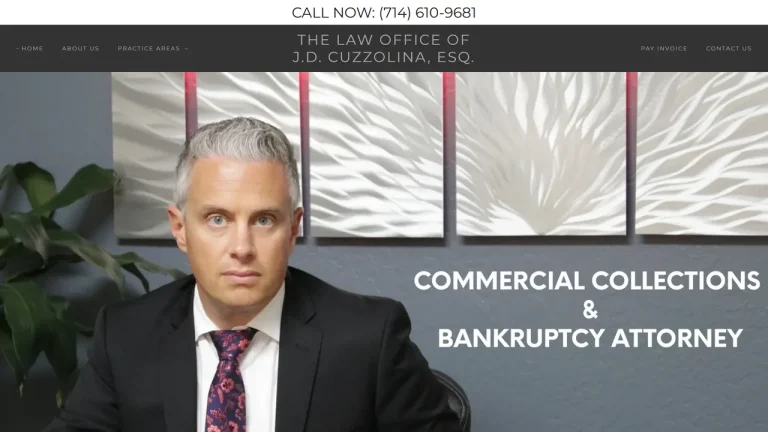
The Law Office of J.D. Cuzzolina Esq. - Yorba Linda, CA

Commercial Finance & Intellectual Property Law in Yorba Linda
Yorba Linda serves as an affluent center for commercial enterprise, corporate executives, and emerging technology ventures in northeast Orange County. From corporate campuses and medical technology innovators operating in the Savi Ranch commercial corridor along the Riverside Freeway to high-growth enterprises bordering Yorba Linda Boulevard and Imperial Highway, businesses require sophisticated legal counsel to protect intangible assets and execute complex financial transactions.
Protecting commercial capital and proprietary technology demands mastery of intersecting federal and state jurisdictions. Federal intellectual property litigation-encompassing utility patents, federal Lanham Act trademarks, and copyright claims-falls under the exclusive jurisdiction of the U.S. District Court for the Central District of California, Southern Division, situated at the Ronald Reagan Federal Building and U.S. Courthouse in nearby Santa Ana. State-level commercial matters, including commercial loan enforcement, trade secret litigation, partnership disputes, and breach of contract actions, are adjudicated in the Orange County Superior Court, primarily through the Central Justice Center or the Complex Civil Litigation Division in Santa Ana.
A qualified Yorba Linda financial and IP attorney helps businesses draft comprehensive technology licensing agreements, protect proprietary data under California statutory rules, maintain compliance with state financial regulations, and defend against predatory infringement lawsuits.
Commercial IP & Financial Legal Fee Matrix
| Case Scenario | Fee Structure | Estimated Cost (USD) | Key Cost Determinants |
|---|---|---|---|
| Proprietary IP Licensing & Commercialization | Flat Fee / Hourly ($400 - $700/hr) | $2,500 - $6,500 | Cross-licensing terms, international distribution rights, royalty audit clauses, indemnification caps. |
| Trade Secret Protection & Non-Disclosure (CUTSA) | Flat Fee / Retainer | $3,500 - $8,000 | Internal audit scope, proprietary information and inventions agreements (PIIA), injunction drafting. |
| Fintech & Commercial Lending Regulatory Compliance | Hourly Retainer | $5,000 - $15,000 | California DFPI licensing requirements, commercial lending documentation, capital disclosure rules. |
| Federal IP & Commercial Fraud Trial (CDCA Santa Ana) | Milestone Retainer | $50,000 - $250,000+ | Markman claim construction hearings, technical expert witness retainers, forensic accounting models. |
Critical Legal Deadlines & Statutes in California
Preserving intellectual property rights and commercial claims requires strict adherence to statutory deadlines. For trade secret misappropriation claims, Cal. Civ. Code § 3426 (the California Uniform Trade Secrets Act) establishes a strict three-year statute of limitations under Section 3426.6, running from the date the misappropriation was discovered or reasonably should have been discovered.
Commercial contract disputes are governed by rigid state timeframes. Under Cal. Civ. Proc. Code § 337, actions for breach of a written commercial agreement or financial promissory note must be commenced within four years. In contrast, oral agreements carry a two-year statutory limitation under Cal. Civ. Proc. Code § 339.
In California employment and IP strategy, businesses must comply with Cal. Bus. & Prof. Code § 16600, which strictly voids non-compete agreements, making clear intellectual property assignment agreements and non-disclosure covenants essential when hiring executives or technical personnel. Furthermore, commercial lending operations and financial platforms must maintain compliance under the California Financing Law codified in Cal. Fin. Code § 22000, which enforces state licensing and disclosure requirements overseen by the California Department of Financial Protection and Innovation (DFPI).
Small Claims Limitations vs. Federal & Superior Court Action
The California Small Claims division operates with a jurisdictional cap of $12,500 for individual claimants and $6,250 for corporate entities under Cal. Civ. Proc. Code § 116.221. Legal representation by attorneys during small claims hearings is expressly prohibited pursuant to Cal. Civ. Proc. Code § 116.530.
Small claims courts possess zero jurisdiction over federal intellectual property matters. Under 28 U.S. Code § 1338, federal district courts hold exclusive subject-matter jurisdiction over patent and copyright disputes. Furthermore, small claims judges lack the authority to issue preliminary injunctions, order the impoundment of counterfeit assets, or enforce trade secret protections. Complex venture capital disputes, technology licensing disputes, and commercial fraud claims involve assets that far surpass small claims limits, necessitating seasoned counsel in the U.S. District Court in Santa Ana or the Orange County Superior Court.
Red Flags When Selecting Financial & IP Counsel
- Attorneys attempting to draft restrictive non-compete covenants that directly violate California public policy under Cal. Bus. & Prof. Code § 16600.
- Lawyers who lack admission or substantial litigation experience in the U.S. District Court for the Central District of California.
- Firms advertising combined financial and IP services without demonstrated expertise in California Department of Financial Protection and Innovation (DFPI) regulatory compliance.
- Fee structures that fail to clearly outline costs associated with e-discovery, forensic accounting, and independent technical expert witness retainers.
Frequently Asked Questions
Why are non-compete clauses void in California employment contracts?
Under Cal. Bus. & Prof. Code § 16600, California strictly prohibits non-compete agreements to promote economic mobility. Employers must protect proprietary technology through compliant confidentiality agreements and trade secret protections rather than non-competes.
Where are federal intellectual property lawsuits heard for Yorba Linda businesses?
Federal patent, trademark, and copyright litigation originating in Yorba Linda is heard in the U.S. District Court for the Central District of California, Southern Division, located at the Ronald Reagan Federal Courthouse in Santa Ana.
What is the statute of limitations for trade secret misappropriation in California?
Under Cal. Civ. Code § 3426, a lawsuit for trade secret misappropriation must be brought within three years after the misappropriation is discovered or should have been discovered through reasonable diligence.
Can a patent infringement dispute be filed in California Small Claims Court?
No. Under 28 U.S. Code § 1338, federal district courts hold exclusive jurisdiction over patent and copyright disputes. State small claims courts have no authority to resolve patent or copyright infringement actions.
What California agency regulates commercial lending and financial technology?
Commercial lending, alternative finance platforms, and fintech ventures are regulated under the California Financing Law in Cal. Fin. Code § 22000, overseen by the California Department of Financial Protection and Innovation (DFPI).