
Workers' Compensation Lawyers in Colorado Springs
Retaining an experienced Colorado Springs workers' compensation attorney protects your medical treatment and wage replacement benefits under state labor laws. Dedicated legal counsel manages insurance denials, challenges low impairment ratings, and resolves contested claims without unnecessary stress. Explore our verified directory below to schedule an initial consultation with local advocates.
Diane K. Bross, PC - Colorado Springs, CO
Clawson & Clawson, LLP - Colorado Springs, CO

Gaddis, Herd, Craw & Adams, P.C. - Colorado Springs, CO
Frederick W Newall Law Office - Colorado Springs, CO

Brylak Law - Colorado Springs, CO
Bachus & Schanker - Colorado Springs, CO
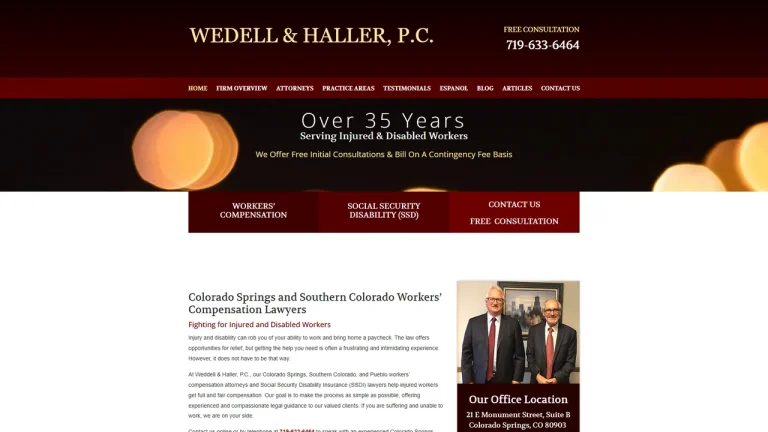
Weddell & Haller, P.C. - Colorado Springs, CO
The Wilhite Law Firm - Colorado Springs, CO

Bradford Pelton, P.C. - Colorado Springs, CO
Allison Tyler Law - Colorado Springs, CO
Wm. Andrew Wills II, P.C. - Colorado Springs, CO
Shakeshaft Law Firm - Colorado Springs, CO
Levine Law LLC - Colorado Springs, CO
McDivitt Law Firm - Colorado Springs, CO
Amy G Injury Firm - Colorado Springs, CO
Ramos Law Personal Injury & Accident Lawyers - Colorado Springs, CO
Protecting Injured Workers' Rights in Colorado Springs
Colorado Springs supports an expansive workforce spanning defense manufacturing, aerospace technology near Peterson Space Force Base, healthcare systems like UCHealth Memorial and Penrose Hospital, commercial construction along the I-25 corridor, and hospitality. When on-the-job injuries occur, injured employees must navigate administrative systems to secure wage loss benefits and specialized medical treatment.
Workplace injury claims are regulated by the Workers' Compensation Act of Colorado under Colo. Rev. Stat. § 8-40-101. Colorado operates a no-fault insurance system where employees receive statutory benefits without having to prove employer fault. However, the exclusive remedy rule under Colo. Rev. Stat. § 8-41-102 prohibits injured workers from filing traditional civil lawsuits against their employers. Contested hearings are administered through the Colorado Division of Workers' Compensation (DOWC) and decided by Administrative Law Judges at the Colorado Office of Administrative Courts (OAC).
Insurance carriers frequently dispute medical procedures, terminate temporary disability pay prematurely, or issue low impairment ratings. A dedicated Colorado Springs workers' compensation lawyer ensures compliance with mandatory filing deadlines, challenges insurer-selected doctors, and advocates for full financial restitution.
Workers' Compensation Benefits & Representation Economics
| Case Scenario | Fee Structure | Estimated Cost (USD) | Key Cost Determinants |
|---|---|---|---|
| Temporary Total Disability (TTD) Wage Calculation | Contingency (Statutory 20% Cap) | $0 Out-of-Pocket (20% of disputed back pay) | Average weekly wage recalculation, inclusion of overtime, and authorized off-work certifications. |
| Permanent Partial Disability (PPD) Rating Dispute | Contingency (Statutory 20% Cap) | $0 Out-of-Pocket (20% of rating increase) | Division Independent Medical Examination (DIME) challenge and AMA Guides impairment ratings. |
| Denied Medical Care / Surgical Authorization | Contingency / Statutory Fees | $0 Out-of-Pocket (Fees contingent on recovery) | Colorado Medical Treatment Guidelines compliance and Rule 16 utilization review appeals. |
| Full & Final Lump-Sum Settlement Agreement | Contingency (Statutory 20% Cap) | $0 Out-of-Pocket (20% of total settlement sum) | Future medical buyouts, permanent total disability exposure, and Medicare Set-Aside requirements. |
Critical Legal Deadlines & Statutes in Colorado
Statutory deadlines dictate whether an injured employee retains the right to benefits under Colorado law. Under Colo. Rev. Stat. § 8-43-102, an injured worker must give written notice of the accident to their employer within 10 days of the incident. Failing to provide written notice within this period may result in statutory penalties, including the forfeiture of one day of compensation for each day of delay.
To formally protect the claim, a Claim for Compensation must be filed with the Colorado Division of Workers' Compensation within two years from the injury date pursuant to Colo. Rev. Stat. § 8-43-103(2). Although this deadline may be extended to three years upon showing reasonable excuse, missing this window extinguishes all statutory rights.
Under Colo. Rev. Stat. § 8-43-404, an employee must select their primary treating physician from the employer's Designated Medical Provider (DMP) list. Once the authorized doctor places the worker at Maximum Medical Improvement (MMI) and the insurer issues a Final Admission of Liability (FAL) under Colo. Rev. Stat. § 8-43-203, the worker has exactly 30 days to file a formal written objection and request a Division Independent Medical Examination (DIME). If no objection is filed within 30 days, the case automatically closes.
Administrative Hearings vs. Small Claims Disqualification
Workers' compensation disputes in Colorado are excluded entirely from the Small Claims Division of the El Paso County Combined Courts, which handles claims up to $7,500 under Colo. Rev. Stat. § 13-6-403. Under Colo. Rev. Stat. § 8-41-102, county and district courts lack subject-matter jurisdiction over workplace injury disputes.
Navigating the administrative DIME process and OAC hearings without counsel places injured workers at a substantial disadvantage against experienced insurance adjusters and defense counsel. A qualified Colorado Springs workers' compensation attorney ensures medical evidence conforms to the Colorado Medical Treatment Guidelines, cross-examines medical evaluators, and negotiates lump-sum settlements that protect future financial stability.
Red Flags When Hiring a Workers' Comp Attorney
- Charging legal fees exceeding the 20 percent statutory contingency cap established by Colo. Rev. Stat. § 8-43-403.
- Failing to advise clients regarding the strict 30-day deadline to challenge a Final Admission of Liability under Colo. Rev. Stat. § 8-43-203.
- Pressuring an injured worker into premature settlement before reaching Maximum Medical Improvement (MMI).
- Law firms lacking regular hearing experience before Administrative Law Judges at the Colorado Office of Administrative Courts.
Frequently Asked Questions
How long do I have to report an on-the-job injury in Colorado?
Under Colo. Rev. Stat. § 8-43-102, you must report your workplace injury to your employer in writing within 10 days of the accident to protect your statutory benefits.
Can I see my own personal doctor for a work injury in Colorado Springs?
Under Colo. Rev. Stat. § 8-43-404, you must select your authorized treating physician from the Designated Medical Provider list provided by your employer, or the medical expenses may not be covered.
What is a Division Independent Medical Examination (DIME)?
A DIME is an evaluation performed by an independent physician selected through the state registry under Colo. Rev. Stat. § 8-43-203 to resolve disputes regarding impairment ratings or Maximum Medical Improvement.
How much can a workers' compensation attorney charge in Colorado?
Attorney fees are strictly limited under Colo. Rev. Stat. § 8-43-403 to a maximum of 20 percent of the contested benefits or settlement recovered for the injured worker.
Can an employer fire me for filing a workers' compensation claim?
No. Colorado law prohibits employers from retaliating against or terminating an employee solely for exercising their lawful right to file a workers' compensation claim.