
Residential Real Estate Lawyers in Colorado
Retaining a knowledgeable Colorado residential real estate lawyer protects your property investments, title rights, and contractual interests during home transactions and neighbor disputes. Dedicated counsel can review complex purchase agreements, resolve title defects before closing, and mediate property boundaries. Explore our directory below to connect with verified Colorado real estate attorneys for experienced legal guidance.

Geraghty Law Office - Denver, CO

Kettelkamp, Young & Kettelkamp, P.C. - Pueblo, CO
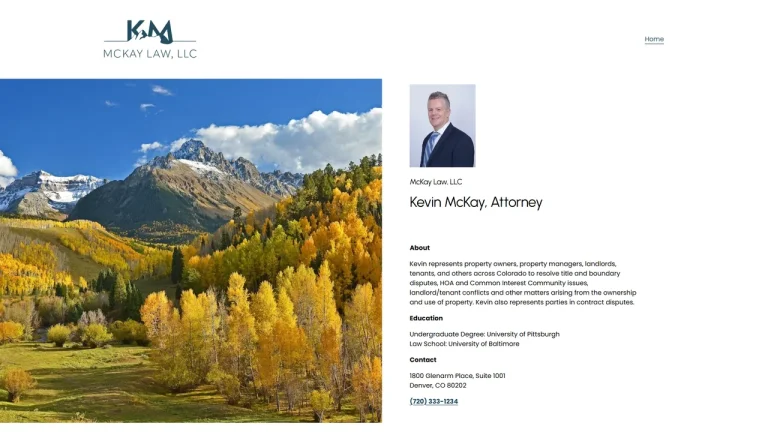
McKay Law, LLC - Denver, CO

Sutherland & Connor LLC - Fort Collins, CO
Frederick W Newall Law Office - Colorado Springs, CO

Gerdes and Roberts Law Firm - Fort Collins, CO

Skulborstad Legal Group - Colorado Springs, CO
Houtchens Law Firm - Greeley, CO
Johnson Law - The Law Firm of Chad W. Johnson, LLC - Denver, CO

William Hughes Attorney at Law - Greeley, CO
Charles E. Longtine P.C. - Westminster, CO

Law Office Of Douglas J Haynes - Pueblo, CO

John Finger, LLC - Pueblo, CO
The Sarbaugh Law Firm - Boulder, CO
Grant & Associates Law Firm, P.C. - Greeley, CO

Flatiron Legal Advisors, LLC - Denver, CO
Packard and Dierking - Boulder, CO
Mullans Piersel & Reed PC - Pueblo, CO

Perko Law - Pueblo, CO
Stephen Carbonneau - Lakewood, CO
Robinson & Henry, P.C. - Denver, CO

Tschetter Sulzer Muccio, P.C. - Denver, CO

Newmoon Law, PC - Pueblo, CO
Property Rights & Real Estate Legal Frameworks in Colorado
Residential real estate across Colorado involves diverse legal dynamics, from urban residential sales across Denver and Colorado Springs to deed restrictions in historic mountain towns like Aspen, Vail, and Breckenridge. The purchase, transfer, and financing of residential real property are governed by state statutes and regulatory guidelines administered by the Colorado Division of Real Estate, a division of the Department of Regulatory Agencies (DORA).
Property disputes, title challenges, and easement conflicts fall under the jurisdiction of Colorado District Courts within the judicial district where the real estate is situated. Any appellate proceedings are directed to the Colorado Court of Appeals and the Colorado Supreme Court, seated at the Ralph L. Carr Colorado Judicial Center in Denver. Colorado real estate lawyers licensed by the Colorado Supreme Court Office of Attorney Regulation Counsel bring vital familiarity with regional zoning, land use codes, and water rights.
While standard transactions frequently involve licensed brokers using Colorado Real Estate Commission (CREC) standard forms, brokers are legally prohibited from providing legal advice or drafting non-standard addenda. Retaining a dedicated residential real estate attorney provides essential representation for custom contracts, title defect curing, boundary disputes, and home defect disclosures, ensuring client assets remain thoroughly protected.
Colorado Residential Real Estate Legal Fees & Service Costs
| Case Scenario | Fee Structure | Estimated Cost (USD) | Key Cost Determinants |
|---|---|---|---|
| Purchase Contract Review & Title Examination | Flat Fee or Hourly | $800 - $2,500 | Title commitment exceptions, unrecorded encumbrances, financing contingencies, and custom contract addenda. |
| Boundary Line, Easement & Fence Disputes | Hourly with Retainer | $3,500 - $12,000 | Land survey analysis, historical adverse possession evidence, and pre-litigation neighbor negotiation. |
| Seller Failure-to-Disclose & Defect Claims | Hourly or Hybrid Retainer | $5,000 - $25,000+ | Structural engineering reports, repair cost documentation, formal mediation, and district court litigation. |
| Quiet Title & Defective Deed Action | Staged Retainer | $4,500 - $15,000 | Chain-of-title gaps, identifying unknown heirs, publication notice procedures, and court hearing frequency. |
Critical Legal Deadlines & Statutes in Colorado
Real estate matters in Colorado are subject to statutory requirements and filing deadlines set forth in the Colorado Revised Statutes. The Colorado Statute of Frauds, codified at Colo. Rev. Stat. § 38-10-108, mandates that all contracts for the leasing for a longer period than one year or for the sale of any lands or interest in lands must be in writing and signed by the party granting or creating the interest.
Claims involving intentional seller misrepresentation or fraudulent concealment on mandatory property disclosure forms must be brought within three years pursuant to Colo. Rev. Stat. § 13-80-101(1)(c). For construction defects in residential dwellings, the Construction Defect Action Reform Act (CDARA) under Colo. Rev. Stat. § 13-80-104 establishes a strict two-year statute of limitations from the date the defect is discovered, bounded by a six-year statute of repose (which may extend to eight years under specific circumstances). Adverse possession claims require proof of continuous, open, adverse, and exclusive possession for eighteen continuous years under Colo. Rev. Stat. § 38-41-101, alongside a good faith belief of ownership.
Small Claims Court vs. Retaining Real Estate Counsel
Under Colo. Rev. Stat. § 13-6-403, the Colorado County Court Small Claims Division resolves disputes seeking monetary relief up to $7,500. This forum is suited for self-represented residential disputes such as landlord security deposit withholding under Colo. Rev. Stat. § 38-12-103, minor escrow deposit disagreements under $7,500, or small property damage claims involving home repairs.
However, small claims courts are strictly barred from resolving real property title actions, boundary modifications, quiet title suits, or granting equitable relief like specific performance to compel a home conveyance. When disputes involve structural home defects exceeding $7,500, complex HOA covenant enforcement under the Colorado Common Interest Ownership Act, or boundary encroachments, filing in Colorado District Court with a qualified residential real estate lawyer is necessary to protect property rights.
Red Flags to Watch for When Hiring a Colorado Real Estate Lawyer
- Reliance on Broker Opinions for Legal Defects: Be cautious if an attorney relies solely on real estate broker forms or title company underwriting without independently reviewing recorded easements, covenants, and deed language.
- Ignoring Colorado Adverse Possession Burdens: Ensure your legal representative is familiar with Colo. Rev. Stat. § 38-41-101, which mandates a clear and convincing evidence standard and good faith belief for adverse possession claims.
- Vague Retainer and Closing Scope: Demand an explicit written engagement agreement stating whether the fee covers only pre-closing contract review or extends to curative title work, post-closing escrow disputes, and HOA covenant negotiations.
- Lack of HOA Law Expertise: In a state where many residential communities are governed by common interest communities, ensure your attorney understands the Colorado Common Interest Ownership Act (Colo. Rev. Stat. § 38-33.3-101).
Frequently Asked Questions
Is a real estate attorney required to close a home sale in Colorado?
Colorado law does not mandate an attorney for closing a residential real estate transaction, and many buyers and sellers use title insurance companies and licensed real estate brokers. However, title agents cannot provide legal counsel, resolve title exceptions, or draft custom legal contingencies. Retaining an attorney ensures that contracts and title commitments are thoroughly reviewed to protect your legal and financial interests.
What are the statutory requirements for adverse possession in Colorado?
Under Colo. Rev. Stat. § 38-41-101, a claimant must demonstrate actual, adverse, hostile, exclusive, and uninterrupted possession of the property for at least eighteen continuous years. Additionally, the claimant must prove by clear and convincing evidence that they held a good faith, reasonable belief that the property was actually theirs.
What disclosures are residential home sellers required to make in Colorado?
Colorado home sellers are legally required to disclose known latent material defects that adversely affect property value or occupant safety. Common disclosures include structural flaws, roof damage, boundary disputes, environmental hazards, and the property water and sewage source. Knowingly concealing material defects can lead to fraud claims under Colo. Rev. Stat. § 13-80-101(1)(c).
How does the Colorado Common Interest Ownership Act protect homeowners?
The Colorado Common Interest Ownership Act (CCIOA), codified at Colo. Rev. Stat. § 38-33.3-101, establishes comprehensive rules governing residential homeowner associations (HOAs). CCIOA regulates HOA lien priority, board governance, transparent financial record disclosures, collection procedures, and limits unreasonable covenant enforcement actions against homeowners.
What is the statutory deadline for landlord security deposit returns in Colorado?
Pursuant to Colo. Rev. Stat. § 38-12-103, a residential landlord must return a tenant security deposit with an itemized statement of deductions within one month after lease termination, unless the lease agreement specifies a longer timeframe not to exceed sixty days. Willful failure to return the deposit may entitle the tenant to treble damages and reasonable attorney fees.