
Employment & Labor Lawyers in Hartford
Retaining experienced Hartford employment and labor lawyers safeguards your career and workplace rights against unlawful discrimination, retaliation, and wage theft. Dedicated advocates guide workers through pre-complaint negotiations, CHRO administrative conferences, and state or federal litigation to resolve disputes effectively. Browse our directory below to connect with proven Hartford County employment attorneys.

The Law Office of Barbara J. Collins - Hartford, CT
Rogin Nassau LLC - Hartford, CT

Harris Beach Murtha - Hartford, CT

Law Offices of Arnaldo J. Sierra - Hartford, CT
Klingman Law, LLC - Hartford, CT

Wiggin and Dana LLP - Hartford, CT

Morrison Mahoney LLP - Hartford, CT

Troutman Pepper Locke - Hartford, CT
The Law Office of Richard P. Lawlor - Hartford, CT
Brown Paindiris & Scott, LLP - Hartford, CT
Brown Rudnick LLP - Hartford, CT
Morgan Lewis & Bockius LLP - Hartford, CT
Neubert, Pepe & Monteith, P.C. - Hartford, CT
Cooney Scully & Dowling - Hartford, CT
Tarabishy Law Firm, LLC - Hartford, CT
Ment Law Group - Hartford, CT

Boyle | Shaughnessy Law - Hartford, CT

Killian & Donohue LLC - Hartford, CT
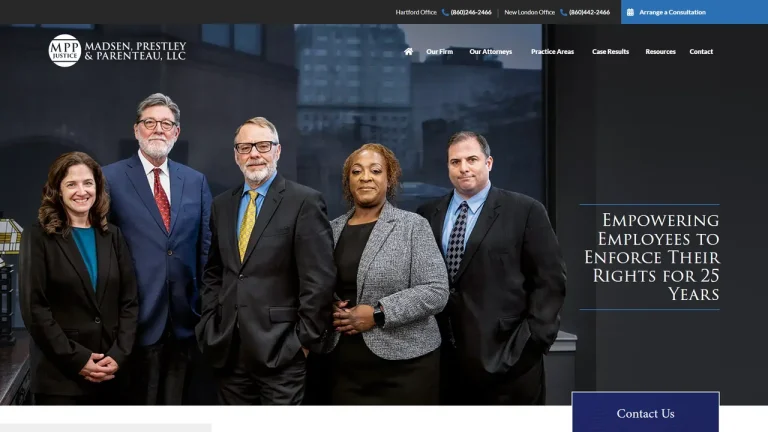
Madsen Prestley & Parenteau, LLC - Hartford, CT

Siegel O'Connor O'Donnell Beck P.C. - Hartford, CT

Ford & Paulekas, LLP - Hartford, CT

O'Connell, Attmore & Morris, LLC - Hartford, CT
Sabatini & Associates - Hartford, CT
Navigating Workplace Law in Hartford and Greater Hartford County
Hartford serves as the economic and administrative center of Connecticut, housing prominent insurance carriers, major healthcare networks, state government headquarters, and regional commercial enterprises. Whether you are an executive negotiating a complex severance package or an employee confronting workplace discrimination, having seasoned legal counsel in Hartford ensures that your career interests and statutory rights receive aggressive protection.
Employment disputes in Connecticut often require navigating both state and federal administrative bodies prior to formal court intervention. Work-related claims routinely commence before the Connecticut Commission on Human Rights and Opportunities (CHRO), headquartered along Columbus Boulevard in Hartford, or the Equal Employment Opportunity Commission (EEOC). If administrative mediation fails, cases proceed to the Hartford Judicial District Courthouse at 95 Washington Street or the U.S. District Court for the District of Connecticut at 450 Main Street.
Local employment lawyers understand the judicial preferences and procedural expectations of Hartford judges and agency investigators. Serving clients across Hartford, West Hartford, East Hartford, Manchester, and Wethersfield, local attorneys work to secure favorable pre-litigation settlements, negotiate restrictive covenants, and vindicate employee rights through decisive courtroom advocacy.
Typical Fee Structures for Hartford Employment Law Matters
| Case Scenario | Fee Structure | Estimated Cost (USD) | Key Cost Determinants |
|---|---|---|---|
| Workplace Discrimination & Retaliation Suit | Contingency Fee | 33.33% - 40% of recovery | Strength of direct documentary evidence, employer insurance coverage, CHRO conciliation success, and depth of trial preparation. |
| Executive Severance & Separation Review | Hourly Rate / Flat Fee | $350 - $650 per hour | Complexity of executive compensation, stock options, equity acceleration clauses, and non-disclosure or non-compete covenants. |
| Unpaid Wages, Commissions & Overtime | Contingency / Statutory Fees | Contingency or court-ordered fees | Completeness of timesheets, number of impacted employees, and eligibility for statutory double damages and attorney fee shifting. |
| Non-Compete Agreement Defense | Hourly Retainer | $2,500 - $7,500 initial retainer | Geographic reach, temporal restrictions, threat of temporary restraining orders, and risk of preliminary injunction hearings. |
Critical Deadlines & Employment Statutes in Connecticut
Strict administrative and statutory deadlines govern employment disputes across Connecticut. Under the Connecticut Fair Employment Practices Act, codified at Conn. Gen. Stat. § 46a-60, employees are protected against unlawful discrimination based on race, sex, age, disability, and gender identity. However, under Conn. Gen. Stat. § 46a-82, an aggrieved worker must formally file a complaint with the CHRO within 300 days of the discriminatory act. Missing this filing window will permanently bar your legal claim.
Once the CHRO issues a formal Release of Jurisdiction, claimants face an immediate statutory timeline under Conn. Gen. Stat. § 46a-101, requiring civil court complaints to be initiated within 90 days of receipt of the release. For wage and hour disputes, actions to collect unpaid minimum wages, overtime, or accrued benefits under Conn. Gen. Stat. § 31-72 must generally be commenced within two years, providing potential recovery of twice the full amount of unpaid wages plus reasonable attorney fees.
Employees experiencing adverse employment actions after reporting statutory violations to public bodies receive robust whistleblower protections under Conn. Gen. Stat. § 31-51m. Such claims must be filed in Superior Court within 90 days of the retaliatory action or within 90 days of exhausting internal employer grievance procedures.
Small Claims Court Limits vs. Hiring a Hartford Employment Attorney
Pursuant to Conn. Gen. Stat. § 51-15, the monetary jurisdiction of the Connecticut Small Claims Court is capped at $5,000. While this forum handles simple contract debts or minor security deposit disagreements, small claims court is fundamentally unsuitable for employment law disputes. Small claims dockets lack equitable jurisdiction to grant injunctions, cannot enforce reinstatement, and cannot adequately address the substantial financial losses associated with career disruption.
Workplace terminations and civil rights claims routinely involve tens or hundreds of thousands of dollars in front pay, back pay, compensatory damages, and emotional distress. Moreover, workplace discrimination requires exhausting mandatory administrative procedures through the CHRO prior to court filings. Hiring a qualified Hartford employment attorney ensures that statutory remedies are fully leveraged in the regular Civil Division of the Superior Court or in federal court, holding corporate employers accountable.
Red Flags When Hiring a Hartford Employment Lawyer
- Guarantees of Immediate Cash Payouts: Ethical employment attorneys will never guarantee specific monetary recoveries or settlement outcomes before reviewing detailed employer records and personnel files.
- Ignorance of CHRO Administrative Deadlines: Avoid legal counsel who fails to explain the mandatory 300-day CHRO exhaustion process or advises filing directly in court before obtaining a release of jurisdiction.
- Demanding Uncapped Upfront Retainers for Wage Claims: For straightforward wage-and-hour violations, attorneys frequently utilize statutory fee-shifting provisions rather than imposing heavy out-of-pocket retainer fees.
- Lack of Federal Court Experience: Many major employment actions in Hartford are removed to the federal courthouse on Main Street; your lawyer must possess an active federal docket history in the District of Connecticut.
Frequently Asked Questions
What is the deadline to report workplace discrimination in Hartford?
Under Conn. Gen. Stat. § 46a-82, you must file a formal complaint with the Connecticut Commission on Human Rights and Opportunities (CHRO) within 300 days of the date the discriminatory conduct or termination occurred.
Can an employer retaliate against me for reporting harassment in Connecticut?
No. Under Conn. Gen. Stat. § 46a-60, employers are strictly prohibited from discharging, demoting, or retaliating against any employee who opposes discriminatory practices or participates in a CHRO proceeding.
Can I recover double damages for unpaid wages in Hartford?
Yes. Under Conn. Gen. Stat. § 31-72, employees who prevail in an action to recover unpaid compensation or overtime may be awarded up to twice the amount of wages owed, alongside court costs and reasonable legal fees.
Must I complete the CHRO process before suing in court?
Yes. Connecticut law mandates exhaustion of administrative remedies through the CHRO. You may only initiate a lawsuit in Superior Court or federal court after the CHRO issues an official Release of Jurisdiction.
Are non-compete agreements enforceable in Connecticut?
Connecticut courts enforce non-competes only if they protect legitimate business interests and remain reasonable in geographic scope, duration, and restriction of employment opportunities without harming the public interest.