
Workplace Discrimination Lawyers in Hartford
Consulting an experienced Hartford workplace discrimination lawyer protects your career, dignity, and legal rights under Connecticut and federal fair employment laws. Skilled employment advocates routinely resolve hostile work environment and bias claims through CHRO mediation and confidential settlement agreements before trial. Explore our directory below to connect with qualified discrimination attorneys serving Hartford County.

Boyle | Shaughnessy Law - Hartford, CT
Hersh & Crockett - Hartford, CT
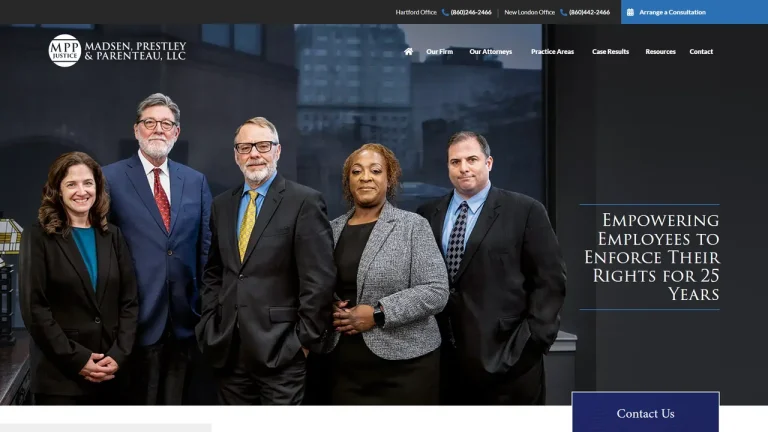
Madsen Prestley & Parenteau, LLC - Hartford, CT

Gordon Rees Scully Mansukhani, LLP - Hartford, CT
Hayber, McKenna & Dinsmore, LLC - Hartford, CT
Sabatini & Associates - Hartford, CT
Spinella & Associates PC - Hartford, CT
Killian & Donohue LLC - Hartford, CT
Crumbie Law Group, LLC - Hartford, CT

Feiner Wolfson LLC - Hartford, CT

Morrison Mahoney LLP - Hartford, CT

The Law Office of Barbara J. Collins - Hartford, CT

Wiggin and Dana LLP - Hartford, CT
Law Office of Ruben E. Acosta, LLC - Hartford, CT
FordHarrison LLP - Hartford, CT
Tarabishy Law Firm, LLC - Hartford, CT

Kainen, Escalera & McHale, P.C. - Hartford, CT
McEleney & McGrail, LLC - Hartford, CT

Livingston, Adler, Pulda, Meiklejohn & Kelly, PC - Hartford, CT

Confronting Workplace Discrimination Across Greater Hartford
Hartford represents the financial and governmental core of Connecticut, employing tens of thousands of workers across insurance underwriting, investment management, state administration, and regional healthcare institutions. In these fast-paced environments, unlawful bias can severely disrupt professional trajectories. Whether manifested through discriminatory pay practices, promotional barriers, persistent hostile work environments, or denial of medical accommodations, workplace discrimination demands aggressive and knowledgeable legal advocacy.
Employees in Hartford are protected under both federal civil rights statutes and the Connecticut Fair Employment Practices Act. The state act offers broader protections than federal law, covering smaller employers and establishing comprehensive protected classes. Most local discrimination disputes initiate through mandatory administrative proceedings at the Connecticut Commission on Human Rights and Opportunities, located in Hartford. When administrative conciliation concludes or a release of jurisdiction is granted, civil lawsuits proceed to the Hartford Judicial District Superior Court at 95 Washington Street or the federal courthouse on Main Street.
Attorneys representing employees in Hartford handle matters across the entire capital metro region, including West Hartford, Glastonbury, Manchester, Wethersfield, East Hartford, and Bloomfield. Local counsel possesses detailed knowledge of the CHRO's fact-finding conferences, regional jury compositions in Hartford County, and effective defense strategies used by regional corporate employers.
Workplace Bias Representation Fee Models and Case Costs
| Case Scenario | Fee Structure | Estimated Cost (USD) | Key Cost Determinants |
|---|---|---|---|
| CHRO Intake, Complaint Drafting & Mediation | Hybrid / Contingency | $3,500 - $7,500 retainer or 33% contingency | Filing schedule, response to employer position statement, and mandatory mediation participation. |
| Hostile Work Environment & Harassment Claims | Contingency Fee | 33% - 40% of gross recovery | Pervasiveness of conduct, internal HR reporting logs, management culpability, and digital evidence. |
| Failure to Accommodate (Disability / Pregnancy) | Contingency / Hourly | $300 - $550/hr or 33% contingency | Interactive process documentation, medical disclosures, and employer undue hardship defenses. |
| State Superior Court or Federal Title VII Trial | Contingency / Retainer | $7,500 - $15,000 retainer or 33% - 40% contingency | Summary judgment response drafting, corporate witness depositions, and forensic economic experts. |
Critical Legal Deadlines & Statutes in Connecticut
Pursuing workplace discrimination claims in Connecticut requires strict adherence to mandatory administrative deadlines. Under the Connecticut Fair Employment Practices Act, codified at Conn. Gen. Stat. § 46a-60, employers are barred from discriminating against employees based on race, color, religious creed, age, sex, gender identity or expression, marital status, national origin, ancestry, status as a veteran, intellectual disability, mental disability, learning disability, or physical disability.
To enforce these rights, a formal complaint must be filed with the Connecticut Commission on Human Rights and Opportunities pursuant to Conn. Gen. Stat. § 46a-82 within 300 days of the discriminatory act. Following an investigation or early mediation, a complainant may request a Release of Jurisdiction. Under Conn. Gen. Stat. § 46a-101, a civil lawsuit must be served and filed in the Superior Court within 90 days of the date the CHRO issues the release.
Victims of discrimination can recover substantial remedies under Conn. Gen. Stat. § 46a-104, which authorizes the Superior Court to grant back pay, front pay, emotional distress damages, reinstatement, mandatory attorney fees, and punitive damages. Parallel federal protections under Title VII of the Civil Rights Act are codified at 42 U.S. Code § 2000e-5, which provides concurrent federal administrative filing mechanisms through EEOC dual-filing procedures.
Small Claims Limits vs. Retaining a Hartford Discrimination Attorney
The Small Claims session in Hartford operates under Conn. Gen. Stat. § 51-15 with a strict $5,000 ceiling. Small claims courts have no statutory jurisdiction over civil rights violations, employment discrimination lawsuits, or CHRO administrative appeals. These specialized claims require complete administrative exhaustion before either the CHRO or the federal Equal Employment Opportunity Commission prior to entering the formal court system.
Attempting to handle workplace discrimination disputes without seasoned legal counsel frequently leads to procedural dismissal. Employers are defended by specialized defense counsel who rigorously file motions to dismiss and motions for summary judgment, claiming legitimate, non-discriminatory business reasons for adverse actions. Retaining a Hartford workplace discrimination lawyer ensures thorough preservation of corporate communications, proper calculation of compensatory damages, and forceful representation during CHRO conciliation conferences and court hearings.
Red Flags When Hiring a Hartford Workplace Discrimination Lawyer
- Failing to track or satisfy the mandatory 300-day CHRO administrative deadline under Connecticut law.
- Promising specific monetary payouts or emotional distress damages without reviewing comparative employee records and personnel files.
- Encouraging an employee to resign immediately before documenting discriminatory incidents through company human resources channels.
- Lacking familiarity with the differences between state CFEPA standards and federal Title VII thresholds regarding employer size and coverage.
Frequently Asked Questions
What employers are covered by Connecticut workplace discrimination law?
The Connecticut Fair Employment Practices Act applies to all employers with three or more employees, providing significantly broader workplace coverage than federal laws, which generally require fifteen or more employees.
What is the deadline to file a discrimination complaint in Hartford?
Complaints must be filed with the Connecticut Commission on Human Rights and Opportunities within 300 days of the date the discriminatory conduct or adverse employment action took place.
Can an employer retaliate against me for reporting harassment?
No. Both Connecticut state law and federal civil rights statutes make it unlawful for an employer to retaliate, demote, harass, or terminate an employee for opposing discriminatory practices or participating in a CHRO investigation.
Can I recover attorney fees if I win my discrimination case?
Yes. Connecticut law explicitly authorizes courts to award reasonable attorney fees and litigation costs to prevailing employees in civil discrimination actions brought after receiving a CHRO Release of Jurisdiction.
Do I have to file with the CHRO before suing in Hartford Superior Court?
Yes. Employees must exhaust their administrative remedies by filing first with the CHRO and obtaining a formal Release of Jurisdiction before initiating a civil lawsuit in Connecticut Superior Court.