
Wrongful Termination Lawyers in Hartford
Retaining an assertive Hartford wrongful termination lawyer protects your professional standing and financial future after an unlawful workplace dismissal. Local employment attorneys frequently secure substantial severance packages and back-pay recoveries through strategic negotiations before initiating formal court proceedings. Review our directory below to connect with top-rated Hartford employment advocates.
Crumbie Law Group, LLC - Hartford, CT
Neubert, Pepe & Monteith, P.C. - Hartford, CT
Sabatini & Associates - Hartford, CT

Wiggin and Dana LLP - Hartford, CT
Law Office of Ruben E. Acosta, LLC - Hartford, CT
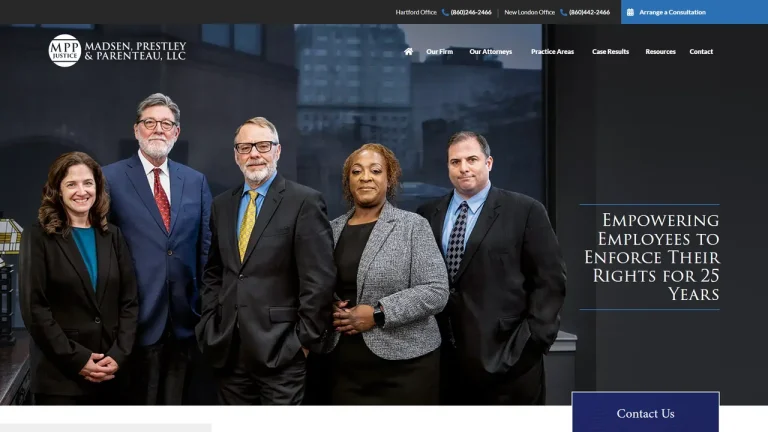
Madsen Prestley & Parenteau, LLC - Hartford, CT

Hayber, McKenna & Dinsmore, LLC - Hartford, CT

Boyle | Shaughnessy Law - Hartford, CT

Livingston, Adler, Pulda, Meiklejohn & Kelly, PC - Hartford, CT

Greater Hartford Legal Aid - Hartford, CT

Gordon Rees Scully Mansukhani, LLP - Hartford, CT
Hersh & Crockett - Hartford, CT
Morgan Lewis & Bockius LLP - Hartford, CT

Feiner Wolfson LLC - Hartford, CT

The Law Office of Barbara J. Collins - Hartford, CT

Morrison Mahoney LLP - Hartford, CT
FordHarrison LLP - Hartford, CT

Challenging Unlawful Discharge Across Hartford's Employment Market
Hartford serves as Connecticut's economic and political capital, housing significant corporate headquarters, major insurance carriers, state administrative departments, healthcare systems, and precision manufacturers. While Connecticut recognizes the doctrine of at-will employment, employers cannot terminate staff for illegal reasons, such as retaliation for reporting unlawful practices, refusing to violate state public policy, or exercising constitutionally protected speech. When an employee is unlawfully dismissed, having dedicated legal counsel in Hartford is critical to asserting statutory rights and recovering lost earnings.
Wrongful termination disputes originating in Hartford are primarily heard in the Civil Division of the Hartford Judicial District Superior Court, located at 95 Washington Street. Cases involving statutory retaliation, discrimination, or whistleblower violations often commence with mandatory administrative proceedings before the Connecticut Commission on Human Rights and Opportunities, headquartered in Hartford. If federal workplace claims are asserted, cases may proceed to the United States District Court for the District of Connecticut, situated on Main Street in downtown Hartford.
Hartford wrongful termination attorneys represent employees across the greater capital region, including West Hartford, East Hartford, Manchester, Wethersfield, Newington, and Bloomfield. Local counsel understands the internal policies of regional corporate employers, the nuances of Connecticut public policy exceptions, and how to navigate state and federal administrative dockets to maximize settlement leverage.
Wrongful Dismissal Representation Fees and Retainer Structures
| Case Scenario | Fee Structure | Estimated Cost (USD) | Key Cost Determinants |
|---|---|---|---|
| Severance Review & Agreement Negotiation | Flat Fee / Hourly | $1,500 - $4,000 | Executive compensation tiers, non-compete terms, equity vesting, and severance payout multipliers. |
| Whistleblower & Public Policy Retaliation | Contingency Fee | 33% - 40% of recovery | Direct evidence of internal or external reports, retaliatory timing, and compensatory damages calculation. |
| State Superior Court Wrongful Discharge Lawsuit | Hybrid / Contingency | $5,000 - $12,500 retainer or 33% contingency | Motion to strike defenses, deposition scheduling, corporate discovery production, and trial preparation. |
| Breach of Implied Contract Dismissal Claim | Hourly Retainer | $350 - $550/hr ($4,000 initial retainer) | Employee handbook disclaimers, written offer letters, and progressive discipline violations. |
Critical Legal Deadlines & Statutes in Connecticut
Navigating wrongful discharge in Connecticut requires immediate compliance with state statutory limitation periods. When a termination involves retaliatory dismissal or statutory discrimination, an administrative complaint must be filed with the Connecticut Commission on Human Rights and Opportunities under Conn. Gen. Stat. § 46a-82 within 300 days of the discriminatory act. Once the CHRO issues a formal Release of Jurisdiction, the employee has exactly 90 days to initiate a civil action in court under Conn. Gen. Stat. § 46a-101.
Connecticut provides strong protections for whistleblowers under Conn. Gen. Stat. § 31-51m, which bars employers from firing workers who report suspected violations of state or federal laws to public bodies. An employee alleging a violation of this statute must bring a civil action within 90 days of the exhausting of administrative remedies, or within 180 days of the retaliatory action. Additionally, under Conn. Gen. Stat. § 31-51q, employers are liable for discharging or disciplining workers who exercise constitutional free speech rights guaranteed by the First Amendment or the Connecticut Constitution, provided the speech does not materially interfere with employment performance.
For common-law wrongful discharge claims based on public policy violations, Connecticut applies the three-year general tort statute of limitations set forth in Conn. Gen. Stat. § 52-577. Implied contract claims are subject to the six-year contract limitation period under Conn. Gen. Stat. § 52-576.
Small Claims Limits vs. Retaining a Hartford Wrongful Termination Attorney
Connecticut Small Claims sessions, capped at $5,000 pursuant to Conn. Gen. Stat. § 51-15, are unsuited for wrongful termination matters. Unlawful dismissal damages typically encompass months or years of lost salary, front pay, emotional distress, lost pension or healthcare benefits, and potential statutory punitive damages. These figures vastly exceed small claims jurisdictional ceilings, and small claims courts cannot award equitable remedies such as job reinstatement.
Wrongful termination claims require comprehensive pre-suit preparation, including subpoenaing corporate emails, deposing managers, and meeting strict administrative exhaustion requirements before the CHRO. A self-represented individual in small claims risks waiving substantial statutory damages or signing invalid releases. Retaining an experienced Hartford wrongful termination attorney levels the playing field against corporate defense firms, enabling workers to utilize Connecticut Judicial Branch e-Services and secure rightful financial compensation.
Red Flags When Hiring a Hartford Wrongful Termination Lawyer
- Guaranteeing specific settlement sums before examining personnel files, disciplinary records, or formal termination documentation.
- Failing to advise on the mandatory 300-day filing deadline before the Connecticut Commission on Human Rights and Opportunities in Hartford.
- Advising an employee to sign a severance separation agreement containing a universal waiver of claims before conducting a thorough legal review.
- Demanding non-refundable upfront retainers for statutory whistleblower claims where statutory fee-shifting provisions apply against the employer.
Frequently Asked Questions
Is Connecticut an at-will employment state?
Yes, Connecticut is an at-will state, meaning an employer may terminate an employee for any lawful reason or no reason. However, terminations motivated by discrimination, retaliation, or violations of established public policy are unlawful exceptions to this rule.
What is the time limit to file a wrongful discharge claim in Hartford?
Claims involving discrimination or retaliation must be filed with the CHRO within 300 days of dismissal. Lawsuits under the state whistleblower statute must generally be filed within 90 days of exhausting remedies or 180 days of the retaliatory act.
Can an employer fire me for exercising free speech in Connecticut?
Under Connecticut statutory law, employers may be held liable for terminating employees who exercise free speech rights protected by the First Amendment or the Connecticut Constitution, provided the speech addresses a matter of public concern and does not substantially disrupt business operations.
What damages can I recover in a wrongful termination lawsuit?
Prevailing plaintiffs may recover back pay with interest, front pay, compensation for emotional distress, lost medical and retirement benefits, reinstatement, and under certain statutes, attorney fees and punitive damages.
Where are wrongful termination lawsuits filed in Hartford?
State wrongful discharge actions are filed at the Hartford Judicial District Superior Court at 95 Washington Street, while federal statutory claims are heard at the U.S. District Court for the District of Connecticut on Main Street.