
Adoption Lawyers in Delaware
Finalizing an adoption in Delaware requires dedicated legal counsel to navigate Family Court procedures and state statutory requirements. Experienced adoption attorneys manage parental rights terminations, state agency clearances, and home placement approvals to ensure legal finality. Browse our directory below to connect with trusted Delaware adoption lawyers ready to guide your family.

Boudart & Mensinger LLP - Wilmington, DE

WhitbeckBeglis - Wilmington, DE

Wahl Family Law - Wilmington, DE

Leslie B. Spoltore - Wilmington, DE

Law Offices of Dana L. Reynolds, LLC - Wilmington, DE
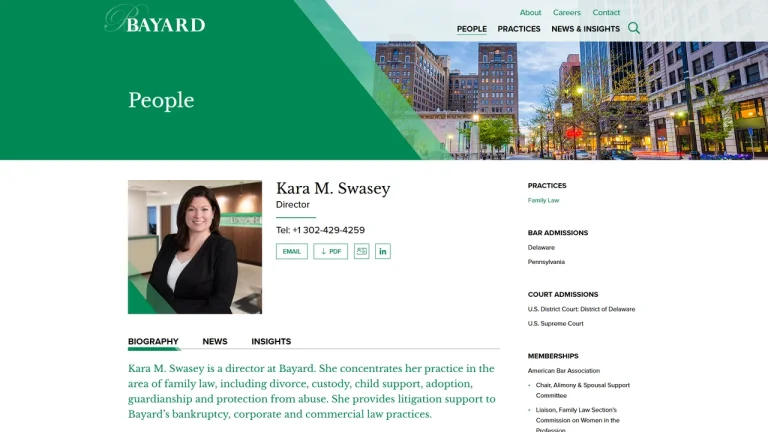
Kara M. Swasey - Wilmington, DE

Law Office of Mary Higgins - Dover, DE

Delaware Family Court Jurisdiction & Adoption Legal Framework
Adoption proceedings in the First State are established to create permanent legal bonds between children and adoptive parents while protecting the fundamental constitutional rights of all parties. Jurisdiction over all adoptions throughout the state is vested exclusively in the Family Court of the State of Delaware under Del. Code tit. 10, § 921(4). Whether finalizing an adoption at the Leonard L. Williams Justice Center in New Castle County, the Kent County Family Court in Dover, or the Sussex County Family Court in Georgetown, prospective adoptive parents must adhere strictly to Delaware's comprehensive adoption statutes.
The statutory backbone of child placement in Delaware is codified in the Delaware Adoption Act under Del. Code tit. 13, § 901 et seq. The law governs various types of adoption, including stepparent adoptions, agency placements through licensed child-placing agencies, independent private placements, foster care adoptions overseen by the Delaware Department of Services for Children, Youth and Their Families (DSCYF), and adult adoptions under Del. Code tit. 13, § 951. In every adoption involving a minor, the court's paramount inquiry remains the best interests of the child.
Adoptions cannot be finalized without addressing the legal parentage of biological parents. The termination of parental rights (TPR) is an essential prerequisite governed by Del. Code tit. 13, § 1103. Retaining an accomplished Delaware adoption lawyer ensures that voluntary consents, background clearances, and home study evaluations satisfy state standards, shielding the adoption decree from future legal challenges.
Delaware Adoption Representation & Case Cost Breakdown
| Case Scenario | Fee Structure | Estimated Cost (USD) | Key Cost Determinants |
|---|---|---|---|
| Stepparent or Close Relative Adoption | Flat Fee ($2,000 - $4,500) | $2,000 - $4,500 | Biological parent consent, waiver of residency investigation under Title 13, criminal history clearances, and decree hearings. |
| Private Agency Placement Adoption | Staged Retainer ($3,500 - $7,500) | $3,500 - $7,500 | Licensed agency coordination, DSCYF report reviews, medical expense authorizations, and final decree filings. |
| Contested Termination of Parental Rights (TPR) | Hourly Retainer ($300 - $500/hr) | $6,000 - $15,000+ | Statutory abandonment proof, evidentiary hearings before Family Court judges, child attorney appointments, and trial transcripts. |
| Interstate Placement (ICPC Compliance) | Hourly Retainer ($325 - $475/hr) | $4,000 - $9,000 | Dual-state ICPC administrator approvals, interstate compact filings under Title 31, and expedited court petitions. |
Critical Legal Deadlines & Statutes in Delaware
Delaware adoption statutes incorporate specific chronological mandates that protect adoptive stability. Under Del. Code tit. 13, § 911, a child must generally reside in the home of the prospective adoptive parents for at least one year before the Family Court will enter a final decree of adoption. However, this statutory waiting period can be waived or reduced to six months at the court's discretion upon recommendations from DSCYF or a licensed adoption agency, and it is routinely waived in stepparent adoptions where statutory relationship criteria are met under Del. Code tit. 13, § 903.
Birth parent consent rules also adhere to strict statutory timelines. Under Del. Code tit. 13, § 909, a biological parent executing a voluntary consent to adoption has strictly fourteen calendar days to revoke that consent in writing; after this fourteen-day statutory revocation window expires, the consent becomes irrevocable except upon clear proof of fraud or duress. Furthermore, when children are brought into or out of Delaware for adoption, the Interstate Compact on the Placement of Children under Del. Code tit. 31, § 381 requires written approval from Delaware ICPC administrators before the child can cross state boundaries.
Small Claims Limitations vs. Professional Legal Representation
The Justice of the Peace Court of Delaware maintains jurisdiction over small claims and minor civil debts up to $25,000 under Del. Code tit. 10, § 9301. However, the Justice of the Peace Court is legally barred from adjudicating adoption petitions, parental rights terminations, or domestic status determinations. Under Del. Code tit. 10, § 921, all adoption proceedings are reserved exclusively for the Family Court of the State of Delaware. Attempting to draft or file adoption agreements outside Family Court procedures produces no legal force or parental recognition.
Attempting to handle an adoption pro se within the Delaware Family Court presents immense risks of procedural dismissal or flawed parental termination. A minor defect in serving notice to an alleged biological father under Del. Code tit. 13, § 1105 or failing to satisfy the federal Indian Child Welfare Act (ICWA) requirements can leave an adoption decree subject to vacatur years later. Retaining an experienced Delaware adoption attorney ensures complete statutory compliance, coordinates mandatory DSCYF background checks, and secures an unassailable final adoption decree.
Red Flags When Hiring a Delaware Adoption Lawyer
- Attorneys who fail to ensure strict compliance with the Interstate Compact on the Placement of Children under Del. Code tit. 31, § 381 when an adoptive child is born outside Delaware.
- Lawyers who misinform biological parents about consent revocation deadlines, ignoring the mandatory fourteen-day statutory window defined in Del. Code tit. 13, § 909.
- Firms lacking familiarity with the specific filing requirements and social study procedures enforced by the Delaware Department of Services for Children, Youth and Their Families.
- Attorneys who guarantee an expedited adoption timeline before completing mandatory state background checks, fingerprinting, and home assessment evaluations.
Frequently Asked Questions
Who is eligible to adopt a child under Delaware law?
Under Del. Code tit. 13, § 903, any person over the age of 21 who is a resident of Delaware at the time of filing may petition to adopt. Both married couples and single individuals may adopt, provided they satisfy state background check criteria, home study evaluations, and court suitability standards.
Can a stepparent adopt a stepchild in Delaware without a home study?
Yes, in many cases. Under Del. Code tit. 13, § 912, the Family Court may waive the formal home study and pre-placement social investigation requirement for stepparent adoptions if the child has lived with the stepparent and biological parent for a continuous period, though criminal clearances remain mandatory.
What are the legal grounds for terminating parental rights in Delaware?
Under Del. Code tit. 13, § 1103, parental rights may be terminated based on voluntary consent, intentional abandonment, severe or chronic abuse, criminal convictions involving violent felonies against a child, or failure to plan adequately for the child's physical and emotional needs over an extended period.
Can an adult be legally adopted in the State of Delaware?
Yes. Delaware recognizes adult adoption under Del. Code tit. 13, § 951. Any adult resident of Delaware may adopt another adult person with that person's written consent, formalizing lifelong familial and estate inheritance relationships through the Family Court.
How does the Interstate Compact on the Placement of Children apply in Delaware?
Under Del. Code tit. 31, § 381, if a child is born in another state and placed with adoptive parents in Delaware, both the sending and receiving states' ICPC offices must review and approve the placement before the child physically enters Delaware, ensuring regulatory safety.