
Bankruptcy Lawyers in Delaware
Filing for consumer or commercial bankruptcy in Delaware provides immediate legal protection from creditors under federal automatic stay provisions. A dedicated Delaware bankruptcy attorney helps eliminate debt, protect home equity, and establish long-term financial stability. Explore our verified statewide directory below to connect with local bankruptcy counsel.

Evans George E - Wilmington, DE
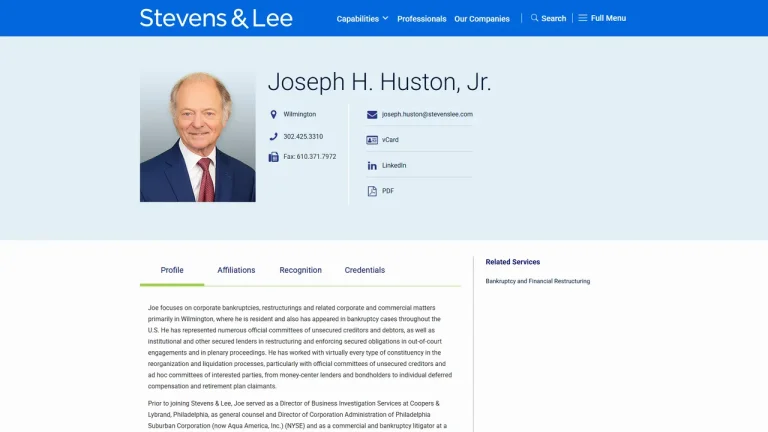
Joseph H. Huston, Jr. - Wilmington, DE

Polsinelli - Wilmington, DE

Faegre Drinker Biddle & Reath LLP - Wilmington, DE

Potter Anderson and Corroon (- Dover, DE)

The Bifferato Firm - Wilmington, DE
Timothy J. Weiler Law - Wilmington, DE
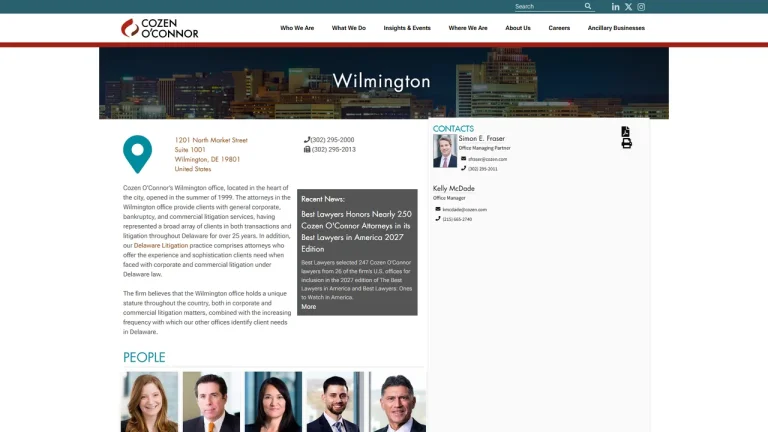
Cozen O'Connor - Wilmington, DE
Schmittinger & Rodriguez PA - Dover, DE

Philip M. Finestrauss, P.A. - Wilmington, DE
Robinson & Cole LLP - Wilmington, DE

Poole, Mensinger, Cutrona & Ellsworth-Aults - Wilmington, DE

Gibbons P.C. - Wilmington, DE

Linebarger Goggan Blair & Sampson, LLP - Wilmington, DE
Morris, Nichols, Arsht & Tunnell LLP - Wilmington, DE

Crabill Law, LLC - Wilmington, DE
Cooch and Taylor, P.A. - Wilmington, DE
Real World Law, PC - Wilmington, DE
Casarino Christman Shalk Ransom & Doss, PA - Wilmington, DE
Avenue Law - Dover, DE
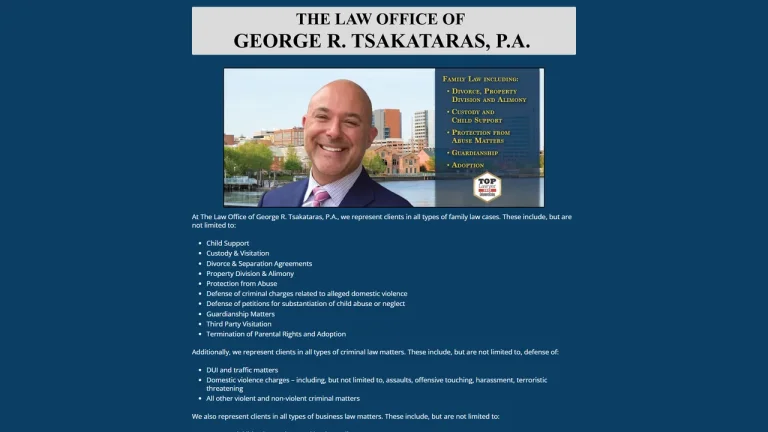
The Law Office of George R. Tsakataras, P.A. - Wilmington, DE

K&L Gates LLP - Wilmington, DE
Campbell & Levine, LLC - Wilmington, DE

Delaware Bankruptcy Jurisdiction and Federal Court Structure
Bankruptcy proceedings in Delaware are governed exclusively by federal law and adjudicated within the United States Bankruptcy Court for the District of Delaware, located on North Market Street in downtown Wilmington. While the Delaware bankruptcy court is globally recognized for presiding over high-profile Chapter 11 corporate reorganizations, it manages an active consumer docket handling Chapter 7 liquidations and Chapter 13 wage-earner repayment plans for individuals residing in New Castle County, Kent County, and Sussex County.
When individuals or business owners face mounting liabilities, filing a bankruptcy petition triggers the immediate protection of the federal automatic stay under 11 U.S. Code § 362. This statutory injunction halts pending foreclosure actions, stops vehicle repossessions, freezes wage garnishments originating from Delaware state courts, and bars creditors from initiating contact. Debt collection actions pending in the Delaware Court of Common Pleas or local Justice of the Peace Courts are immediately stayed upon filing.
Consumer bankruptcy practice in Delaware requires comprehensive knowledge of state-specific exemption statutes. Delaware has chosen to opt out of the federal bankruptcy exemption scheme, requiring Delaware filers to claim exemptions created under Delaware statutory law. Experienced Delaware bankruptcy attorneys admitted to the Bar of the Delaware Supreme Court and the federal district court structure filings to protect primary residences, pension accounts, tools of trade, and essential personal property against bankruptcy trustee liquidation.
Delaware Bankruptcy Representation Fee Guide
| Case Scenario | Fee Structure | Estimated Cost (USD) | Key Cost Determinants |
|---|---|---|---|
| Chapter 7 Consumer Liquidation | Flat Fee | $1,200 - $2,500 | Household income relative to state median, asset complexity, and creditor count. |
| Chapter 13 Debt Adjustment & Repayment Plan | Court-Approved Flat Fee | $3,500 - $5,500 | Mortgage arrearage cure schedule, disposable income calculations, and plan length. |
| Small Business Chapter 11 Subchapter V Reorganization | Retainer & Hourly | $15,000 - $45,000+ | Cash collateral motions, creditor negotiations, and plan confirmation requirements. |
| Adversary Proceeding Defense (Dischargeability) | Hourly Rate | $3,500 - $12,000+ | Allegations of fraud, luxury credit purchases, deposition volume, and trial preparation. |
Critical Legal Deadlines & Statutes in Delaware
Strict procedural rules and deadlines govern Delaware bankruptcy cases. Because Delaware has exercised its opt-out authority under 11 U.S. Code § 522(b), debtors must utilize Delaware state exemptions pursuant to Del. Code tit. 10, § 4914. Under this statute, Delaware filers may claim a homestead exemption of up to $125,000 in equity in their primary residence, safeguarding homeownership against unsecured creditor claims.
Debtors filing for Chapter 7 relief must satisfy the statutory means test under 11 U.S. Code § 707(b) to prove that their annualized monthly income does not exceed the Delaware median income for a household of comparable size. Following the petition filing, the Section 341 Meeting of Creditors must be held within 21 to 40 days. Creditors face a strict deadline under federal bankruptcy rules to file adversary complaints challenging the discharge of specific debts under 11 U.S. Code § 523 within 60 days following the first scheduled meeting of creditors date. Chapter 13 debtors must begin making plan payments to the Chapter 13 trustee within 30 days after the petition is filed.
Justice of the Peace Court Debt Actions vs. Federal Bankruptcy Protection
Under Del. Code tit. 10, § 9301, the Delaware Justice of the Peace Court exercises jurisdiction over civil debt collection actions up to $25,000. Creditors routinely utilize JP Courts to obtain default judgments, subsequently seeking wage garnishments and bank levies through the Delaware Court of Common Pleas. While debtors can defend individual lawsuits in JP Court, each case must be litigated separately, offering no resolution for broader debt burdens.
Filing for bankruptcy provides comprehensive debt relief that resolves multiple collection matters simultaneously through a single federal action. Navigating bankruptcy pro se carries substantial risk; improperly scheduled assets, failure to produce tax returns, or claiming incorrect exemptions under Delaware law can cause the loss of personal property or result in case dismissal. Retaining a dedicated bankruptcy attorney ensures that filings comply with local rules of the Delaware Bankruptcy Court and protects assets from trustee liquidation.
Red Flags When Selecting a Delaware Bankruptcy Attorney
- High-Volume Petition Mills: Avoid firms where clients never consult directly with a licensed attorney and all interactions are delegated to non-lawyer administrative staff.
- Promises that All Debts Can Be Discharged: Ethical bankruptcy lawyers explain that specific obligations-such as domestic support orders, recent tax obligations, and student loans-generally cannot be discharged under bankruptcy law.
- Unfamiliarity with Delaware Opt-Out Exemptions: Counsel must demonstrate deep knowledge of Del. Code tit. 10, § 4914 to ensure that homestead and vehicle equity are fully protected from trustee liquidation.
- Failure to Provide Upfront Written Fee Disclosures: Federal bankruptcy law requires attorneys to execute detailed written disclosures detailing all legal costs, court filing charges, and credit counseling requirements.
Frequently Asked Questions
Where is the United States Bankruptcy Court located in Delaware?
The United States Bankruptcy Court for the District of Delaware is located at 824 North Market Street in Wilmington, handling both consumer and corporate filings for the entire state.
Can I use federal bankruptcy exemptions if I file in Delaware?
No. Delaware has opted out of the federal bankruptcy exemption scheme. Debtors who have lived in Delaware for the requisite statutory period must use Delaware state exemptions to protect property.
How much home equity can I protect under Delaware bankruptcy law?
Under Delaware state statute, debtors can protect up to $125,000 of equity in their primary residence through the state homestead exemption.
What is the difference between Chapter 7 and Chapter 13 bankruptcy?
Chapter 7 liquidates non-exempt assets to eliminate qualifying unsecured debt in three to four months, while Chapter 13 restructures debt into a court-supervised three- to five-year repayment plan.
Does filing bankruptcy in Delaware immediately stop a wage garnishment?
Yes. The filing of a bankruptcy petition activates the automatic stay under federal law, immediately halting wage garnishments, bank attachments, and debt collection lawsuits.