
Debt Relief Lawyers in Dover
Resolving overwhelming debt burdens in Dover requires assertive legal defense against aggressive collection agencies under Delaware consumer protection laws. A local debt relief attorney defends against creditor lawsuits, negotiates lump-sum settlements, and protects your paycheck from wage garnishment. Explore our directory below to consult with top-rated Dover debt defense lawyers.

The Law Office of William F. Jaworski - Dover, DE
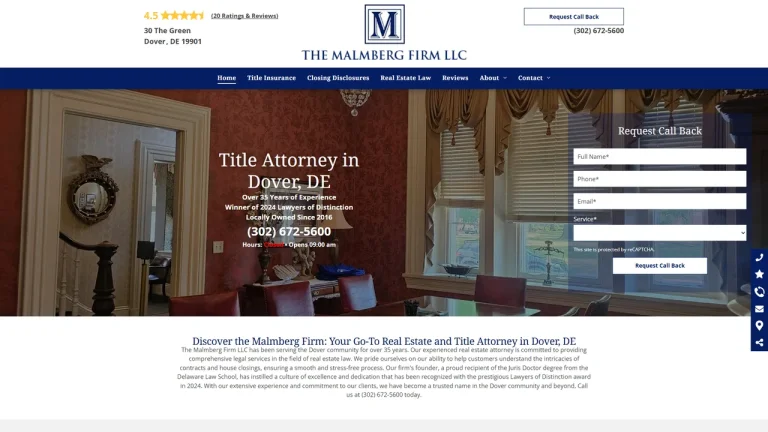
The Malmberg Firm LLC - Dover, DE
Strategic Debt Defense in the Kent County Court System
Financial distress impacts hardworking individuals and families across Dover, Camden, Smyrna, Wyoming, Harrington, Cheswold, and surrounding Kent County communities near Dover Air Force Base. When credit card debts, medical expenses, or personal loans go into default, national debt buyers and collection law firms rapidly file civil collection lawsuits to secure enforceable judgments. Navigating these judicial proceedings demands knowledgeable local legal representation.
Debt collection claims in Dover are filed in the Delaware Justice of the Peace Court (primarily JP Court 16 in Dover) for claims up to $25,000, or in the Court of Common Pleas for Kent County, located at 38 The Green in historic Dover. When creditors secure judgments against unrepresented consumers, they promptly initiate post-judgment wage garnishments or execute bank levies to freeze savings accounts through the Kent County Sheriff.
Hiring a Dover debt defense attorney levels the legal playing field against institutional collectors. A dedicated attorney evaluates whether the debt buyer actually owns the account, scrutinizes the chain of assignment bills of sale, and enforces statutory protections under Delaware law, frequently resolving contested debts out of court for a fraction of the claimed balance.
Estimated Debt Relief Fees and Legal Representation Scenarios
Legal fees for debt defense and settlement in Dover depend on whether a formal collection lawsuit is pending, the total debt volume, and whether representation involves courtroom litigation.
| Case Scenario | Fee Structure | Estimated Cost (USD) | Key Cost Determinants |
|---|---|---|---|
| Out-of-Court Debt Settlement Negotiation | Percentage of Savings or Flat Fee | 15% - 25% of savings or $1,000 - $2,500 | Total aggregate balance, original creditor settlement policies, single versus multi-account portfolios |
| JP Court / Court of Common Pleas Lawsuit Defense | Flat Retainer or Hourly | $1,200 - $3,000 | Challenging debt buyer standing, filing Bills of Particulars, asserting statute of limitations defenses |
| Wage Garnishment Defense & Exemption Hearing | Fixed Flat Fee | $600 - $1,400 | Calculating Delaware 15% net disposable income caps, asserting head-of-household statutory exemptions |
| FDCPA Debt Collector Harassment Lawsuit | Contingency / Statutory Fee Shifting | $0 Client Cost (Statutory fees) | Documented phone harassment, deceptive collection threats, statutory damages under federal law |
Critical Legal Deadlines & Statutes in Delaware
Delaware strictly regulates the timeframe within which creditors can pursue unpaid consumer obligations. Under 10 Del. C. § 8106, actions based on simple contracts, promissory notes, and revolving credit card accounts are subject to a strict three-year statute of limitations from the date of default. If a collector files a lawsuit on debt older than three years without an intermediate payment reviving the debt, the lawsuit can be dismissed with prejudice.
When a collection summons is served, responsive deadlines are critical. Under Justice of the Peace Court Civil Rule 7, a defendant served with a civil complaint must file a written answer or request a Bill of Particulars within fifteen days of service. In the Court of Common Pleas, a formal written answer must be submitted within twenty days. Missing these tight windows allows the creditor to obtain an immediate default judgment.
Regarding post-judgment wage execution, Delaware provides exceptional protections under 10 Del. C. § 4913, which caps wage garnishments at no more than 15% of net disposable income and strictly prohibits more than one wage garnishment from running against an individual at the same time. Consumer protection rights are further codified under the Delaware Consumer Fraud Act at 6 Del. C. § 2513 and debt settlement regulations under 6 Del. C. § 2401A.
Justice of the Peace Court vs. Professional Legal Defense
The Delaware Justice of the Peace Court possesses civil jurisdiction over claims up to $25,000 pursuant to 10 Del. C. § 9301. Because this jurisdictional cap is substantially higher than small claims limits in other jurisdictions, major credit card and banking disputes involving significant sums are adjudicated in local JP courts without standard civil discovery procedures.
Unrepresented consumers in Dover frequently concede liability during hearings, unaware that third-party debt buyers routinely lack the authenticated account agreements, complete billing histories, or competent witness affidavits required to prove their claims. A Dover debt defense lawyer demands a formal Bill of Particulars, exposes chain-of-custody defects in debt portfolios, or appeals adverse magistrate judgments to the Court of Common Pleas for a trial de novo under 10 Del. C. § 9571.
Furthermore, out-of-state telemarketing debt settlement companies cannot represent you in Delaware courts. Relying on non-lawyer settlement mills often results in consumers making monthly escrow payments while creditors obtain default judgments and freeze bank accounts.
Red Flags in Debt Relief and Settlement Services
- Upfront fee demands from non-lawyer companies: Organizations demanding substantial advance fees prior to settling debts violate the Delaware Uniform Debt-Management Services Act under 6 Del. C. § 2401A.
- Advice to ignore Dover court summonses: Unlicensed debt settlement outfits often instruct clients to disregard court paperwork from JP Court 16, resulting in immediate default judgments.
- Unrealistic debt reduction claims: Be wary of telemarketers promising to eliminate 80% to 90% of debt without reviewing creditor identity or legal standing.
- Failing to disclose taxable debt forgiveness: Discharged or settled debts exceeding $600 may trigger IRS Form 1099-C cancellation-of-debt income unless statutory insolvency exclusions apply.
Frequently Asked Questions
What is the statute of limitations on credit card debt in Delaware?
Under 10 Del. C. § 8106, the statute of limitations on debt collection, including credit card debt and personal loans, is three years from the date of the last payment or initial default.
How much of my paycheck can be garnished for debt in Delaware?
Under 10 Del. C. § 4913, wage garnishments are strictly capped at 15% of your net disposable income. Additionally, Delaware law prohibits multiple creditors from garnishing wages concurrently; subsequent creditors must wait in line.
Where are debt collection lawsuits filed in Dover?
Claims up to $25,000 are typically filed in the Justice of the Peace Court 16 in Dover. Larger claims or appeals are heard in the Court of Common Pleas for Kent County, located at 38 The Green in Dover.
What is a Bill of Particulars in Delaware debt collection cases?
A Bill of Particulars is a formal demand filed in Justice of the Peace Court requiring the plaintiff to provide an itemized breakdown of the debt, accounting statements, and proof of contractual liability before the case proceeds to trial.
Can a debt collector freeze my bank account in Delaware?
A debt collector cannot freeze your bank account without first securing a court judgment. Once a judgment is entered, they can issue a bank levy through the Kent County Sheriff, but you have the right to claim statutory exemptions.