
Child Custody Lawyers in District Of Columbia
Resolving child custody disputes in the District of Columbia requires knowledgeable representation focused on the best interests of your children. A dedicated D.C. child custody attorney helps establish balanced legal and physical custody arrangements while safeguarding parental relationships. Review our directory below to consult an experienced local lawyer.

Capital Family & Divorce Law Group - Washington, DC

Carolyn Goodman, Attorney at Law - Washington, DC

Potomac Family Law - Washington, DC

The Fathers' Rights Firm - Washington, DC

Barkat Law Firm - Washington, DC

Public Defender Service for the District of Columbia - Washington, DC

Open City Advocates - Washington, DC

Children's Law Center - Washington, DC

Jessica T. Ornsby, Esq. - Washington, DC

The Law Offices of David Stein - Washington, DC

Volunteer Legal Advocates - Washington, DC

P. A. Davis Law Office LLC - Washington, DC

Jesse A Gadson Law Offices - Washington, DC
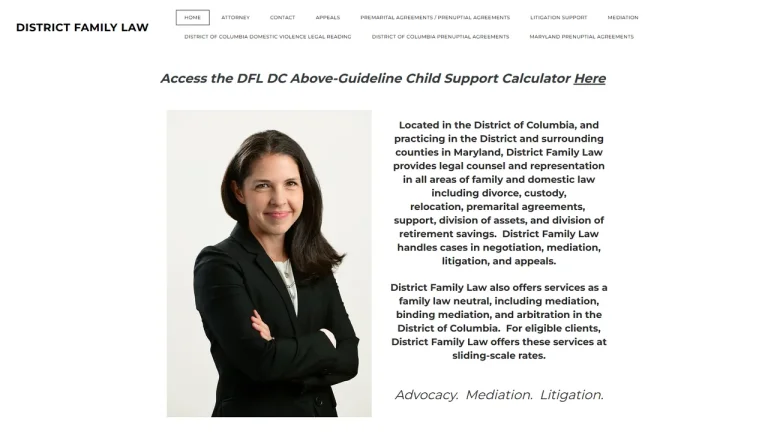
District Family Law - Washington, DC

Tucker PLLC - Family Law - Washington, DC

D.C. Superior Court Custody Jurisdiction and Best Interests Standards
Custody and parental disputes in the District of Columbia fall under the jurisdiction of the Family Court of the Superior Court of the District of Columbia, based at the H. Carl Moultrie Courthouse on Indiana Avenue NW. Serving families across all wards and neighborhoods of Washington, D.C., the Domestic Relations Branch hears initial custody petitions, visitation motions, paternity establishments, and emergency protective proceedings. Judicial determinations are anchored strictly to the best interests of the child standard.
District of Columbia custody jurisprudence distinguishes between legal custody-the legal authority to make major decisions regarding education, medical treatment, and religious upbringing-and physical custody, which defines where the child resides and the specific schedule of parenting time. Under D.C. Code § 16-914, the court operates with a statutory presumption that joint legal and joint physical custody is in the child's best interests, unless an intrafamily offense or evidence of parental unfitness is demonstrated. D.C. judges actively utilize the Multi-Door Dispute Resolution Division to help parents design detailed parenting schedules through structured mediation.
Retaining a child custody attorney licensed by the District of Columbia Bar provides parents with critical procedural advantages. Experienced local lawyers collaborate with Guardians ad Litem (GALs) and evaluators from the Family Court Social Services Division to ensure that home environments, school stability, and existing parental bonds are presented effectively before presiding D.C. Superior Court judges.
District of Columbia Child Custody Representation Fee Guide
| Case Scenario | Fee Structure | Estimated Cost (USD) | Key Cost Determinants |
|---|---|---|---|
| Uncontested Custody & Parenting Agreement | Flat Fee or Limited Hourly | $2,500 - $5,000 | Parental cooperation, detail in holiday parenting plans, and Multi-Door mediation speed. |
| Contested Legal and Physical Custody Litigation | Hourly with Retainer | $7,500 - $25,000+ | Guardian ad Litem involvement, psychological evaluations, and trial hearing days. |
| Interstate Relocation & Jurisdictional Disputes (UCCJEA) | Hourly with Retainer | $10,000 - $35,000+ | Notice compliance, travel burden assessments, school records, and cross-border motions. |
| Post-Judgment Custody Modification Proceeding | Hourly Rate | $3,500 - $12,000 | Demonstration of substantial change in circumstances and altered work schedules. |
Critical Legal Deadlines & Statutes in the District of Columbia
Navigating child custody proceedings in D.C. requires adherence to statutory criteria and jurisdictional rules. Under the Uniform Child Custody Jurisdiction and Enforcement Act (UCCJEA), codified at D.C. Code § 16-4602.01, the District of Columbia possesses jurisdiction to make an initial child custody determination only if D.C. is the child's home state-meaning the child lived in the District with a parent for at least six consecutive months immediately prior to the commencement of the proceeding.
Substantive custody factors are governed by D.C. Code § 16-914, which sets out seventeen statutory criteria that the court must evaluate, including the wishes of the parents, the child's adjustment to home and school, and the capacity of each parent to facilitate a continuing relationship with the other. Modifications of existing custody decrees are controlled by D.C. Code § 16-914(f)(1), requiring the moving party to establish a substantial and material change in circumstances before the court will alter legal or physical custody. Following an adverse trial ruling, appeals must be lodged with the District of Columbia Court of Appeals within 30 days under Rule 4 of the D.C. Court of Appeals Rules.
Small Claims Limitations and the Need for Family Law Representation
Under D.C. Code § 11-1321, the Small Claims and Conciliation Branch of the D.C. Superior Court handles minor financial claims up to $10,000. It has no jurisdiction to issue custody orders, establish parenting time, or resolve parental disputes. All child custody and visitation matters fall under the exclusive subject-matter jurisdiction of the D.C. Superior Court Family Court.
Attempting to represent oneself in a contested child custody dispute carries enormous personal risk. Self-represented parents frequently struggle to navigate the D.C. Superior Court Rules of Procedure for the Family Court or fail to introduce admissible evidence concerning emotional wellness and parental fitness. A dedicated D.C. custody lawyer conducts cross-examinations, cross-examines court-appointed evaluators, and crafts enforceable parenting plans that protect parental access and minimize future conflict.
Red Flags When Selecting a District of Columbia Family Law Attorney
- Promising Guaranteed Sole Legal or Physical Custody: D.C. statutory law strongly favors joint custody; attorneys who guarantee sole custody without documenting severe parental unfitness are misleading clients.
- Encouraging High-Conflict or Alienating Behavior: Counsel who advises withholding parenting time or disrupting court-ordered visitation undermines the client's credibility under D.C. Code § 16-914.
- Lack of Courtroom Experience in D.C. Family Court: Custody practices require familiarity with local judges and administrative processes at the Moultrie Courthouse; avoid lawyers unfamiliar with D.C. Multi-Door mediation.
- Unclear Billing for Guardian ad Litem and Expert Fees: Retainers should clearly outline how third-party expenses, including custody evaluators and court-appointed guardians, are billed and managed.
Frequently Asked Questions
What is the presumption of joint custody in the District of Columbia?
Under D.C. Code § 16-914, there is a legal presumption that joint legal and joint physical custody is in the best interests of the child, unless evidence of domestic violence, child abuse, or parental unfitness is proven.
What is the difference between legal custody and physical custody in D.C.?
Legal custody refers to the right to make major decisions regarding the child's education, healthcare, and welfare, whereas physical custody determines where the child resides and the day-to-day parenting schedule.
How long must a child live in Washington, D.C. before the court has jurisdiction?
Under the UCCJEA codified in D.C. Code § 16-4602.01, D.C. must be the child's home state, meaning the child must have resided in the District for at least six continuous months immediately prior to filing.
Can a parent relocate outside the District of Columbia with a child?
A parent seeking to relocate must provide advance notice and obtain either the written consent of the other parent or approval from the D.C. Superior Court, demonstrating that the move serves the child's best interests.
How can an existing custody order be modified in D.C.?
Under D.C. Code § 16-914(f)(1), the parent requesting modification must show that a substantial and material change in circumstances has occurred since the prior order and that modifying custody is in the child's best interests.