
Divorce Lawyers in District Of Columbia
Navigating a divorce in the District of Columbia requires experienced legal counsel familiar with local equitable distribution and residency statutes. A skilled D.C. divorce attorney protects your assets, negotiates separation agreements, and facilitates resolution through court-annexed mediation. Browse our directory below to consult trusted local family lawyers.

Potomac Family Law - Washington, DC

Jesse A Gadson Law Offices - Washington, DC

Tucker PLLC - Family Law - Washington, DC
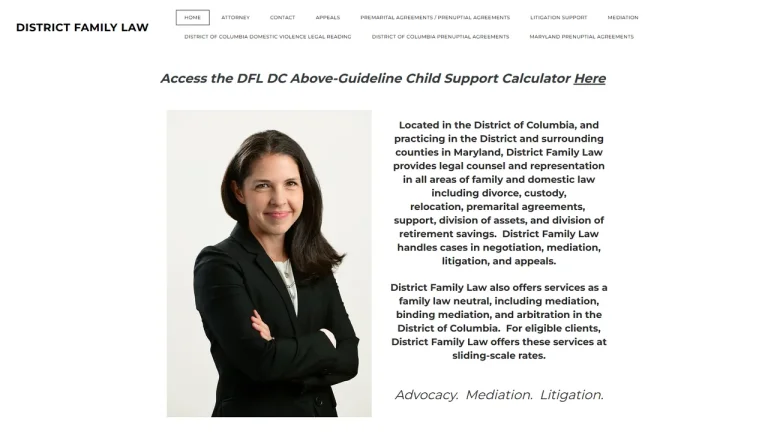
District Family Law - Washington, DC

Carolyn Goodman, Attorney at Law - Washington, DC

Barkat Law Firm - Washington, DC

Capital Family & Divorce Law Group - Washington, DC

The Law Offices of David Stein - Washington, DC

The Fathers' Rights Firm - Washington, DC

Legall Law - Washington, DC

Law Office of Sebastian Krop, PLLC - Washington, DC

Jessica T. Ornsby, Esq. - Washington, DC

P. A. Davis Law Office LLC - Washington, DC

D.C. Superior Court Family Division and Marital Dissolution Practice
Divorce and domestic relations cases in the District of Columbia are adjudicated exclusively within the Family Court of the Superior Court of the District of Columbia, situated at the H. Carl Moultrie Courthouse on Indiana Avenue NW. Serving residents across all four quadrants-Northwest, Northeast, Southwest, and Southeast-the Domestic Relations Branch oversees contested divorces, legal separations, annulments, and marital property division. D.C. family courts emphasize amicable dispute resolution, frequently directing parties to early mediation sessions through the court's Multi-Door Dispute Resolution Division.
Marital property division in the District follows the principle of equitable distribution codified at D.C. Code § 16-910. Unlike community property jurisdictions, D.C. courts divide marital assets based on fairness rather than an automatic equal split. In a jurisdiction characterized by a substantial concentration of federal agency personnel, non-profit executives, military officers, and private sector professionals, marital estates often involve complex financial portfolios. These frequently encompass federal retirement packages under CSRS or FERS, military pensions, Thrift Savings Plans (TSPs), private business equity, and specialized deferred compensation.
Retaining a divorce lawyer licensed by the District of Columbia Bar ensures your marital estate is evaluated accurately through formal discovery mechanisms. Experienced D.C. practitioners understand local judicial tendencies within the Moultrie Courthouse, drafting enforceable separation agreements and Qualified Domestic Relations Orders (QDROs) that withstand post-judgment challenges before the District of Columbia Court of Appeals.
District of Columbia Divorce Representation Fee Guide
| Case Scenario | Fee Structure | Estimated Cost (USD) | Key Cost Determinants |
|---|---|---|---|
| Uncontested Dissolution with Signed Separation Agreement | Flat Fee or Limited Hourly | $2,500 - $5,500 | Completeness of asset disclosures, agreement terms, and waiver of formal hearing. |
| Contested Divorce & Equitable Asset Distribution | Hourly with Retainer | $8,000 - $30,000+ | Real estate valuations, deposition volume, motion practice, and trial duration. |
| High-Net-Worth Division with Federal Pensions & TSPs | Hourly with Retainer | $15,000 - $65,000+ | Forensic accounting, retirement plan division orders, and international business assets. |
| Post-Judgment Alimony or Property Enforcement | Hourly Rate | $3,500 - $9,500 | Contempt motions, subpoena enforcement, and demonstration of substantial change. |
Critical Legal Deadlines & Statutes in the District of Columbia
Filing for divorce in the District requires strict adherence to statutory threshold criteria. Under D.C. Code § 16-902, at least one spouse must have been a bona fide resident of the District of Columbia for at least six continuous months immediately prior to filing the divorce complaint. Establishing domicile requires objective evidence, such as D.C. voter registration, driver's licenses, or local residential leases.
Under reformed grounds for divorce set forth in D.C. Code § 16-904, a party may petition for dissolution asserting that the marriage has ceased to be mutually beneficial or that one or both parties wish to terminate the marital relationship. Spousal support determinations are guided by D.C. Code § 16-913, which authorizes the court to award alimony based on factors including the duration of the marriage, each spouse's financial resources, earning capabilities, and contributions to the household. Following a final decree issued by a Superior Court judge, an aggrieved party must file a notice of appeal with the District of Columbia Court of Appeals within 30 days under Rule 4 of the D.C. Court of Appeals Rules.
Small Claims Limitations and the Need for Family Law Representation
The Small Claims and Conciliation Branch of the Superior Court of the District of Columbia exercises civil jurisdiction over controversies up to $10,000 under D.C. Code § 11-1321. However, the Small Claims Branch has no subject-matter jurisdiction over divorce, alimony, or the equitable distribution of marital property. All domestic relations proceedings belong exclusively within the Family Court Division at the H. Carl Moultrie Courthouse.
Attempting to handle a contested divorce pro se exposes parties to severe long-term financial harm. Spouses who self-represent frequently overlook tax consequences associated with transferring residential property or miscalculate survivorship benefits in federal retirement systems. An experienced D.C. divorce attorney utilizes formal interrogatories, requests for production, and court-mandated alternative dispute resolution to protect your entitlements, negotiate favorable settlements, and avoid protracted courtroom litigation.
Red Flags When Selecting a District of Columbia Family Law Attorney
- Unnecessary Escalation Instead of Multi-Door Mediation: Be cautious of attorneys who bypass court-sponsored mediation in favor of immediate, costly motion practice that drains marital assets through billable hours.
- Unfamiliarity with Federal Retirement and Thrift Savings Plans: Due to D.C.'s workforce profile, divorce counsel must possess demonstrable experience dividing federal pensions (CSRS/FERS) and drafting Court Orders Acceptable for Processing (COAPs).
- Guarantees of Specific Alimony Amounts or Property Splits: Because D.C. judges exercise broad statutory discretion under equitable distribution principles, no ethical attorney can promise a predetermined outcome.
- Lack of Transparent Fee Agreements and Escrow Accounting: Ensure the firm provides a written retainer contract specifying hourly rates, billing increments, and clear procedures for refunding unearned retainer balances under D.C. Bar rules.
Frequently Asked Questions
What is the residency requirement to file for divorce in Washington, D.C.?
Under D.C. law, at least one of the spouses must have been a bona fide resident of the District of Columbia for a minimum of six continuous months immediately preceding the filing of the divorce complaint.
How is property divided in a District of Columbia divorce?
The District of Columbia is an equitable distribution jurisdiction under D.C. Code § 16-910, meaning the judge divides marital property fairly based on statutory factors, which does not necessarily require an exact 50-50 division.
Can federal pensions and retirement benefits be divided during a D.C. divorce?
Yes. Federal pensions under CSRS or FERS, military retirement benefits, and Thrift Savings Plan accounts accumulated during the marriage are considered marital property subject to equitable division via specialized court orders.
What role does the Multi-Door Dispute Resolution Division play in D.C. divorces?
The Multi-Door Dispute Resolution Division provides court-annexed mediation services to help divorcing couples negotiate custody, property, and support agreements amicably before proceeding to a trial before a Superior Court judge.
How is alimony determined under District of Columbia law?
Judges evaluate factors such as the duration of the marriage, the standard of living established, the age and physical health of each party, their respective financial resources, and the earning capacity of both spouses.