
Child Custody Lawyers in Washington, D.C.
Resolving child custody disputes requires compassionate advocacy centered entirely on the child's best interests under District law. Retaining an experienced Washington, D.C. child custody attorney protects your parental rights and helps resolve contentious parenting plans through court-ordered mediation before litigating in trial court. Explore our directory below to connect with dedicated family law professionals across the District.

The Fathers' Rights Firm - Washington, DC

Barkat Law Firm - Washington, DC
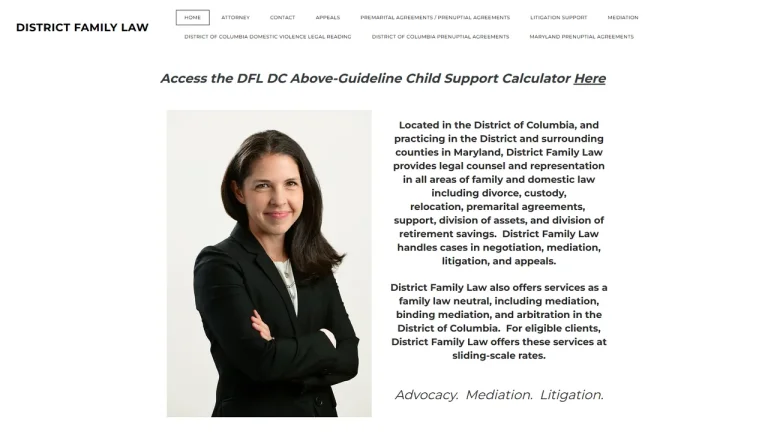
District Family Law - Washington, DC

P. A. Davis Law Office LLC - Washington, DC

Tucker PLLC - Family Law - Washington, DC

Carolyn Goodman, Attorney at Law - Washington, DC

The Law Offices of David Stein - Washington, DC

Volunteer Legal Advocates - Washington, DC

Public Defender Service for the District of Columbia - Washington, DC

Jesse A Gadson Law Offices - Washington, DC

Potomac Family Law - Washington, DC

Jessica T. Ornsby, Esq. - Washington, DC

Open City Advocates - Washington, DC

Capital Family & Divorce Law Group - Washington, DC

Children's Law Center - Washington, DC

Navigating Child Custody and Parental Rights in Washington, D.C.
Child custody determinations in Washington, D.C. center exclusively on the welfare and stability of the child. Custody disputes for District residents are adjudicated within the Family Court Division of the Superior Court of the District of Columbia, situated at the H. Carl Moultrie Courthouse on Indiana Avenue NW. Whether parents reside in Capitol Hill, Georgetown, Petworth, or Anacostia, the court exercises strict oversight over both legal and physical custody arrangements.
District law distinguishes clearly between legal custody, which conveys the authority to make critical life decisions regarding medical care, education, and religious upbringing, and physical custody, which governs where the child resides on a daily basis. Judges within the D.C. Superior Court generally encourage joint custody arrangements that promote active participation from both parents, provided there is no substantiated history of domestic violence or neglect.
Retaining an experienced Washington, D.C. child custody lawyer ensures your case is handled with procedural diligence from initial intake through final disposition. Local family law attorneys regularly guide clients through mandatory alternative dispute programs, including the D.C. Superior Court Multi-Door Dispute Resolution Division, striving to negotiate enforceable parenting agreements that protect your relationship with your children while avoiding protracted courtroom trials.
Washington, D.C. Child Custody Legal Fee Estimates
| Case Scenario | Fee Structure | Estimated Cost (USD) | Key Cost Determinants |
|---|---|---|---|
| Uncontested Custody & Parenting Agreement | Flat Fee / Initial Retainer | $2,000 - $4,500 | Degree of mutual parental cooperation, complexity of holiday visitation schedules, Multi-Door mediation sessions |
| Contested Custody Litigation | Hourly ($350 - $750/hr) | $7,500 - $25,000 | Temporary custody motion practice, witness depositions, formal discovery requests, evidentiary hearings |
| High-Conflict Custody & Guardian ad Litem Evaluation | Retainer + Hourly Rate | $20,000 - $60,000+ | Guardian ad Litem fees, independent psychological evaluations, forensic home studies, multi-day bench trial |
| Post-Judgment Custody Modification | Hourly / Staged Retainer | $3,500 - $10,000 | Substantial change in circumstances evidence, parental relocation disputes, school enrollment alterations |
Critical Custody Deadlines & Statutory Standards in D.C.
Judicial evaluations of custody in the District are governed strictly by the statutory best interests factors codified at D.C. Code § 16-914. The court examines all relevant dynamics, including the child's emotional and developmental needs, the sincerity of each parent's request, the capacity of the parents to communicate effectively, and the child's adjustment to their home, school, and community. Under this same statute, any finding by a preponderance of the evidence that a parent has committed an intrafamily offense creates a rebuttable presumption that joint custody is detrimental to the child.
Jurisdiction over child custody matters is governed by the Uniform Child Custody Jurisdiction and Enforcement Act (UCCJEA), enacted at D.C. Code § 16-4602.01. Under the UCCJEA, the D.C. Superior Court possesses home state jurisdiction only if the child has lived in the District with a parent or person acting as a parent for at least six consecutive months immediately preceding the commencement of the proceeding, or since birth for infants under six months of age.
Once a final custody decree is entered, neither parent can alter the arrangement unilaterally. Under D.C. Code § 16-914(f), a custody order may be modified only upon a showing that a substantial and material change in circumstances has occurred since the entry of the initial order and that modification is in the best interests of the child. Failure to file responsive pleadings within 21 calendar days following service of a custody complaint can result in a default judgment under D.C. Superior Court Family Court Rules.
Multi-Door Mediation vs. Courtroom Family Litigation
Parties filing contested custody actions in the D.C. Superior Court are routinely referred to the Multi-Door Dispute Resolution Division prior to trial scheduling. Through structured mediation, parents attempt to design mutually acceptable parenting schedules with the assistance of a neutral mediator. Informal parenting understandings reached outside court, however, carry no legal authority and cannot be enforced through police assistance or judicial contempt proceedings until formalized into a court-sanctioned consent order.
Proceeding to a contested bench trial pro se introduces severe vulnerabilities. In courtroom litigation, unrepresented parents must conduct formal discovery, examine and cross-examine witnesses under D.C. evidentiary rules, and respond to evaluations performed by court-appointed Guardians ad Litem. Retaining a seasoned child custody lawyer ensures that vital evidence, school records, and testimony are presented persuasively to secure an outcome that safeguards your parental bond.
Red Flags When Choosing a D.C. Custody Attorney
- Attorneys who advocate high-conflict tactics or parental alienation strategies that alienate the Family Court judge and harm the child's emotional well-being.
- Practitioners who guarantee sole legal and physical custody outcomes without reviewing the evidentiary record or acknowledging District statutory preferences for shared parenting.
- Unfamiliarity with D.C. Superior Court Family Court cross-practice rules or the administrative protocols of the Multi-Door Dispute Resolution Division.
- Refusal to provide a clear, written retainer agreement outlining billable hourly increments, administrative costs, and retainer replenishment policies.
Frequently Asked Questions
What is the difference between legal custody and physical custody in Washington, D.C.?
Legal custody under D.C. Code § 16-914 refers to the decision-making power concerning major aspects of the child's life, such as education, healthcare, and religious practices. Physical custody refers to where the child resides and spends their time on a day-to-day schedule.
Does the District of Columbia give preference to mothers over fathers in custody disputes?
No. District law explicitly prohibits gender bias in custody determinations. Under D.C. Code § 16-914(a)(2), both parents enter custody proceedings on equal footing, and judges must decide custody based strictly on the best interests of the child.
What is a Guardian ad Litem (GAL) in a D.C. custody case?
A Guardian ad Litem is an independent attorney appointed by the D.C. Superior Court judge to represent the best interests of the child in contested custody proceedings. The GAL conducts interviews, reviews confidential records, and submits a formal recommendation to the court.
Can a parent relocate outside Washington, D.C. with the child?
A parent cannot relocate outside the District with a child if doing so substantially impairs the other parent's custodial rights under an existing court order. The relocating parent must either obtain written consent from the other parent or petition the D.C. Superior Court for permission under D.C. Code § 16-914.
Can child custody orders be modified in the D.C. Superior Court?
Yes. A custody order may be modified if the moving party proves a substantial and material change in circumstances has occurred since the previous decree and demonstrates that modifying custody serves the child's best interests under D.C. Code § 16-914(f).