
Criminal Defense Lawyers in Washington, D.C.
Securing a skilled Washington, D.C. criminal defense lawyer immediately protects constitutional rights and ensures aggressive advocacy across District courts. Experienced defense counsel often resolves allegations through pre-trial diversion, suppressed evidence motions, and negotiated dismissals before formal trial. Review our directory below to connect with a qualified District attorney for a confidential case review.
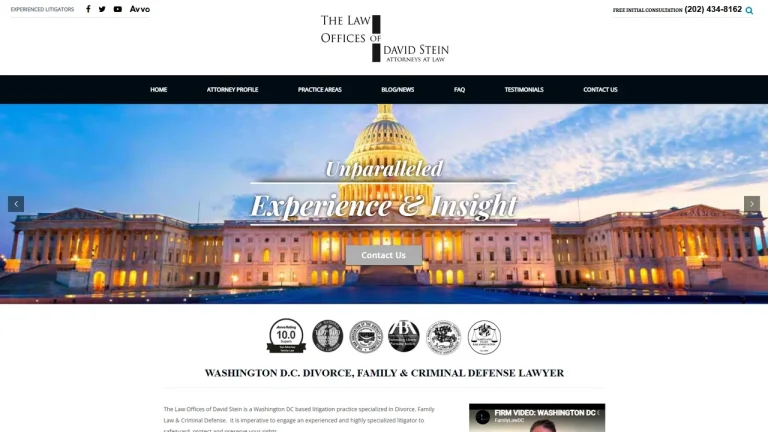
The Law Offices of David Stein - Washington, DC

Abe Legal - Washington, DC
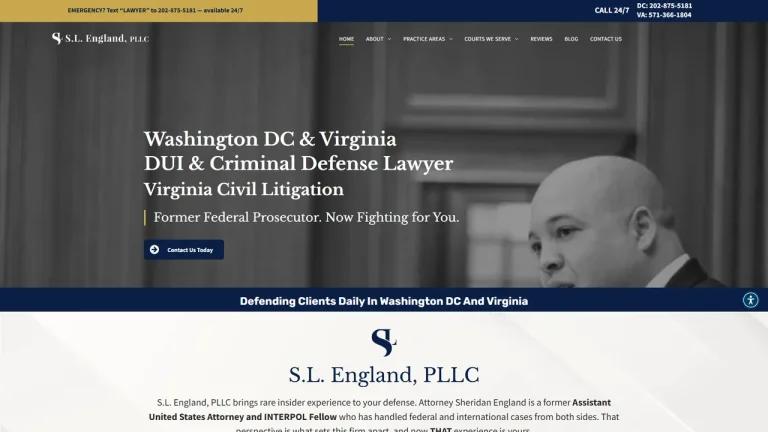
S.L. England, PLLC - Washington, DC

The Nawash Law Office - Washington, DC

Monument Legal - Washington, DC

Brown Rudnick LLP - Washington, DC
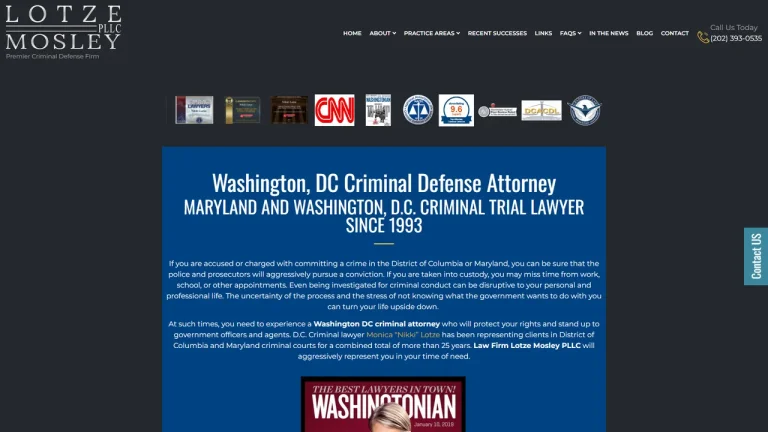
Lotze Mosley PLLC - Washington, DC
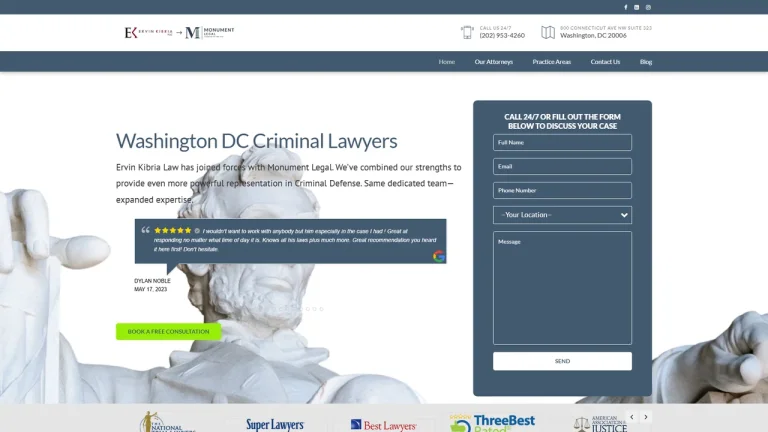
Ervin Kibria Law - Washington, DC
Wagner, PLLC - Washington, DC

Open City Advocates - Washington, DC
Eric Siegel Law - Washington, DC
National Security Law Firm - Washington, DC
The Abraham Law Firm - Washington, DC

Federal Practice Group - Washington, DC
Federal Public Defender - District of Columbia - Washington, DC

Jay P. Mykytiuk, Trial Attorney - Washington, DC

Remus Enterprises Law Group - Washington, DC

Christopher J. Mutimer - Washington, DC
Equal Justice Under Law - Washington, DC

Matthew Wilson Attorney at Law - Washington, DC
Law Office K Lawson Wellington - Washington, DC
Watson & Associates, LLC - Washington, DC

Thorn Law Group - Washington, DC
Understanding Criminal Defense Practice in Washington, D.C.
Facing criminal allegations in Washington, D.C. requires understanding the District's distinct prosecutorial and judicial framework. Unlike any other jurisdiction, criminal prosecutions in the District are split between two distinct authorities: the United States Attorney's Office for the District of Columbia (USAO), which prosecutes all adult felonies and major misdemeanors, and the Office of the Attorney General for the District of Columbia (OAG), which prosecutes municipal violations, juvenile offenses, and traffic crimes such as DUI.
Most local criminal proceedings are adjudicated at the H. Carl Moultrie Courthouse on Indiana Avenue NW, home to the Criminal Division of the Superior Court of the District of Columbia. From initial presentment in Courtroom C-10 through preliminary hearings and jury trials, defendants face rigorous prosecution supported by the Metropolitan Police Department (MPD) and federal law enforcement agencies.
Individuals arrested and detained in the District are processed through the Central Detention Facility (DC Jail) or the Correctional Treatment Facility (CTF) under the oversight of the D.C. Department of Corrections. Retaining experienced defense counsel immediately ensures prompt intervention at initial presentment, effective management with the Pretrial Services Agency for the District of Columbia (PSA), and proactive suppression of unlawfully gathered evidence.
Washington, D.C. Criminal Defense Legal Fee Structures
| Case Scenario | Fee Structure | Estimated Cost (USD) | Key Cost Determinants |
|---|---|---|---|
| First-Offense DUI / Traffic Misdemeanor Defense | Flat Fee Arrangement | $2,500 - $6,000 | Breathalyzer/toxicology validity, field sobriety testing body-worn camera footage, and OAG diversion program eligibility. |
| Domestic Violence & Assault Misdemeanor Defense | Flat Fee / Hourly | $4,000 - $9,000 | Civil Protection Order (CPO) cross-proceedings, witness cooperation, and Deferred Sentencing Agreement (DSA) negotiations. |
| Non-Violent Felony & Narcotics Distribution Defense | Retainer & Hourly Rate | $7,500 - $20,000+ ($400 - $650/hr) | Search warrant legality, fourth amendment suppression hearings, evidentiary discovery volume, and grand jury presentments. |
| Violent Felony & Complex Trial Litigation | Litigation Retainer & Hourly | $15,000 - $50,000+ ($500 - $800/hr) | Preventive detention hearings, ballistics and DNA forensic analysis, expert witness retainers, and multi-week jury trial. |
Critical Legal Deadlines & Statutes in Washington, D.C.
The criminal process in Washington, D.C. is governed by rigorous constitutional and statutory timetables. Under D.C. Code § 23-113, general misdemeanors carry a three-year statute of limitations, while specific non-violent felonies carry a six-year limitations period. Severe offenses, including first-degree murder, armed robbery, and first-degree sexual abuse, have no statute of limitations under District law, permitting prosecution at any time.
Following an arrest by the Metropolitan Police Department, an accused individual must be presented before a magistrate judge in Courtroom C-10 of the Moultrie Courthouse within statutory presentment windows, typically within 24 to 48 hours. If the prosecution files a motion for preventive detention without bail under D.C. Code § 23-1322, the court must conduct a formal detention hearing within three to five business days, during which defense counsel must challenge the government's proffer of dangerousness or flight risk.
For individuals seeking to clear past criminal arrests, the District of Columbia Criminal Record Sealing Act governs statutory eligibility. Under D.C. Code § 16-803, a motion to seal non-conviction records on grounds of actual innocence may be filed at any time, whereas motions to seal eligible misdemeanor or non-violent felony conviction records require waiting periods between two and eight years following the full completion of sentences and supervision.
Small Claims Limits vs. Professional Representation in Washington, D.C.
While the Small Claims and Conciliation Branch of the D.C. Superior Court provides an informal venue for civil monetary disputes up to $10,000 under D.C. Code § 11-1321, it has no authority or jurisdiction over criminal matters. Criminal allegations involve constitutional liberty interests, potential incarceration in the D.C. Jail, and permanent criminal records that cannot be addressed in small claims court.
Facing criminal charges without private counsel or court-appointed counsel is dangerous. Under the Sixth Amendment and District procedural rules, every accused individual has the fundamental right to legal defense. Navigating the bifurcated prosecutorial structure between the USAO and OAG, cross-examining arresting officers, filing motions to suppress unconstitutionally seized evidence, and negotiating dispositions such as the Stet Docket or Deferred Prosecution Agreements require a dedicated defense attorney admitted to the District of Columbia Bar.
Red Flags & Hiring Precautions for Washington, D.C. Legal Counsel
- Guaranteed Dismissals or Trial Outcomes: Rule 7.1 of the D.C. Rules of Professional Conduct strictly prohibits attorneys from promising specific case outcomes; any practitioner guaranteeing an outright dismissal or acquittal should be immediately avoided.
- Immediate Plea Urgency Without Investigation: Beware of defense lawyers who pressure you to enter an early guilty plea at initial presentment without reviewing police body-worn camera footage, grand jury transcripts, or USAO papering documents.
- Lack of Local Moultrie Courthouse Experience: Ensure your defense attorney regularly practices in the D.C. Superior Court Criminal Division and is thoroughly familiar with the local bench, magistrate judges, and Pretrial Services Agency protocols.
- Hidden Fee Structures: Demand a clear, written retainer agreement that explicitly states whether preliminary hearings, trial representation, investigator fees, and expert witness retainers are included in the quoted fee.
Frequently Asked Questions
Who prosecutes criminal charges in Washington, D.C.?
Criminal offenses in the District are prosecuted by two agencies: the United States Attorney's Office for the District of Columbia (USAO), which handles adult felonies and serious misdemeanors, and the Office of the Attorney General for D.C. (OAG), which handles juvenile matters and municipal violations like DUI.
Does Washington, D.C. have a commercial cash bail system?
No. Under the District's bail statute, D.C. Code § 23-1321, commercial cash bail bonds are prohibited. Defendants are either released on personal recognizance under Pretrial Services Agency supervision or held in preventive detention without bond under D.C. Code § 23-1322.
Where are criminal arraignments held in Washington, D.C.?
Adult criminal presentments and arraignments are conducted in Courtroom C-10 at the H. Carl Moultrie Courthouse, located at 500 Indiana Avenue NW in Downtown Washington, D.C.
Can a criminal arrest record be sealed in Washington, D.C.?
Yes. Under D.C. Code § 16-803, eligible non-conviction arrest records and certain non-violent convictions may be sealed through a motion filed with the D.C. Superior Court Criminal Division based on statutory waiting periods or proof of actual innocence.
What is the statute of limitations for misdemeanors in D.C.?
Under D.C. Code § 23-113, most misdemeanor offenses carry a three-year statute of limitations from the date the alleged offense occurred.