
Drug Crime Defense Lawyers in Washington, D.C.
Facing drug crime charges in Washington, D.C. puts your freedom and career at immediate risk under strict local and federal enforcement. Retaining an experienced criminal defense lawyer allows you to challenge unlawful searches, negotiate diversion programs, and avoid severe penalties. Explore our directory below to connect with qualified D.C. defense counsel today.

The Rollins and Chan Law Firm - Washington, DC

Jay P. Mykytiuk, Trial Attorney - Washington, DC
David Benowitz Criminal Lawyer - Washington, DC
EPW Law PLLC - Washington, DC
Ervin Kibria Law - Washington, DC
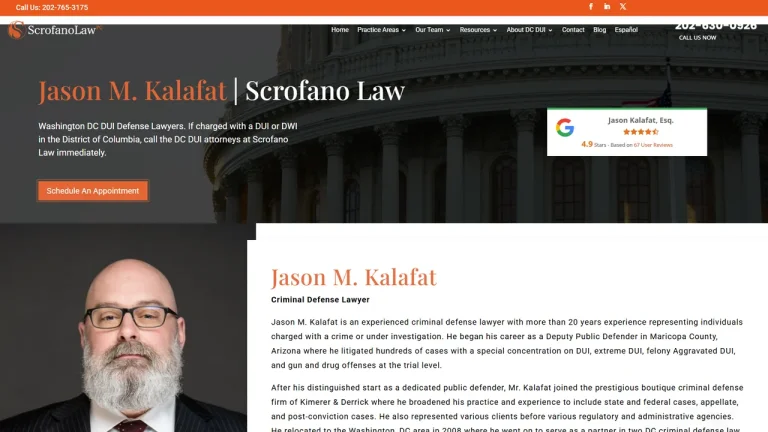
Jason Kalafat, Esq. - Washington, DC

Hannah Akintoye Law, PLLC - Washington, DC
Federal Attorney Rammy Barbari - Washington, DC
Federal Public Defender - District of Columbia - Washington, DC

Matthew Wilson Attorney at Law - Washington, DC
Scrofano Law PC - Washington, DC

Monument Legal - Washington, DC
The Abraham Law Firm - Washington, DC

Thorn Law Group - Washington, DC
Navigating Drug Crime Prosecution in the District of Columbia
Facing narcotics or controlled substance allegations in Washington, D.C. introduces distinct procedural complexities. Unlike standard state jurisdictions, adult criminal prosecutions in the District are primarily spearheaded by the United States Attorney's Office for the District of Columbia (USAO) at the Superior Court of the District of Columbia, located inside the H. Carl Moultrie Courthouse on Indiana Avenue NW.
Arrests initiated by the Metropolitan Police Department (MPD) or federal law enforcement bodies across wards such as Shaw, Columbia Heights, Anacostia, and Downtown D.C. trigger rapid presentment before a magistrate judge. Following an arrest, individuals are evaluated by the D.C. Pretrial Services Agency (PSA), which submits strict release recommendations to the court.
A seasoned D.C. drug defense lawyer understands the intricacies of local prosecution strategies and statutory diversion pathways. Whether asserting Fourth Amendment suppression challenges or pursuing alternatives through the D.C. Superior Court Drug Court, local counsel is essential for mitigating life-altering consequences and preserving professional clearances.
Typical Drug Crime Defense Fee Structures
| Case Scenario | Fee Structure | Estimated Cost (USD) | Key Cost Determinants |
|---|---|---|---|
| Misdemeanor Possession (Simple Possession) | Flat Retainer | $2,500 - $5,000 | Prior criminal history, qualification for D.C. diversion programs, substance schedule classification. |
| Felony Possession with Intent to Distribute (PWID) | Staged Flat Fee / Hourly | $6,000 - $15,000 | Quantity of seized contraband, packaging evidence, cash seizure forfeiture, suppression motion drafting. |
| Complex Federal Narcotics Conspiracy & Distribution | Hourly / Substantial Retainer | $15,000 - $35,000+ | Wiretap discovery analysis, federal sentencing guideline calculations, multi-defendant trial representation. |
| Record Sealing & Expungement (Post-Disposition) | Flat Legal Fee | $1,500 - $3,500 | Statutory waiting periods, actual innocence burden of proof, USAO objection responses. |
Critical Legal Deadlines & Statutes in Washington, D.C.
In the District of Columbia, drug violations are primarily prosecuted under the Controlled Substances Act, codified at D.C. Code § 48-904.01. This statute strictly regulates manufacture, distribution, and possession with intent to distribute (PWID) of controlled substances, imposing severe felony penalties and mandatory minimum incarceration depending on drug schedules and proximity to schools.
Procedural timelines begin immediately following arrest. Under Superior Court Criminal Rules, an arrested individual must be brought before a magistrate judge for presentment within 24 hours. If the government files a motion for preventive detention under D.C. Code § 23-1322, the court may order a five-day continuance before holding a full evidentiary detention hearing, during which the defendant remains in custody at the Central Detention Facility.
For non-violent first-time offenders, early intervention is pivotal. Motions to suppress physical evidence obtained in violation of constitutional protections must be filed within strict pretrial omnibus filing deadlines, typically within 20 to 30 days post-arraignment. Following a dismissal or deferred prosecution agreement, individuals may seek record sealing pursuant to the statutory frameworks of D.C. Code § 16-803.
Small Claims Disconnect vs. Professional Criminal Defense
The Small Claims and Conciliation Branch of the Superior Court of the District of Columbia, authorized under D.C. Code § 11-1321, possesses a monetary jurisdictional limit of $10,000. This division exists solely to arbitrate minor civil grievances, contract breaches, and property disputes. It holds no authority or procedural mechanism to adjudicate criminal complaints, search warrant validity, or penal sanctions.
Criminal drug charges are prosecuted in the Criminal Division of the Superior Court or the U.S. District Court for the District of Columbia. Navigating these courtrooms without legal counsel invites catastrophic legal exposure. The United States Attorney's Office deploys experienced career prosecutors with extensive forensic and investigative resources.
While an individual accused of a crime possesses the constitutional right to proceed pro se, attempting self-representation in drug prosecutions almost invariably results in forfeiture of suppression arguments, miscalculated sentencing exposure, and lasting criminal records. An attorney evaluates police body-worn camera footage, tests chain of custody protocols, and identifies procedural violations that warrant dismissal.
Red Flags & Ethical Safeguards in D.C. Criminal Defense
- Attorneys promising a guaranteed dismissal or guaranteed diversion placement before reviewing police paperwork and laboratory analysis.
- Lawyers who fail to provide a written retainer contract detailing all stages of representation, including motion practice and trial fees.
- Practitioners who urge a quick guilty plea at presentment without thoroughly inspecting body-worn camera footage and search warrant affidavits.
- Counsel lacking direct trial experience within the Criminal Division at the H. Carl Moultrie Courthouse in Washington, D.C.
Frequently Asked Questions
What is the difference between simple possession and possession with intent to distribute (PWID) in D.C.?
Simple possession involves having a controlled substance strictly for personal use, which is treated as a misdemeanor under D.C. Code § 48-904.01(d). Possession with Intent to Distribute (PWID) is a felony under D.C. Code § 48-904.01(a), charged when prosecutors allege that factors such as packaging materials, scales, large amounts of cash, or quantity indicate an intent to sell or transfer the narcotics.
Can marijuana possession still be prosecuted in Washington, D.C.?
Under District initiative laws, adults 21 and older may possess up to two ounces of marijuana for personal use on non-federal land. However, possessing more than two ounces, public consumption, selling marijuana, or possessing any amount on federal land (which constitutes significant portions of D.C., including National Mall parkland and federal installations) remains illegal and subject to criminal prosecution.
What is the D.C. Superior Court Drug Court program?
The Superior Court Drug Court is a specialized, supervised treatment diversion program for non-violent substance-dependent offenders. Successful completion of treatment milestones, regular drug testing, and court appearances can lead to the reduction or complete dismissal of underlying criminal charges without incarceration.
How does the USAO handle preventive detention in D.C. drug cases?
Under D.C. Code § 23-1322, prosecutors from the United States Attorney's Office can request preventive detention without bond for felony drug offenses involving firearms, substantial quantities, or repeat offenders. The court conducts an evidentiary hearing to evaluate flight risk and danger to the community before deciding on release conditions.
Can a drug charge on my D.C. record be sealed or expunged?
Yes. Under D.C. Code § 16-803, individuals may petition the court to seal criminal records. Arrests that did not result in conviction can be sealed on grounds of actual innocence at any time, or under the interests of justice standard after statutory waiting periods. Convictions for certain non-violent misdemeanors may also be eligible for sealing after satisfying statutory timelines.