
Divorce Lawyers in Atlanta
Connect with top-rated divorce lawyers in Atlanta, Georgia to navigate marital dissolution, equitable asset division, alimony, and complex separation decrees. Experienced Fulton County divorce attorneys guide clients through structured negotiation and court-annexed mediation to safeguard financial independence without unnecessary litigation. Review our verified directory below to schedule a confidential consultation with an Atlanta divorce attorney.

Turner & Bowerman, LLC - Attorneys at Law - Atlanta, GA

Tyler Family Law, LLC - Atlanta, GA

McGahren Law Firm, LLC - Atlanta, GA

Law Office of Laquetta S. Pearson, PC - Atlanta, GA

Quantum Law Group - Atlanta, GA
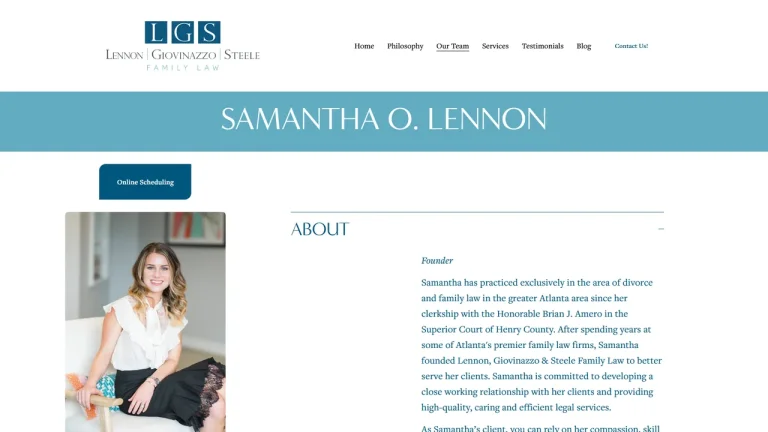
Samantha O. Lennon - Atlanta, GA

Buckhead Family Law - Atlanta Divorce Lawyer - Atlanta, GA

Personal Injury Law Office of Tee Okonkwo, P.C. of Atlanta - Atlanta, GA

Resurgens Legal Counsel - Atlanta, GA

Atlanta Family Law Firm - The Edwards Law Group - Atlanta, GA

Fagan Law Group, LLC - Atlanta, GA

Atlanta Divorce Law Group - Atlanta, GA

Beyah Law, LLC - Atlanta, GA

Perrie and Associates LLC - Atlanta, GA
Allen Meadors, Attorney at Law - Atlanta, GA

Washington Legal Group - Atlanta, GA

Cohan & Levy - Atlanta, GA

Thomas Law and Consulting - Atlanta, GA

Atlanta Family Law Group LLC - Atlanta, GA

NVP Family Law, LLC - Atlanta, GA

KF Law, LLC - Atlanta, GA

Michelle B. Rapoport (Warner Bates) - Atlanta, GA

Williams Oinonen LLC - Atlanta, GA

Strategic Divorce Representation in Atlanta and Fulton County
Navigating the dissolution of marriage in Atlanta involves intricate legal considerations under Georgia domestic relations law. From complex property distribution disputes involving executive compensation in Buckhead and Midtown to family estates in Inman Park and Grant Park, resolving marital conflicts requires assertive negotiation and strategic courtroom advocacy.
Divorce petitions in Atlanta are litigated within the Fulton County Superior Court Family Division, operating from the Lewis R. Slaton Courthouse on Pryor Street SW. Fulton County features a specialized Family Division with designated judges, mandatory 30-day status conferences, and court-annexed alternative dispute resolution overseen by the Fulton County ADR Office. Domestic filings are governed by the Fulton County Standing Order, which automatically freezes marital assets and restrains parties from altering insurance coverage.
Retaining an experienced Atlanta divorce attorney ensures your individual assets, retirement equity, and financial future remain protected. Seasoned domestic counsel prepares compelling financial disclosures, retains forensic accountants when business valuations are contested, and advocates effectively during mediation sessions to secure an equitable settlement outside of court.
Atlanta Divorce Legal Fees & Cost Determinants
| Case Scenario | Fee Structure | Estimated Cost (USD) | Key Cost Determinants |
|---|---|---|---|
| Uncontested Dissolution (Executed Agreement) | Flat Fee | $1,250 - $3,000 | Both parties sign agreement, financial disclosures waived or brief, no court hearing required. |
| Contested Divorce with Real Estate & Asset Tracing | Retainer & Hourly ($300 - $525/hr) | $5,000 - $16,000+ | Separate vs. marital property characterization, residential appraisals in Buckhead or Midtown. |
| Complex Executive Divorce & Alimony Dispute | Retainer & Hourly ($375 - $650/hr) | $12,000 - $40,000+ | Deferred compensation, restricted stock units (RSUs), forensic cash-flow analysis, business valuation. |
| Temporary Hearings & Standing Order Violations | Flat Retainer & Hourly | $3,500 - $8,500 | Enforcing asset freezes, immediate spousal support motions, exclusive marital home possession. |
Critical Legal Deadlines & Statutes in Georgia
Initiating a divorce action in Atlanta requires strict adherence to Georgia statutory timelines. Under O.C.G.A. § 19-5-2, at least one spouse must have been a bona fide resident of Georgia for a continuous period of at least 6 months prior to filing the divorce petition in Superior Court. Georgia recognizes 13 distinct grounds for divorce under O.C.G.A. § 19-5-3, with the vast majority submitted on the no-fault ground that the marriage is irretrievably broken.
For uncontested matters featuring an executed settlement agreement and acknowledgment of service, O.C.G.A. § 19-5-8 permits a Superior Court judge to enter a final decree 31 days after service is completed. When spousal support is disputed, the court evaluates statutory factors under O.C.G.A. § 19-6-5, including financial resources, marriage duration, earning capacity, and standard of living. However, under O.C.G.A. § 19-6-1, a spouse is barred from receiving permanent alimony if the separation was caused by that spouse's adultery or willful desertion, making fault analysis essential during contested financial proceedings.
Fulton Family Division Navigation vs. Pro Se Filing
Under Georgia law, the Fulton County Magistrate Court does not hold jurisdiction over divorce or marital asset division. All dissolution actions must proceed through the Fulton County Superior Court. While unrepresented spouses may attempt to file using standardized self-help forms, proceeding pro se within the Fulton County Family Division presents severe procedural challenges.
Fulton County strictly enforces case management tracks requiring mandatory filing of Domestic Relations Financial Affidavits (DRFA), initial case management conferences, and mandatory mediation within 60 days of service. Pro se litigants frequently miscalculate asset classifications, inadvertently waive rights to executive deferred compensation, or fail to draft compliant Qualified Domestic Relations Orders (QDROs) to divide 401(k) accounts. Hiring an Atlanta divorce attorney ensures strict adherence to court rules and secures enforceable settlement decrees.
Red Flags When Hiring an Atlanta Divorce Lawyer
- Attorneys who guarantee precise asset split percentages or alimony outcomes before completing formal financial discovery.
- Lawyers who intentionally inflame spousal conflicts to inflate billable hours instead of utilizing Fulton County ADR mediation.
- Firms lacking familiarity with the specific standing orders and case management timelines enforced by Fulton Family Division judges.
- Attorneys who fail to explain the tax consequences of real estate equity transfers and the division of retirement portfolios under Georgia law.
Frequently Asked Questions
What is the residency requirement to file for divorce in Atlanta?
Pursuant to O.C.G.A. § 19-5-2, either you or your spouse must have maintained bona fide residency in Georgia for at least 6 consecutive months immediately prior to filing the divorce petition in the Fulton County Superior Court.
How does Georgia divide marital property during a divorce?
Georgia follows the equitable distribution principle. The court divides marital property acquired during the marriage fairly and equitably based on marital contributions, economic circumstances, and conduct, which does not necessarily mean an automatic 50/50 division.
Does adultery affect alimony awards in Atlanta divorce proceedings?
Yes. Under O.C.G.A. § 19-6-1, a spouse is barred from receiving alimony if the court finds by a preponderance of the evidence that the marital separation was caused by that spouse's adultery or willful desertion.
What is the Fulton County Standing Order on Domestic Relations?
The Fulton County Standing Order is an automatic court order triggered upon filing that freezes marital assets, bars transferring or hiding property, prohibits canceling insurance policies, and prevents removing children from the court's jurisdiction.
How fast can an uncontested divorce be finalized in Atlanta?
Under O.C.G.A. § 19-5-8, an uncontested divorce with a fully executed settlement agreement and an acknowledgment of service can be signed and finalized by a Superior Court judge 31 days after the respondent has acknowledged service.