
Business Litigation Lawyers in Georgia
Commercial disputes in Georgia threaten corporate assets. Connect with top Georgia business litigation lawyers to resolve complex lawsuits and protect equity. Experienced trial attorneys represent enterprises in shareholder disputes, trade secret claims, and breach of fiduciary duty actions across Georgia courts. Explore our directory below to consult an accomplished Georgia business litigator today.

Property Claims Litigation Group LLC - Atlanta, GA

Burr and Forman LLP - Atlanta, GA

Parker Hudson - Atlanta, GA

The Law Office of S. Lamar Gardner, LLC - Atlanta, GA

Bloom Parham, LLP - Atlanta, GA

McDermott Will & Emery - Atlanta, GA

Drew Eckl & Farnham, LLP - Augusta, GA

Benjamin Wallace, Bankruptcy Attorney - Columbus, GA
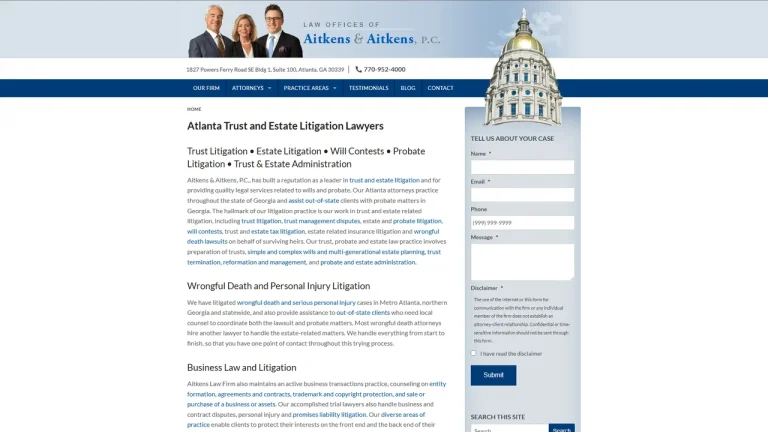
Aitkens and Aitkens, P.C. - Atlanta, GA

Travers W. Paine III, PC - Augusta, GA
Mayers Law Firm, LLC - Augusta, GA

GA Eminent Domain Law Firm - Sandy Springs, GA

Downs Law, LLC - Atlanta, GA

Drew Eckl and Farnham, LLP - Atlanta, GA
Peavy Law, LLC - Atlanta, GA

Arrington | Owoo PC - Atlanta, GA

KF Law, LLC - Atlanta, GA

Buchalter - Atlanta, GA

Clark, Smith & Sizemore LLC - Macon, GA

Davis Lawyers LLC - Atlanta, GA

Terry Group, PLLC - Atlanta, GA

Knowles Gallant Timmons LLC - Atlanta, GA

The Elevation Law Firm, LLC - Atlanta, GA

The Georgia Statewide Business Court & Commercial Litigation Forums
Complex commercial disputes in Georgia are adjudicated in sophisticated judicial venues designed to resolve high-stakes corporate warfare. Major commercial litigation is heard across Georgia Superior Courts, which hold exclusive jurisdiction over equitable relief, corporate dissolutions, and fiduciary claims under O.C.G.A. § 15-6-8. In addition, Georgia established the specialized Georgia Statewide Business Court under O.C.G.A. § 15-5A-1 et seq., providing an expedited, business-focused forum for complex commercial matters with claims of at least $1,000,000 (or $500,000 for commercial real property disputes).
Business litigation spans a wide range of corporate conflict, including shareholder derivative actions under O.C.G.A. § 14-2-740, LLC member squeeze-outs under the Georgia LLC Act, breaches of fiduciary duty under O.C.G.A. § 14-11-305, and misappropriation of proprietary technology under the Georgia Trade Secrets Act codified at O.C.G.A. § 10-1-760 et seq. Major commercial hubs-such as the Fulton County Superior Court Business Court Division in Atlanta, and courts in Savannah, Columbus, and Augusta-regularly manage emergency motions for temporary restraining orders (TROs) and interlocutory injunctions.
Successfully navigating commercial litigation requires counsel with extensive trial experience and a deep understanding of Georgia corporate jurisprudence. Retaining an accomplished business litigator ensures rapid motion practice, vigorous e-discovery management, and strategic positioning to secure summary judgment or prevail at trial.
Georgia Business Litigation Fee Structures & Case Scenarios
| Case Scenario | Fee Structure | Estimated Cost (USD) | Key Cost Determinants |
|---|---|---|---|
| Emergency Injunction & TRO (Trade Secrets/Non-Compete) | Hourly Retainer ($400 - $750/hr) | $7,500 - $25,000 | Evidentiary hearing speed, forensic electronic audits, witness affidavits, and verified complaint drafting. |
| Shareholder Derivative Suit or LLC Member Squeeze-Out | Hourly Retainer ($450 - $800/hr) | $20,000 - $75,000+ | Forensic accounting, statutory demand compliance under Title 14, valuation expert reports, and mediation. |
| Georgia Statewide Business Court Commercial Action | Hourly ($500 - $900/hr) or Hybrid | $35,000 - $120,000+ | $1M+ amount in controversy, specialized procedural case management, extensive depositions, and expert testimony. |
| Commercial Contract Breach & Statutory Bad-Faith Litigation | Hourly Retainer ($400 - $700/hr) | $15,000 - $50,000 | Discovery motion practice, summary judgment briefs, and statutory fee claims under Section 13-6-11. |
Critical Legal Deadlines & Statutes in Georgia
Procedural deadlines in Georgia civil litigation are rigid and carry severe consequences if neglected. Under O.C.G.A. § 9-11-12(a), a defendant served with a civil complaint must file an answer within strictly thirty calendar days. If an answer is not filed, the case enters default; under O.C.G.A. § 9-11-55(a), the defendant has an automatic statutory right to open the default as of right within fifteen days upon payment of accrued costs, after which default judgment may be entered.
For substantive commercial torts, actions for misappropriation of trade secrets under the Georgia Trade Secrets Act must be brought within five years after discovery pursuant to O.C.G.A. § 10-1-766. Fraud and tortious interference with business relations carry a four-year limitations period under O.C.G.A. § 9-3-31. Furthermore, in shareholder derivative actions, O.C.G.A. § 14-2-742 requires a plaintiff to make a formal written demand upon the corporation and wait ninety days before initiating suit, unless waiting would result in irreparable harm.
Magistrate Court Limitations vs. High-Stakes Business Litigation
Georgia Magistrate Courts operate with a jurisdictional limit capped at $15,000 pursuant to O.C.G.A. § 15-10-2(5). Magistrate Courts possess zero authority to hear equitable claims, order emergency freezes on corporate bank accounts, issue injunctions, or rule on complex corporate dissolution suits.
Commercial litigation frequently involves existential business risks, millions of dollars in damages, and intricate fiduciary duties under the Georgia Business Corporation Code. Attempting to manage business litigation pro se or without specialized trial counsel can be catastrophic; under Georgia law, corporations and LLCs cannot even be represented by non-lawyer officers in Superior Court. Engaging seasoned business litigation counsel protects corporate equity, leverages statutory bad-faith fee recovery under O.C.G.A. § 13-6-11, and ensures robust advocacy before Georgia judges.
Red Flags When Hiring a Georgia Business Litigation Lawyer
- Attorneys who fail to meet the strict thirty-day answer deadline under O.C.G.A. § 9-11-12, allowing the company to fall into statutory default.
- Lawyers who initiate a shareholder derivative lawsuit without satisfying the mandatory ninety-day written demand rule required by O.C.G.A. § 14-2-742.
- Firms lacking experience appearing before the Georgia Statewide Business Court or county Superior Court commercial divisions.
- Litigators who fail to plead statutory bad faith under O.C.G.A. § 13-6-11 to preserve client recovery of legal fees against stubborn and litigious opponents.
Frequently Asked Questions
What is the jurisdiction of the Georgia Statewide Business Court?
Established under O.C.G.A. § 15-5A-1, the Georgia Statewide Business Court hears complex commercial cases with claims of at least $1,000,000 (or $500,000 for commercial real estate), providing specialized judicial oversight and accelerated management.
How long does a defendant have to answer a lawsuit in Georgia?
Under O.C.G.A. § 9-11-12(a), a defendant has thirty calendar days to file an answer. If missed, the defendant has an automatic right to open default within fifteen days by paying court costs under O.C.G.A. § 9-11-55(a).
What is the prerequisite for filing a shareholder derivative action in Georgia?
Under O.C.G.A. § 14-2-742, a shareholder must make a written demand on the corporation and wait ninety days before filing suit, unless the demand was rejected earlier or irreparable injury would occur.
What is the statute of limitations for trade secret misappropriation in Georgia?
Pursuant to O.C.G.A. § 10-1-766, an action under the Georgia Trade Secrets Act must be brought within five years from the date the misappropriation was discovered or should have been discovered.
Can a non-lawyer business owner represent their company in Georgia Superior Court?
No. Under Georgia law, while individuals can represent themselves pro se in Magistrate Court, corporations and LLCs must be represented by a licensed attorney in Georgia State, Superior, and Business Courts.