
DUI/DWI Defense Lawyers in Hawaii
Retaining a proven Hawaii DUI lawyer protects your driving privileges and liberty against severe statutory penalties. Experienced local defense attorneys challenge breathalyzer calibrations, contest administrative license revocations, and seek case dismissals before trial. Browse our statewide directory to connect with a qualified Hawaii defense practitioner today.

Law Office of Guy Matsunaga Honolulu, HI
Law Office of Jason Z. Say, LLLC - Honolulu, HI

J.T. Kim, Attorney at Law, LLLC - Honolulu, HI

The Law Office of R. Patrick McPherson - Honolulu, HI

The Law Office of Victor Bakke, ALC - Honolulu, HI
The Law Office of R. Patrick McPherson Honolulu, HI

Timothy I. MacMaster - Honolulu, HI
Sapolu Law Office - Honolulu, HI

Michael Fayard, Criminal Defense Attorney Honolulu, HI

Myron H. Takemoto, Attorney At Law - Honolulu, HI

Law Office of Dean C.M. Hoe Honolulu, HI
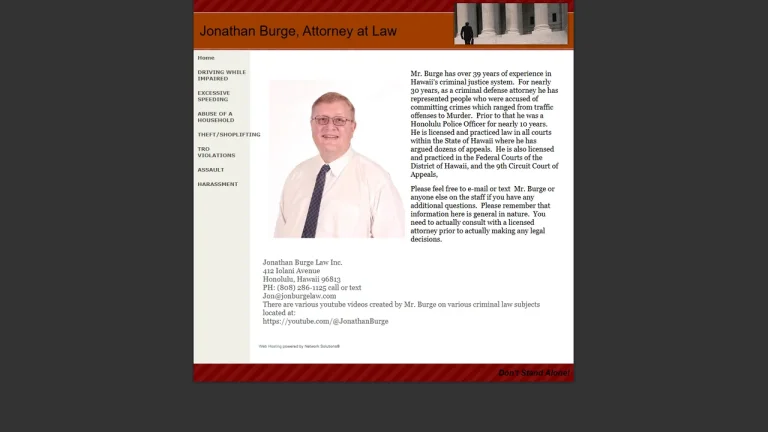
Jonathan Burge, Attorney At Law - Honolulu, HI

Law Office Of James B. Lewis PA - Honolulu, HI
Law Offices of Noah Fiddler - Honolulu, HI
Richard D Gronna Attorney At Law - Honolulu, HI
Law Offices of Steve Cedillos - Honolulu, HI
Office of the Public Defender - State of Hawaii - Honolulu, HI
Law Office of Myles S. Breiner - Honolulu, HI
William Li Attorney At Law - Honolulu, HI
Law Office of Kyle T. Dowd, LLLC - Honolulu, HI

The Law Office of Kevin O'Grady, LLC - Honolulu, HI
James Lewis - Honolulu, HI

Law Office of Jason R. Burks - Honolulu, HI

Hawaii OVUII Law & Circuit Court Trial Framework
In Hawaii, drunk driving offenses are formally classified as Operating a Vehicle Under the Influence of an Intoxicant (OVUII). Unlike jurisdictions with fractured local court systems, Hawaii administers criminal traffic matters through a unified judiciary organized into four geographical circuits. Whether an arrest takes place on the bustling roads of Oahu or across the more remote highways of Maui, Hawaii Island, or Kauai, defendants face severe administrative and criminal sanctions enforced by state prosecutors.
Misdemeanor and petty misdemeanor OVUII offenses originate in the District Court of the respective circuit: the First Circuit in Honolulu, the Second Circuit in Wailuku, the Third Circuit in Hilo and Kona, and the Fifth Circuit in Lihue. If a defendant demands a jury trial or faces felony habitual charges, jurisdiction transfers to the Circuit Court. Court filings, motions to suppress evidence, and appearance notices are recorded through the state digital platform, the Judiciary Electronic Filing and Service System (JEFS). Retaining an attorney admitted to the Hawaii State Bar Association ensures your defense adheres to localized courtroom procedures and judicial expectations.
An OVUII arrest triggers two distinct proceedings: the criminal case before the court and an immediate civil administrative action before the Administrative Driver's License Revocation Office (ADLRO). Navigating both tracks requires skilled legal advocacy to subpoena arresting officers, evaluate standardized field sobriety testing protocols, and challenge blood alcohol concentration (BAC) test results obtained through evidentiary breath machines.
Hawaii OVUII Defense Fee Structures & Representation Costs
| Case Scenario | Fee Structure | Estimated Cost (USD) | Key Cost Determinants |
|---|---|---|---|
| First-Time OVUII (Standard BAC / No Collision) | Flat Legal Fee | $2,500 - $5,000 | District Court pretrial hearings, plea bargaining, police bodycam video review, ADLRO hearing representation. |
| ADLRO License Revocation Hearing Only | Flat Fee / Hourly Hybrid | $1,000 - $2,500 | Subpoenaing the arresting officer, drafting administrative briefs, challenging calibration logs. |
| Repeat Offense or Elevated BAC (Above 0.15) | Flat Fee / Staged Retainer | $4,500 - $9,000 | Mandatory minimum jail time exposure, ignition interlock device defense, contested evidentiary hearings. |
| Felony Habitual OVUII (Circuit Court Jury Trial) | Retainer + Trial Per Diem | $8,500 - $25,000+ | Grand jury defense, toxicology expert witness retention, jury selection, comprehensive motion practice. |
Critical Legal Deadlines & Statutes in Hawaii
Time is of the essence following an intoxicated driving arrest in Hawaii due to strict statutory timelines governing both administrative driver licensing and criminal procedure. The primary criminal statute is Haw. Rev. Stat. § 291E-61, which prohibits operating a vehicle with a blood or breath alcohol concentration of 0.08 or higher, or while impaired by any intoxicant. A first-time conviction carries mandatory substance abuse assessments, license revocation, community service or jail time, and the mandatory installation of an ignition interlock device under Haw. Rev. Stat. § 291E-62.
Parallel to the court process, drivers face automatic administrative license suspension administered by the ADLRO pursuant to Haw. Rev. Stat. § 291E-31. Following arrest, an individual receives a temporary permit valid for only 30 days. To contest this revocation, a respondent must submit a written request for an ADLRO administrative hearing within six days of receiving the notice of administrative review decision, or three days after the temporary driving permit expires. Failing to meet this administrative deadline results in immediate and unappealable license revocation.
Under the state implied consent statute, Haw. Rev. Stat. § 291E-11, refusing to submit to a chemical test of breath, blood, or urine leads to extended administrative revocation periods that cannot be reduced through early ignition interlock permits. For the criminal charge itself, the procedural clock is governed by Rule 48 of the Hawaii Rules of Penal Procedure (HRPP), which mandates that criminal charges must be brought to trial within six months (180 days) of arrest or citation, excluding statutory tolling periods. The general statute of limitations for non-felony traffic offenses is one year under Haw. Rev. Stat. § 701-108.
Self-Representation Risks in Hawaii District Courts
Individuals charged with an OVUII sometimes contemplate self-representation in District Court to avoid legal fees, mistakenly viewing an impaired driving citation as a routine traffic infraction. In reality, OVUII is a serious criminal offense that establishes a permanent criminal record upon conviction. Pro se defendants rarely possess the technical knowledge required to challenge the precision of the Intoxilyzer instruments utilized by island police departments or cross-examine officers regarding the subjective interpretation of field sobriety tests.
Retaining experienced defense counsel ensures all technical and constitutional defenses are leveraged. A knowledgeable attorney scrutinizes the reasonable suspicion underlying the initial traffic stop, files motions to suppress evidence obtained through unlawful roadside questioning, and represents your interests at the ADLRO hearing to pursue conditional driving permits. When mandatory minimum sentences or license revocations threaten your employment, professional representation is indispensable.
Red Flags When Hiring a Hawaii DUI Defense Lawyer
- Guaranteed Case Dismissals: Any attorney who promises an outright dismissal or acquittal before reviewing the police reports and toxicological calibration logs is violating Hawaii ethical standards.
- Unfamiliarity with ADLRO Administrative Procedures: Defense lawyers who focus only on the courtroom proceedings while ignoring the ADLRO license hearing may cost you your legal ability to drive for an entire year.
- Mainland Firms Lacking Island Court Standing: Out-of-state referral networks often lack licensed attorneys physically based on Oahu, Maui, or the Neighbor Islands, complicating personal court appearances.
- Failure to Challenge Technical Testing Equipment: Be wary of counsel who routinely urges immediate guilty pleas without inspecting the maintenance records and certifications of the breath testing device.
Frequently Asked Questions
What is the legal difference between DUI and OVUII in Hawaii?
In Hawaii, DUI is legally designated as Operating a Vehicle Under the Influence of an Intoxicant (OVUII) under Haw. Rev. Stat. § 291E-61. The terms are used interchangeably by the public, but the charge covers both alcohol and drug-induced impairment.
What is the ADLRO and how does it affect my driver's license?
The Administrative Driver's License Revocation Office (ADLRO) is the civil agency that revokes driving privileges independently of the criminal court under Haw. Rev. Stat. § 291E-31. You must request a formal administrative hearing within days of your arrest decision to contest the revocation.
Can I get a conditional driving permit during an OVUII revocation in Hawaii?
Yes, eligible drivers can often obtain an Ignition Interlock Device (IID) permit under Haw. Rev. Stat. § 291E-62, allowing them to operate vehicles equipped with an approved interlock system during the revocation period, provided they did not unlawfully refuse chemical testing.
Is an OVUII considered a criminal misdemeanor in Hawaii?
A first-offense OVUII without aggravating factors is generally classified as a petty misdemeanor, carrying up to five days of jail time, mandatory fines, and community service. Repeat offenses within a ten-year window carry escalated misdemeanor and felony penalties.
What happens if I refuse a breathalyzer test in Hawaii?
Under the implied consent law in Haw. Rev. Stat. § 291E-11, refusing chemical testing results in immediate civil driver's license revocation for a minimum of one to two years without the option of an early ignition interlock permit for the first six months.