
IRS Dispute Lawyers in Hawaii
Resolving an IRS tax controversy in Hawaii requires proactive legal defense to protect your assets and halt aggressive collection measures. Experienced tax attorneys manage direct negotiations with federal examiners to settle audits, remove federal liens, and abate penalties. Review our directory below to connect with local counsel practicing across Oahu, Maui, Kauai, and the Big Island.

Hawaii Debt Solutions - Honolulu, HI
Affinity Law Group LLLC - Honolulu, HI
Tsugawa Lau and Muzzi LLLC - Honolulu, HI

Allen N. Davey LLC, Attorney at Law, CPA - Honolulu, HI

Gilbert Employment Law, P.C. - Honolulu, HI
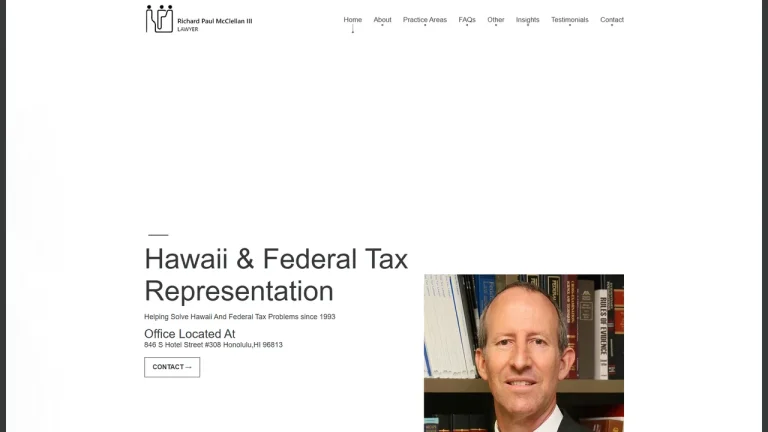
Richard Paul McClellan III, Tax Attorney - Honolulu, HI

Blake Goodman, PC, Bankruptcy & Debt Settlement Attorneys - Honolulu, HI
AB Tax Law APC - Honolulu, HI

Federal Tax Controversy Resolution Across the Hawaiian Islands
Taxpayers in Hawaii dealing with Internal Revenue Service examinations, unfiled returns, or enforcement actions navigate federal administrative processes distinct from local county affairs. Federal tax administration in the state centers around the IRS Local Office in Honolulu, which oversees audits, collection investigations, and summons compliance for individuals and businesses operating across Oahu, Maui, Kauai, and Hawaii County.
When administrative appeals within the IRS Independent Office of Appeals fail to resolve a disputed deficiency, judicial litigation takes place before the United States Tax Court or the United States District Court for the District of Hawaii, located at the Prince Jonah Kuhio Kalanianaole Federal Building in Honolulu. The U.S. Tax Court periodically schedules special trial sessions in Honolulu to hear cases involving Hawaii residents.
Federal tax litigation requires legal counsel admitted to the Hawaii State Bar Association, the United States District Court for the District of Hawaii, and the United States Tax Court. Local attorneys leverage deep familiarity with regional economic realities, cost-of-living standards, and judicial procedures to safeguard taxpayer rights against federal tax levies, wage garnishments, and statutory penalties.
Estimated Legal Fees and Defense Costs for Federal IRS Disputes
| Case Scenario | Fee Structure | Estimated Cost (USD) | Key Cost Determinants |
|---|---|---|---|
| IRS Audit Defense (Correspondence / Office Exam) | Hourly Rate ($350 - $600/hr) | $2,500 - $7,500 | Number of tax years audited, complexity of Schedule C business deductions, and substantiation documentation availability. |
| Collection Due Process (CDP) & Lien Relief | Retainer + Hourly Rate | $3,500 - $9,000 | Urgency of bank levy or wage garnishment, lien subordination requirements, and preparation of Form 12153 hearings. |
| Offer in Compromise (OIC) Submission | Flat Fee or Staged Retainer | $4,000 - $8,500 | Reasonable Collection Potential (RCP) calculations, equity in Hawaii real estate, and future earning capacity evaluations. |
| United States Tax Court Petition & Litigation | Retainer + Hourly Billing | $10,000 - $30,000+ | Pre-trial stipulation complexity, expert accounting testimony, motion practice, and calendar call representation in Honolulu. |
Critical Legal Deadlines & Federal Tax Statutes
Federal tax law imposes unyielding statutory timelines that govern taxpayer appeals and enforcement limitations. When the IRS issues a Notice of Deficiency (90-day letter), the taxpayer has strictly 90 days from the mailing date to petition the United States Tax Court pursuant to 26 U.S. Code § 6213(a). This deadline is jurisdictional and cannot be extended by IRS agents or judicial discretion; failure to file within 90 days forfeits pre-payment judicial review.
Taxpayers seeking to challenge proposed levies or liens must file a Collection Due Process request within 30 days under 26 U.S. Code § 6330 using IRS Form 12153. For standard tax assessments, the IRS must assess taxes within three years after the return is filed pursuant to 26 U.S. Code § 6501(a), which extends to six years under 26 U.S. Code § 6501(e) if substantial omissions exceed 25 percent of gross income. The federal collection statute expiration date limits enforcement to ten years from assessment under 26 U.S. Code § 6502(a).
Small Claims Limitations vs. Federal Tax Jurisdiction
State small claims courts in Hawaii, which operate with a $5,000 statutory limit under Haw. Rev. Stat. § 633-27, have no authority to hear disputes involving federal tax liabilities. Under the principle of sovereign immunity and federal jurisdictional statutes codified in 28 U.S. Code § 1340, exclusive jurisdiction over federal tax controversies belongs to the United States Tax Court, the United States Court of Federal Claims, and federal district courts.
In the United States Tax Court, individuals with disputed amounts under $50,000 may elect simplified "Small Tax Case" procedures pursuant to 26 U.S. Code § 7463. While this procedure features informal evidentiary rules, decisions rendered in small tax cases are final and cannot be appealed to the United States Court of Appeals. Consequently, taxpayers facing substantial tax liabilities or complex statutory penalties require professional representation to preserve all avenues of appellate relief.
Red Flags When Retaining an IRS Dispute Attorney
- Out-of-state telemarketing firms guaranteeing immediate tax debt elimination through federal "fresh start" programs without evaluating real property equity in Hawaii.
- Representatives demanding full non-refundable fees upfront without conducting a thorough analysis of IRS master transcripts or statutory collection expiration dates.
- Practitioners lacking admission to practice before the United States Tax Court or the United States District Court for the District of Hawaii.
- Advisors who fail to address parallel state tax liabilities with the Hawaii Department of Taxation that inevitably arise following federal audit adjustments.
Frequently Asked Questions
Where are United States Tax Court trials held for Hawaii taxpayers?
The United States Tax Court conducts periodic trial sessions in Honolulu at the federal courthouse, allowing Hawaii taxpayers to litigate their disputes locally rather than traveling to Washington, D.C.
How does an attorney halt an active IRS bank levy or wage garnishment?
An attorney can halt collection activity by requesting a Collection Due Process hearing under 26 U.S. Code § 6330 within 30 days of notice, proving economic hardship under 26 U.S. Code § 6343, or submitting an Offer in Compromise or installment agreement proposal.
How does real estate equity in Hawaii affect an Offer in Compromise?
The IRS calculates a taxpayer's Reasonable Collection Potential by factoring in the quick sale equity of real property. Due to high real estate values across Hawaii, taxpayers often require an attorney to negotiate proper asset valuations, allowances, and encumbrances to secure an acceptable settlement.
What is the difference between an enrolled agent, a CPA, and an IRS dispute attorney?
While CPAs and enrolled agents prepare returns and represent clients in routine administrative audits, only licensed attorneys can invoke attorney-client privilege under 26 U.S. Code § 7525 for criminal tax inquiries and provide formal trial representation in federal court.
Does an IRS audit adjustment impact my Hawaii state taxes?
Yes. Under Hawaii law, taxpayers must report federal tax adjustments to the Hawaii Department of Taxation. An adverse federal audit outcome generally triggers a corresponding state assessment for General Excise Tax or state income tax.