
Divorce & Family Law Lawyers in Idaho
Retaining an experienced Idaho family law attorney ensures your parental rights and community property interests are protected under state statutes. Dedicated legal counsel frequently resolves disputes through out-of-court mediation and negotiated settlements, avoiding bitter and costly courtroom battles. Explore our directory below to schedule a consultation with a compassionate, verified Idaho lawyer.
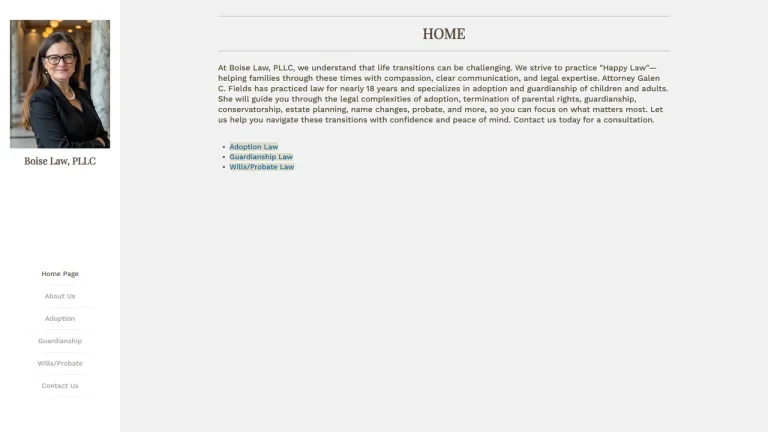
Boise Law, PLLC - Boise, ID

Anderson Law Offices - Nampa, ID

William H Wellman - Attorney at Law - Nampa, ID

Vail Family Law PLLC - Meridian, ID

Morris Bower & Haws PLLC - Nampa, ID

Sperry Law Office, PLLC - Boise, ID
The Cox Law Firm, PLLC - Boise, ID

Naugle Law Offices Boise, ID

Nampa Divorce Lawyer - ID

Charlton Law Boise, ID

That Attorney Guy PLLC - Nampa, ID

Baldwin Law, PLLC - Meridian, ID

Boise Attorney Group - Meridian, ID

Miller Law PLLC - Nampa, ID

Joe Frick Law, PLLC Boise, ID

Barnum Law PLLC - Boise, ID

Boise Law Group, PLLC - Boise, ID

Roedel Law Offices - Boise, ID

Bublitz Law, P.C. - Boise, ID

Hardee, Piñol & Kracke PLLC - Boise, ID

Cosho Humphrey, LLP - Boise, ID

Law/Alternatives/PLLC Boise, ID

Barrera Legal Group Idaho - Meridian, ID
Guiding Families Through Idaho Domestic Relations Jurisdictions
Navigating marital dissolution, parental rights, and asset distribution involves emotional stress and complex legal choices. In Idaho, domestic relations cases are governed by comprehensive family statutes administered through the Magistrate Division of the District Court, designed to protect children and establish equitable financial independence.
Idaho's judicial system operates across seven judicial districts covering forty-four counties. Family proceedings are filed in the county of residence, with prominent dockets managed in the Fourth Judicial District (Ada County in Boise), the Third Judicial District (Canyon County in Caldwell), the First Judicial District (Kootenai County in Coeur d'Alene), and the Seventh Judicial District (Bonneville County in Idaho Falls). Complex appeals progress to the District Court, the Idaho Court of Appeals, or the Idaho Supreme Court.
Resolving family controversies effectively requires legal representation licensed by the Idaho State Bar. Knowledgeable family lawyers utilize the statewide iCourt system to handle mandatory disclosures, navigate court-connected mediation, and advocate for clients during evidentiary hearings before magistrate judges.
Idaho Divorce & Family Law Fee Structures and Cost Benchmarks
| Case Scenario | Fee Structure | Estimated Cost (USD) | Key Cost Determinants |
|---|---|---|---|
| Uncontested Divorce (No Minor Children) | Flat Fee or Modest Retainer | $1,500 - $3,500 | Consensus on community property division, debt allocation, and prompt execution of marital settlement paperwork. |
| Contested Child Custody & Parenting Plan Dispute | Hourly Rate ($275 - $500/hr) | $6,000 - $20,000+ | Court-ordered custody evaluations, mediation sessions, guardian ad litem involvement, and contested temporary hearings. |
| High-Asset Community Property Dissolution | Retainer + Hourly Billing | $12,000 - $40,000+ | Forensic accounting, real estate and agricultural land appraisals, business valuations, and Qualified Domestic Relations Orders (QDROs). |
| Post-Decree Custody or Child Support Modification | Hourly Rate ($275 - $450/hr) | $2,500 - $8,000 | Demonstrating a substantial and material change in circumstances, parental relocation disputes, and recalculated income disclosures. |
Critical Legal Deadlines & Statutes in Idaho
Parties entering family law proceedings in Idaho must comply with strict jurisdictional timelines and statutory mandates. Before a court can grant a decree of divorce, the filing party must have resided continuously in Idaho for at least six full weeks (forty-two days) immediately prior to filing the petition pursuant to Idaho Code § 32-701. This is one of the shortest residency requirements in the United States.
Upon being served with a divorce petition and summons, the respondent has strictly twenty days to file a formal written response or answer under the Idaho Rules of Family Law Procedure. In dividing assets, Idaho is a community property state: all property acquired during marriage is presumed community property to be divided substantially equally under Idaho Code § 32-906 and Idaho Code § 32-912, while separate property acquired before marriage or by gift is protected under Idaho Code § 32-903. Child custody determinations are strictly governed by the best interests of the child standard under Idaho Code § 32-717, and child support calculations must follow statutory guidelines established under Idaho Code § 32-706. Spousal maintenance awards are evaluated under factors set forth in Idaho Code § 32-705.
Small Claims Court Restrictions vs. Magistrate Family Jurisdiction
The Small Claims Department of the Magistrate Division in Idaho operates with a $5,000 monetary ceiling under Idaho Code § 1-2301. However, small claims courts are strictly barred from presiding over any domestic relations matters. Under Idaho Code § 1-2210, jurisdiction over divorce, legal separation, child custody, child support, and adoption is reserved exclusively for the formal Magistrate Division of the District Court.
Attempting to handle domestic relations disputes without an attorney exposes parties to serious risks, including permanent forfeiture of community property rights, unfavorable parenting schedules, and miscalculated support orders. An experienced Idaho family lawyer ensures that all financial affidavits are meticulously audited, marital debts are equitably assigned, and parenting agreements establish durable safeguards for your children.
Red Flags When Selecting an Idaho Family Law Attorney
- Attorneys who make unrealistic guarantees regarding sole physical custody or specific child support amounts prior to completing formal financial discovery.
- Practitioners who needlessly escalate hostility between co-parents to generate excessive billable hours rather than seeking constructive mediation.
- Lawyers who lack familiarity with Idaho community property statutes, risking improper commingling of your separate premarital assets.
- Vague retainer contracts that obscure hourly rates, minimum billing increments, or fees charged for paralegal administrative tasks.
Frequently Asked Questions
What are the legal grounds for divorce in Idaho?
Most divorces in Idaho proceed on no-fault grounds based on irreconcilable differences pursuant to Idaho Code § 32-610. Fault-based grounds such as extreme cruelty, adultery, or willful desertion are also recognized under Idaho Code § 32-603, but are less commonly utilized.
How is property divided in an Idaho divorce?
Idaho is a community property state under Idaho Code § 32-906. Courts presume that all real and personal property acquired during the marriage belongs equally to both spouses and should be divided equally, unless compelling factors warrant an unequal distribution.
How long do you have to live in Idaho before filing for divorce?
Under Idaho Code § 32-701, the filing spouse must have been a resident of Idaho for at least six full weeks (forty-two days) immediately preceding the commencement of the divorce action.
How do Idaho courts determine child custody arrangements?
Child custody determinations are based solely on the best interests of the child pursuant to Idaho Code § 32-717. Judges evaluate factors including the child's relationship with each parent, parental character, home stability, and any history of domestic violence.
Is mediation mandatory in Idaho divorce cases involving custody?
Under the Idaho Rules of Family Law Procedure, courts routinely order parents into mandatory mediation to resolve disputed custody and parenting time issues before setting the matter for a contested trial.