
Employment & Labor Lawyers in Indiana
Connect with premier Indiana employment and labor lawyers to resolve workplace discrimination, wrongful termination, wage disputes, and contract claims. Dedicated legal advocates safeguard employee rights under state statutes and negotiate structured severance agreements to avoid courtroom disputes. Review verified legal practitioners in our directory below to book a comprehensive consultation.

Saeed & Little LLP - Indianapolis, IN

Legalmente Hablando Indy - Indianapolis, IN

Latitude - Indianapolis, IN

Jeselskis Brinkerhoff and Joseph, LLC - Indianapolis, IN

Vlink Law Firm - Indianapolis, IN

Berger & Berger LLP - Evansville, IN

SouthBank Legal, LLC - South Bend, IN

Hall Render Killian Heath and Lyman P.C. - Indianapolis, IN
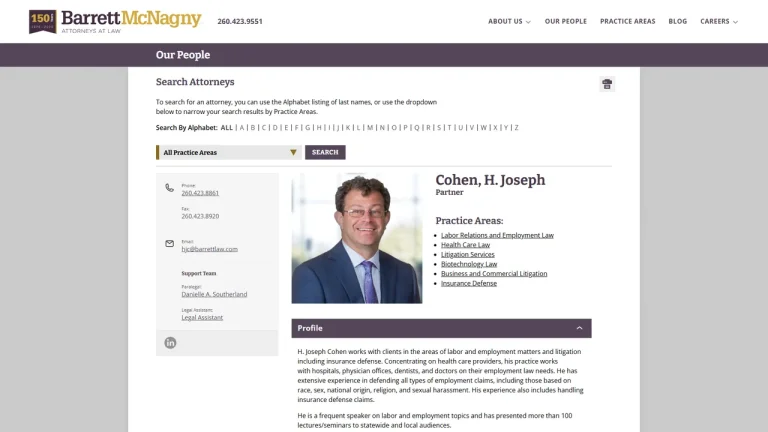
H. Joseph Cohen, Attorney at Law - Fort Wayne, IN

Pinkus & Pinkus - Indianapolis, IN
Thomas Martin Law L.L.C. - Indianapolis, IN

Michelle Smith Scott Communication and Law - Indianapolis, IN

Barrett McNagny LLP: Carta H. Robison - Fort Wayne, IN
Due Doyle Fanning & Alderfer, LLP - Indianapolis, IN

Thomas E. Ludwiski - Barrett McNagny LLP - Fort Wayne, IN

JC Law Offices - Evansville, IN

Krieg DeVault LLP - Carmel, IN
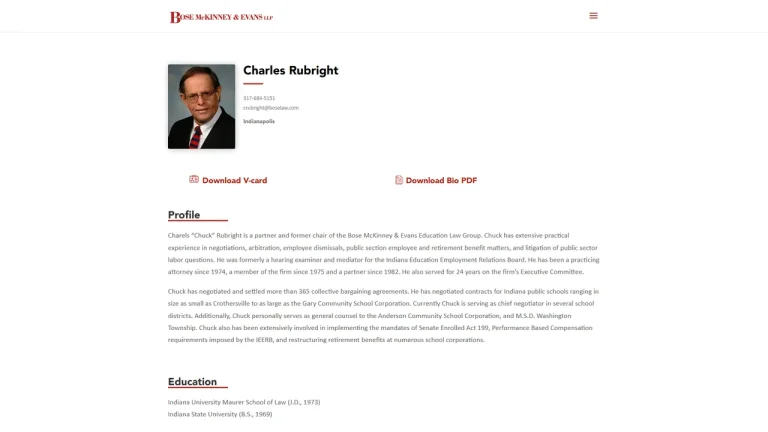
Charles R. Rubright - Bose McKinney and Evans - Indianapolis, IN

Bose McKinney & Evans LLP - Fort Wayne, IN

Amundsen Davis, LLC - Indianapolis, IN

Amber Boyd Attorney at Law - Indianapolis, IN
Dale & Eke Professional Corporation - Indianapolis, IN
Taft Stettinius and Hollister LLP - Indianapolis, IN
Indiana Labor Laws and Circuit Court Venues
Employment relationships in Indiana operate within the framework of at-will employment, but state and federal statutes provide critical protections against wrongful discharge, wage theft, and unlawful discrimination. When employers violate statutory duties, workers can seek redress in state and federal courts across Indiana.
Litigation is initiated in Indiana Circuit and Superior Courts in regional jurisdictions, including the Marion County Superior Court in Indianapolis, the Lake County Superior Court in Crown Point, the Allen County Superior Court in Fort Wayne, the Hamilton County Superior Court in Noblesville, and the Vanderburgh County Superior Court in Evansville. Court documents are filed digitally through the Indiana E-Filing System (IEFS). Employment claims under federal acts proceed before the U.S. District Court for the Southern District of Indiana or the Northern District of Indiana.
Lawyers handling workplace disputes must be licensed by the Indiana Supreme Court and registered with the Indiana State Bar Association (ISBA). Experienced labor counsel assists workers through the administrative charge processes of the Indiana Civil Rights Commission (ICRC) and the federal Equal Employment Opportunity Commission (EEOC) before pursuing courtroom remedies.
Indiana Employment Legal Representation Costs
| Case Scenario | Fee Structure | Estimated Cost (USD) | Key Cost Determinants |
|---|---|---|---|
| Severance & Non-Compete Contract Review | Flat Fee or Hourly | $600 - $2,000 | Geographic scope of restrictive covenants, trade secret provisions, and severance payout negotiations. |
| Wage Payment Act Claim | Contingency + Fee Shifting | 33.3% to 40% of gross recovery | Calculation of statutory liquidated damages, payroll record audits, and employer conciliation attempts. |
| Workers' Comp Retaliatory Discharge Action | Contingency Fee | 33.3% to 40% of gross recovery | Direct evidence linking injury filing to termination, lost wage calculations, and trial preparation. |
| Litigated Workplace Discrimination Trial | Contingency + Advanced Expenses | 40% of gross recovery | ICRC or EEOC administrative filings, depositions of executive supervisors, and jury trial proceedings. |
Critical Legal Deadlines & Statutes in Indiana
Navigating an employment dispute in Indiana requires meeting strict statutory filing deadlines. Under the Indiana Civil Rights Law, codified in Ind. Code § 22-9-1-3, an administrative complaint alleging workplace discrimination based on race, religion, color, sex, disability, national origin, or ancestry must be filed with the Indiana Civil Rights Commission (ICRC) within 180 days of the discriminatory occurrence. Charges dual-filed with the EEOC are governed by the federal 300-day limit under 42 U.S. Code § 2000e-5.
Indiana provides robust remedies for wage theft under the Indiana Wage Payment Act (Ind. Code § 22-2-5-1) and the Indiana Wage Claims Act (Ind. Code § 22-2-9-1). Under Ind. Code § 22-2-5-2, employees whose wages are wrongfully withheld are entitled to recover unpaid amounts plus mandatory liquidated damages of up to double the unpaid wages, along with reasonable attorney fees. Wage claims must be filed within two years under Ind. Code § 34-11-2-1.
While Indiana follows the at-will doctrine, the landmark Frampton exception protects workers from retaliatory discharge. Terminating an employee for filing a worker's compensation claim violates public policy under Ind. Code § 22-3-2-1. Retaliatory discharge lawsuits under this doctrine are governed by the two-year statute of limitations in Ind. Code § 34-11-2-4.
Small Claims Court Limits vs. Superior Court Labor Advocacy
In Indiana, small claims courts possess jurisdiction over claims up to $10,000 under Ind. Code § 33-28-3-4 and Ind. Code § 33-34-3-2. While a simple claim for an unpaid final paycheck can be filed in small claims court, these courts lack the authority to grant equitable remedies, order employee reinstatement, or navigate complex civil rights actions.
Employers routinely retain defense counsel to enforce non-compete agreements or argue that terminations were based on legitimate performance deficiencies. An experienced Indiana employment attorney uses statutory discovery to obtain internal payroll files, leverages fee-shifting provisions under Ind. Code § 22-2-5-2 so the employer covers legal costs, and presents claims effectively before administrative agencies and trial courts.
Red Flags When Selecting an Indiana Employment Attorney
- Missing the 180-Day ICRC Cutoff: Avoid attorneys who overlook the strict 180-day administrative filing requirement under Ind. Code § 22-9-1-3.
- Demanding Unwarranted Retainers for Wage Claims: Reputable labor lawyers represent employees on contingency in wage theft cases, as Indiana law provides mandatory fee-shifting under Ind. Code § 22-2-5-2.
- Failing to Identify Frampton Retaliation: Reject legal counsel who does not investigate potential retaliatory discharge when an employee is terminated shortly after reporting a work injury.
- Overlooking Restrictive Covenant Traps: Beware of firms that do not thoroughly evaluate geographic limitations and non-solicitation language before advising on severance agreements.
Frequently Asked Questions
Is Indiana an at-will employment state?
Yes. Indiana is an at-will employment state, meaning employers can discharge workers for any reason, provided it does not violate public policy, employment contracts, or anti-discrimination statutes.
What is a Frampton retaliatory discharge claim in Indiana?
A Frampton claim is a wrongful termination lawsuit recognized under Indiana law when an employee is fired in retaliation for exercising their statutory right to file a workers' compensation claim under Ind. Code § 22-3-2-1.
How long do I have to file a discrimination complaint in Indiana?
Under Ind. Code § 22-9-1-3, an administrative complaint must be filed with the Indiana Civil Rights Commission (ICRC) within 180 days of the discriminatory action.
What damages can an employee recover for unpaid wages in Indiana?
Pursuant to Ind. Code § 22-2-5-2, employees can recover unpaid wages, mandatory liquidated damages up to double the unpaid amount, and reasonable attorney fees.
Are non-compete agreements legally enforceable in Indiana?
Non-compete agreements are strictly construed by Indiana courts and are only enforceable if they protect a legitimate employer interest and are reasonable in duration, geographic area, and scope of activity.