
Bankruptcy Lawyers in Iowa
Consulting an experienced Iowa bankruptcy lawyer protects your primary assets and halts creditor harassment under federal and state statutory exemption laws. Skilled legal counsel navigates Chapter 7 and Chapter 13 proceedings to restructure debts while shielding your home from liquidation. Browse our statewide directory below to schedule a case evaluation with a qualified Iowa attorney.

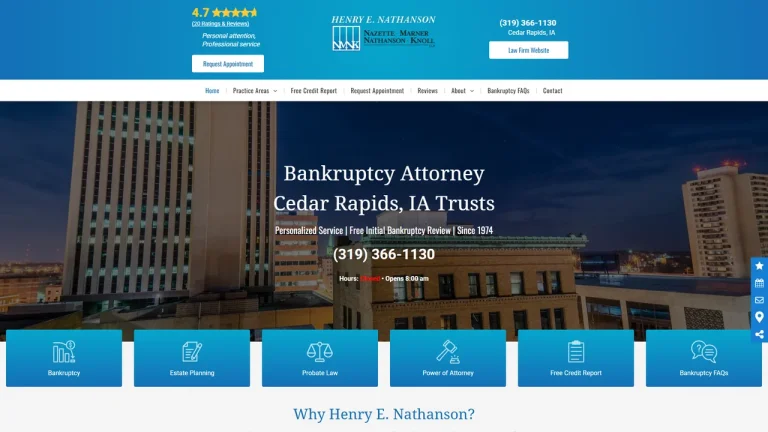
Nazette Marner Nathanson & Shea LLP - Cedar Rapids, IA

Law Office of Bradford Davis - Council Bluffs, IA

Bracker Law - Council Bluffs, IA

Iowa Bankruptcy Attorney John M Heckel - Cedar Rapids, IA

H.J. Dane Law Office - Davenport, IA

Clarence B. Meldrum, Jr., Attorney - Council Bluffs, IA

Brooks Law Firm - Davenport, IA
Meldrum & Benson Law, P.C. - Council Bluffs, IA
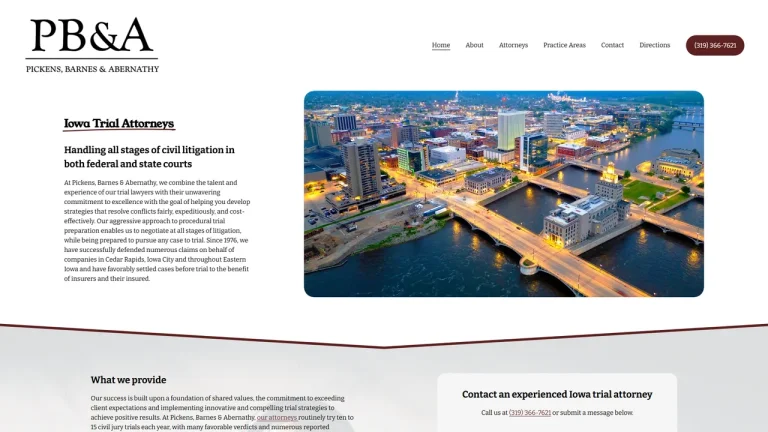
Pickens, Barnes & Abernathy - Cedar Rapids, IA

Nancy L. Thompson Law Office, P.C. - Des Moines, IA

Iowa City Attorney - IA
Gina L. Kramer, Attorney at Law - Dubuque, IA

Dwyer & Wing, P.C. - Davenport, IA
Pioneer Law Office - Dubuque, IA
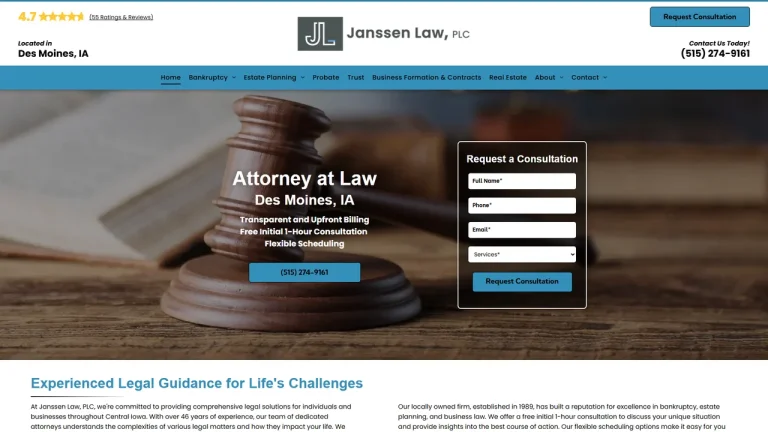
Janssen Law, PLC - Des Moines, IA
Telpner Peterson Law Firm, LLP - Council Bluffs, IA
Wil Forker Law Office - Sioux City, IA
Klinger, Robinson & Ford, LLP - Cedar Rapids, IA
Andrea Buckley, Attorney at Law - Sioux City, IA

H. J. (Jack) Dane, Attorney - Davenport, IA

Austen Law Office - Des Moines, IA
Fitzgerald, Klesner, & Pavelich, PLC - Iowa City, IA

Kevin Ahrenholz - Iowa Bankruptcy Attorney - Des Moines, IA
Navigating Bankruptcy Jurisdiction Across Iowa Federal Districts
Seeking federal debt relief in Iowa requires thorough knowledge of federal bankruptcy procedure and state exemption statutes. Bankruptcy filings are handled exclusively by the United States Bankruptcy Court, divided into two distinct federal jurisdictions: the Northern District of Iowa, with divisional courtrooms in Cedar Rapids and Sioux City, and the Southern District of Iowa, convening in Des Moines, Council Bluffs, and Davenport.
Electronic filings and schedules are submitted through the federal Case Management/Electronic Case Files (CM/ECF) system. Federal bankruptcy trustees operating under the Department of Justice U.S. Trustee Program oversee individual and commercial dockets. Under Iowa Code § 627.10, Iowa is an opt-out state, meaning debtors residing in Iowa must claim state statutory property exemptions rather than federal exemptions to protect their belongings.
Engaging a skilled bankruptcy attorney admitted by the Iowa State Bar Association ensures that your assets-including agricultural property, primary residences, tools of trade, and retirement pensions-are protected to the fullest extent of the law. Experienced counsel communicates directly with trustees and creditors, conducts mandatory means testing, and represents you at the Section 341 Meeting of Creditors to secure a financial fresh start.
Typical Attorney Fee Structures and Costs for Iowa Bankruptcy Filings
| Case Scenario | Fee Structure | Estimated Cost (USD) | Key Cost Determinants |
|---|---|---|---|
| Chapter 7 Consumer Liquidation | Flat Fee plus filing fee | $1,200 - $2,500 (plus $338 court fee) | Means test complexity, median income comparison, number of creditors, exemption scheduling. |
| Chapter 13 Wage Earner Reorganization | Court-Approved Flat Fee | $3,500 - $5,000 (plus $313 court fee) | Mortgage arrearage cure, 36 to 60-month repayment plan formulation, priority tax debt resolution. |
| Chapter 11 Subchapter V Small Business Reorganization | Hourly Retainer ($300 - $550/hr) | $10,000 - $35,000+ | Commercial debt limits, cash collateral motions, consensual plan confirmation with creditors. |
| Adversary Proceeding / Fraud Defense | Hourly Retainer ($275 - $475/hr) | $5,000 - $18,000+ | Section 523 dischargeability challenges, formal written discovery, evidentiary trial hearings. |
Critical Legal Deadlines & Statutes in Iowa
Filing a bankruptcy petition immediately triggers the automatic stay under 11 U.S. Code § 362, which legally prohibits creditors from continuing collection calls, filing lawsuits, garnishing wages, or conducting foreclosure auctions. Prior to filing, debtors must complete an approved credit counseling course within 180 days before submitting their petition pursuant to 11 U.S. Code § 109(h). Following the petition, a debtor education course must be completed to obtain a formal discharge under 11 U.S. Code § 727(a)(11).
Because Iowa opted out of federal bankruptcy exemptions under Iowa Code § 627.10, filers must claim state statutory protections. Iowa provides an exceptional homestead exemption under Iowa Code § 561.16 and Iowa Code § 561.2, which protects unlimited equity in a primary dwelling, limited to one-half acre within an incorporated city or up to 40 acres outside municipal boundaries. Non-homestead exemptions are codified in Iowa Code § 627.6, allowing debtors to protect up to $7,000 in motor vehicle equity, $7,000 in household goods, and $10,000 in tools of trade used in farming or business.
Federal procedural rules impose strict timelines on bankruptcy dockets. The Section 341 Meeting of Creditors must be scheduled within 20 to 40 days after the filing date under Federal Rule of Bankruptcy Procedure 2003. Creditors have a strict deadline of 60 days following the first date set for the 341 meeting to file a complaint objecting to the discharge of a debt under Federal Rule of Bankruptcy Procedure 4004. Missing this 60-day objection window permanently bars creditors from challenging the discharge.
Small Claims Limitations vs. Federal Bankruptcy Relief
Under Iowa Code § 631.1, small claims divisions of the Iowa District Court maintain a monetary ceiling of $6,500. While small claims courts are designed to resolve minor contractual debts and unpaid open accounts, they have zero legal authority to modify consumer debts, stop creditor collection actions across multiple accounts, or issue an enforceable discharge order.
Creditors frequently secure judgments in small claims court and proceed to file wage garnishments under Iowa Code § 642.21. Attempting to manage multiple debts through small claims or filing pro se bankruptcy petitions creates immense risks. Self-represented debtors routinely make errors on the Chapter 7 Means Test under 11 U.S. Code § 707(b) or miscalculate property exemptions under Iowa Code § 627.6, resulting in bankruptcy trustees seizing assets that could have been protected. An experienced Iowa bankruptcy lawyer protects your legal exemptions, structures filings correctly, and secures debt elimination without procedural errors.
Red Flags to Avoid When Selecting an Iowa Bankruptcy Attorney
- Non-lawyer bankruptcy petition preparers who offer low fees but cannot provide legal counsel or represent you before the bankruptcy trustee.
- Attorneys who fail to explain Iowa's mandatory state exemption opt-out under Iowa Code § 627.10 and attempt to use inapplicable federal exemptions.
- Law firms that advertise low introductory rates but introduce hidden costs for pulling credit reports, filing reaffirmation agreements, or attending the 341 meeting.
- Practitioners who routinely push every debtor into a Chapter 13 plan without evaluating eligibility for a faster, less expensive Chapter 7 discharge.
Frequently Asked Questions
What is the difference between Chapter 7 and Chapter 13 bankruptcy in Iowa?
Chapter 7 liquidates eligible non-exempt assets to discharge unsecured debts in three to five months for individuals passing the means test. Chapter 13 creates a three- to five-year repayment plan to catch up on missed mortgage payments and restructure debts while retaining non-exempt assets.
Does Iowa allow the use of federal bankruptcy exemptions?
No. Under Iowa Code § 627.10, Iowa has opted out of federal exemptions. Iowa filers must use state property exemptions, such as the homestead exemption under Iowa Code § 561.16 and personal property exemptions under Iowa Code § 627.6.
How does the Iowa homestead exemption protect my home?
Pursuant to Iowa Code § 561.2, Iowa protects unlimited monetary equity in your primary residence, provided the property is limited to one-half acre within a city plat or up to 40 acres outside a municipal boundary.
What is the automatic stay in bankruptcy?
Under 11 U.S. Code § 362, filing a bankruptcy petition automatically halts most civil collection actions, wage garnishments, foreclosure proceedings, and repossession efforts immediately.
How long does a bankruptcy discharge stay on my credit report?
A Chapter 7 bankruptcy filing generally remains on credit reports for up to ten years from the filing date, while a completed Chapter 13 bankruptcy typically remains for up to seven years under federal reporting rules.