
Business Formation Lawyers in Kansas
Retaining an experienced Kansas business formation lawyer ensures your commercial entity is properly structured to protect personal assets under state statutes. Skilled corporate counsel drafts customized operating agreements, navigates Secretary of State filings, and establishes solid governance to prevent future shareholder disputes. Browse our statewide directory to connect with a trusted Kansas business formation attorney today.

MSB Law, LC - Overland Park, KS
Bever Dye, LC - Wichita, KS
Myers Longhofer, LLC - Overland Park, KS

Young Bogle McCausland Wells and Blanchard - Wichita, KS

Foundry Law Group - Overland Park, KS
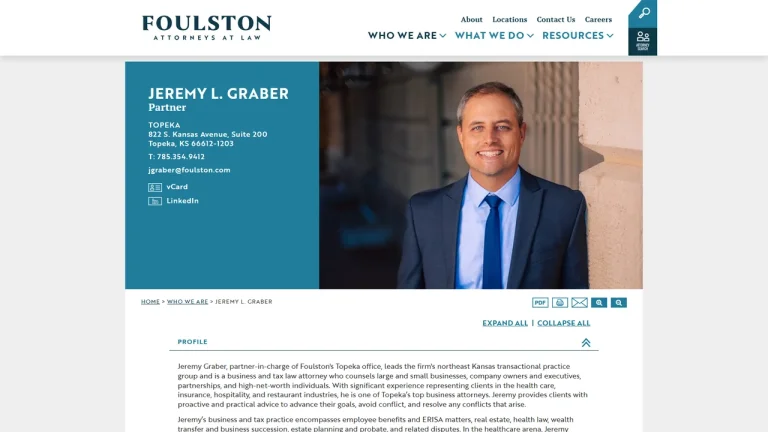
Jeremy L. Graber - Topeka, KS

Snyder & Snyder - Topeka, KS

The Smalley Law Firm, LLC - Overland Park, KS

Alex Mitchell Law Office - Wichita, KS

Hinkle Law Firm LLC - Wichita, KS

Schlagel Long, LLC - Olathe, KS

Riordan, Fincher & Mayo, PA - TOPEKA, KS

Dietrick Law - Topeka, KS
Washburn Law Office, Topeka, KS
Midwest Law LC - Overland Park, KS
Krieger Law Firm, LLC - Olathe, KS

Willard Law Office LLC - Topeka, KS
Foulston Siefkin LLP - Overland Park, KS
Sage Law, LLP - Overland Park, KS

TRIPLETT WOOLF GARRETSON, LLC - Wichita, KS
W Law Group, LC - Overland Park, KS

Waddell Law Firm LLC - Overland Park, KS

Schoonover & Moriarty LLC - Olathe, KS

Kansas Entity Governance & Secretary of State Administration
Launching a commercial venture in the State of Kansas requires selecting the optimal entity architecture to shield personal assets, minimize tax burdens, and facilitate operational growth. From burgeoning technology startups and professional practices in Johnson County and the Kansas City metropolitan area to manufacturing enterprises and agricultural operations in Sedgwick, Shawnee, and Douglas counties, proper corporate formation establishes the legal bedrock of business success.
Entity filings are administered statewide by the Kansas Secretary of State located in Topeka, primarily through the digital Kansas Business Center portal. Choosing between a Limited Liability Company (LLC), Series LLC, C-Corporation, S-Corporation, or Limited Partnership depends on state statutory compliance and capitalization goals. Attorneys admitted to the Kansas Bar Association ensure that your organizational documents satisfy statutory filing requirements under the Kansas Revised Limited Liability Company Act or the Kansas General Corporation Code, while establishing robust internal governance structures.
While standard state registration creates a legal entity, executing tailored internal agreements is essential for protecting ownership equity. An experienced Kansas business formation lawyer drafts customized operating agreements, corporate bylaws, shareholder buy-sell provisions, and equity vesting schedules that prevent internal deadlock and shield business owners from personal liability before county district courts.
Kansas Business Formation Legal Fee Structures
| Case Scenario | Fee Structure | Estimated Cost (USD) | Key Cost Determinants |
|---|---|---|---|
| Single-Member LLC Formation & EIN Filing | Flat Legal Fee | $750 - $1,800 | Articles of Organization, standard operating agreement, federal tax ID setup, registered agent appointment. |
| Multi-Member LLC with Buy-Sell Operating Agreement | Flat Fee / Hourly Hybrid | $1,800 - $4,500 | Manager-managed terms, dispute resolution clauses, capital call requirements, transfer restriction rules. |
| Corporate Incorporation (C-Corp / S-Corp Election) | Flat Legal Fee | $2,000 - $5,000 | Articles of Incorporation, corporate bylaws, organizational minutes, initial stock issuance ledger. |
| Kansas Series LLC Structuring (Asset Segregation) | Flat Fee / Hourly Hybrid | $2,500 - $6,000 | Master LLC agreement, separate series operating terms, cross-liability insulation provisions. |
Critical Legal Deadlines & Statutes in Kansas
Business organizations in Kansas must comply with explicit statutory mandates governing formation, internal operation, and ongoing state maintenance. The foundation for limited liability companies is the Kansas Revised Limited Liability Company Act, codified at K.S.A. § 17-7662. Under K.S.A. § 17-7673, an LLC is formally formed when Articles of Organization are filed with the Kansas Secretary of State. The operating agreement, which governs member rights and duties, is validated under K.S.A. § 17-7668. For enterprises seeking to compartmentalize liabilities across separate real estate or operational holdings, Kansas authorizes the creation of Series LLCs under K.S.A. § 17-76,143.
Corporations are governed by the Kansas General Corporation Code, beginning at K.S.A. § 17-6001, with Articles of Incorporation filed pursuant to K.S.A. § 17-6002. In addition to initial formation filings, ongoing corporate standing is strictly contingent upon meeting mandatory administrative deadlines. Under K.S.A. § 17-76,139 for LLCs and K.S.A. § 17-7503 for corporations, every domestic business entity must file an annual information report with the Kansas Secretary of State on or before the fifteenth day of the fourth month following the close of the entity tax year.
Failing to file the required annual report and pay the statutory fee within 90 days of the due date results in the immediate forfeiture of the business entity charter under K.S.A. § 17-76,139. Forfeiture strips the entity of its active legal status, potentially exposing owners to personal liability for liabilities incurred while in forfeited status. For internal contractual claims, actions based on a written operating agreement or shareholder contract are subject to a five-year statute of limitations pursuant to K.S.A. § 60-511.
Pro Se Filing Risks vs. Professional Legal Structuring
Entrepreneurs frequently consider using automated online filing services or attempting self-filing with the Kansas Secretary of State to save startup expenses. While state online portals make filing initial Articles of Organization straightforward, automated services merely register the shell entity without drafting enforceable internal contracts. Furthermore, under Kansas law, business entities cannot represent themselves pro se in general civil litigation within Kansas District Courts; they must appear through licensed legal counsel.
Utilizing boilerplate operating agreements leaves founders severely exposed to internal member deadlock, unauthorized debt generation, and veil-piercing lawsuits. If an LLC fails to observe basic organizational formalities, creditors can seek to "pierce the corporate veil" in district court, holding individual founders personally liable for business debts. Retaining a dedicated Kansas business formation lawyer ensures that ownership rights are documented, capital contribution requirements are specified, and appropriate commercial licensing is verified before trading commences.
Red Flags to Watch for in Kansas Business Formation Legal Services
- Generic One-Size-Fits-All Operating Agreements: Boilerplate documents downloaded from internet filing mills frequently omit Kansas-specific provisions regarding member dissociation and manager indemnification.
- Failing to Address the Kansas Annual Report Deadline: Incompetent formation services fail to notify clients of the annual report filing deadline under K.S.A. § 17-76,139, leading to entity forfeiture.
- Ignoring Deadlock Resolution Provisions: Operating agreements for 50/50 multi-member LLCs must include clear buy-sell or mediation clauses to avoid expensive judicial dissolution in district court.
- Overlooking Kansas Series LLC Separation Rules: Attorneys structuring Series LLCs under K.S.A. § 17-76,143 must establish separate bank accounts and accounting records for each series to maintain liability firewalls.
Frequently Asked Questions
What is the advantage of a Kansas Series LLC?
Under K.S.A. § 17-76,143, a Kansas Series LLC allows business owners to segregate assets and liabilities into distinct internal cells under a single master LLC, protecting individual assets from liabilities incurred by other series.
When is the Kansas annual report due for an LLC?
Pursuant to K.S.A. § 17-76,139, an LLC must file its annual report with the Kansas Secretary of State on or before the fifteenth day of the fourth month following the close of its taxable year.
What happens if my Kansas business entity is forfeited?
If an entity fails to file its annual report within 90 days of the deadline, its charter is forfeited under K.S.A. § 17-76,139. The entity loses its legal capacity to sue in court and may be reinstated only by filing delinquent reports and paying penalties.
Is an operating agreement legally required for an LLC in Kansas?
While K.S.A. § 17-7668 does not require an operating agreement to be filed publicly with the state, having a written agreement is vital to establish voting rights, profit sharing, and protect limited liability status in court.
Can a non-lawyer represent an LLC in a Kansas District Court?
No. Under Kansas Supreme Court precedent and procedural rules, limited liability companies and corporations cannot appear pro se and must be represented by an attorney admitted to practice law in Kansas.