
Business & Real Estate Lawyers in Kansas
Connect with experienced Kansas business and real estate lawyers to handle commercial transactions, entity formation, contract disputes, and property closings. Skilled legal counsel structures protective agreements under state statutes and resolves complex commercial conflicts out of court. Browse verified attorneys in our statewide directory below to arrange a consultation.
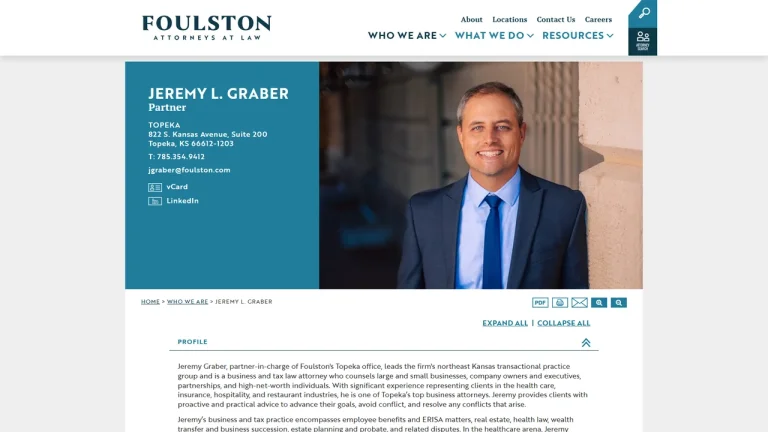
Jeremy L. Graber - Topeka, KS

Midwest Law LC - Overland Park, KS
Cross Law Firm, LLC - Overland Park, KS

Kansas Legal Services - Topeka, KS

McDonald Tinker PA - Wichita, KS

Baker, Storey, and Watson - Topeka, KS

Stern & Mauck, LLC - Overland Park, KS

Coppaken Law Firm - Overland Park, KS
Newman, Hesse and Associates PA Topeka, KS

Kerns Law Group - Wichita, KS

Fleeson Gooing Coulson & Kitch, L.L.C. - Wichita, KS
Tilton & Tilton - Topeka, KS

Conwell Law, LLC - Topeka, KS

Olson Henry, LLC - Wichita, KS

Evans & Dixon, LLC - Overland Park, KS
Juris Law & Mediation, LLC - Olathe, KS

Kathleen R. Reeves LLC - Wichita, KS

Sutton Law Office - Overland Park, KS
Frank M Ojile - Wichita, KS

Arn Mullins Unruh Kuhn Wilson - Wichita, KS
Jackson Lewis PC - Overland Park, KS

Law Office of Michael a. Millett, P.A. - Overland Park, KS

Fisher Patterson Sayler Smith - Topeka, KS
Kansas Corporate and Real Estate Legal Framework
Commercial enterprises and real property holdings across Kansas operate under established statutory systems governing corporate organization, commercial leasing, title transfers, and contract enforcement. Navigating business expansion and real estate developments requires precise adherence to state recording requirements and corporate governance statutes.
Legal matters and property disputes are litigated in Kansas District Courts across thirty-one judicial districts. Key commercial venues include the Johnson County District Court in Olathe within the Tenth Judicial District, the Sedgwick County District Court in Wichita within the Eighteenth Judicial District, the Shawnee County District Court in Topeka within the Third Judicial District, the Wyandotte County District Court in Kansas City within the Twenty-Ninth Judicial District, and the Douglas County District Court in Lawrence within the Seventh Judicial District. Property instruments, deeds, and encumbrances are recorded with individual County Register of Deeds offices, while corporate filings and annual reports are administered by the Kansas Secretary of State. Court documents are filed digitally via Kansas Courts eFiling.
Attorneys handling business transactions and real property disputes must be admitted to practice by the Kansas Supreme Court and regulated by the Kansas Supreme Court Office of the Disciplinary Administrator and the Kansas Bar Association (KBA). Experienced counsel ensures that commercial contracts, mechanic's liens, and corporate formations comply with state statutory requirements.
Kansas Business & Real Estate Legal Fee Overview
| Case Scenario | Fee Structure | Estimated Cost (USD) | Key Cost Determinants |
|---|---|---|---|
| LLC Formation & Corporate Structuring | Flat Fee | $800 - $2,500 | Kansas Secretary of State filings, custom operating agreements, and member ownership structures. |
| Commercial Real Estate Closing Review | Flat Fee or Hourly | $1,200 - $3,500 | Environmental due diligence, title commitment examination, survey defect analysis, and closing documents. |
| Mechanic's Lien Filing & Enforcement | Flat Fee or Hourly | $1,000 - $3,500 | District Court clerk filing, statutory verified statement drafting, and foreclosure pleadings. |
| Commercial Contract & Real Estate Litigation | Hourly Rate | $7,500 - $30,000+ | Discovery volume, expert appraisal witnesses, summary judgment practice in District Court, and trial litigation. |
Critical Legal Deadlines & Statutes in Kansas
Transactions involving real property in Kansas must strictly adhere to the Kansas Statute of Frauds, codified at K.S.A. § 33-106. Under this statute, all contracts for the sale of land, leases exceeding one year, and agreements not to be performed within one year must be in writing and signed by the party to be charged.
Kansas is a notice recording jurisdiction for real property conveyances. Pursuant to K.S.A. § 58-2223, an unrecorded deed, mortgage, or conveyance is invalid against a subsequent purchaser for valuable consideration without notice until it is filed with the appropriate Register of Deeds. Contractors and suppliers protecting payment rights must comply with the mechanic's lien deadlines set forth in K.S.A. § 60-1102, requiring general contractors to file a lien statement with the District Court clerk within four months after last furnishing labor or materials, while subcontractors must file within three months under K.S.A. § 60-1103. An action to foreclose the lien must be filed within one year of recording pursuant to K.S.A. § 60-1105.
Statutory limitations for contract enforcement are established under Title 60. Under K.S.A. § 60-511, actions upon written contracts must be commenced within five years. Oral agreements are governed by a three-year statute of limitations under K.S.A. § 60-512, and fraud actions must be filed within two years under K.S.A. § 60-513. Business entity governance is regulated under the Kansas Revised Limited Liability Company Act, codified at K.S.A. § 17-7662 et seq.
Small Claims Limitations vs. Commercial Legal Representation
In Kansas, small claims jurisdiction is capped at $4,000 under K.S.A. § 61-2703, and lawyers are generally prohibited from participating in small claims hearings under K.S.A. § 61-2707. While small claims can resolve modest residential security deposit disputes, it cannot accommodate commercial real estate or corporate matters.
Small claims courts have zero legal authority to quiet title, enforce commercial leases, issue mechanic's lien foreclosures, or adjudicate shareholder derivative claims. High-value transactions and commercial disputes require formal representation in Kansas District Courts. An experienced Kansas business and real estate lawyer structures enforceable contracts, resolves title clouds, and safeguards commercial interests throughout the transaction.
Red Flags When Selecting a Kansas Business & Real Estate Lawyer
- Generic Operating Agreements: Avoid lawyers who provide boilerplate LLC forms that fail to address member voting rights and dissociation under the Kansas Revised Limited Liability Company Act (K.S.A. § 17-7662).
- Missing Mechanic's Lien Deadlines: Reject counsel who overlooks the strict three-month or four-month filing requirements under K.S.A. § 60-1102 and K.S.A. § 60-1103.
- Ignoring Notice Recording Rules: Ensure your attorney promptly records conveyances with the Register of Deeds to preserve priority over subsequent purchasers under K.S.A. § 58-2223.
- Skipping Environmental Due Diligence: In commercial property purchases, beware of counsel that fails to require Phase I environmental assessments and complete title commitment audits.
Frequently Asked Questions
Does a real estate contract need to be in writing under Kansas law?
Yes. Under the Kansas Statute of Frauds (K.S.A. § 33-106), any agreement for the sale of real property or leases exceeding one year must be in writing and signed by the party to be charged.
What is the deadline to file a mechanic's lien in Kansas?
Under K.S.A. § 60-1102, general contractors have four months from the last date of work to file a lien statement, while subcontractors must file within three months under K.S.A. § 60-1103.
What is the statute of limitations for breach of contract in Kansas?
Pursuant to K.S.A. § 60-511, lawsuits for breach of a written contract must be brought within five years, while oral agreements have a three-year deadline under K.S.A. § 60-512.
How are limited liability companies governed in Kansas?
LLCs are governed by the Kansas Revised Limited Liability Company Act under K.S.A. § 17-7662, which allows members broad flexibility in drafting custom operating agreements.
What recording rule applies to Kansas real estate deeds?
Kansas is a notice recording state under K.S.A. § 58-2223, meaning an unrecorded deed is invalid against a subsequent bona fide purchaser who buys the property without notice.