
Financial & IP Lawyers in Kansas
Consult leading Kansas financial and IP lawyers to protect proprietary trade secrets, secure patent portfolios, and negotiate complex commercial financing deals. Knowledgeable counsel defends intellectual property rights in federal court and structures transactions under Kansas commercial codes. Explore our statewide Kansas directory below to connect with verified legal professionals.

Callahan Law Firm - Overland Park, KS

Skinner Law, LLC - Olathe, KS
Federal Public Defender - Wichita, KS

Wiesner and Frackowiak, LC - Overland Park, KS

Jordan Schwartz Law Office - Overland Park, KS

Tax Solutions Law Firm, LLC - Overland Park, KS

Sloan, Eisenbarth, Glassman, McEntire and Jarboe, L.L.C. - Topeka, KS
Dewey and Lund LLP - Wichita, KS
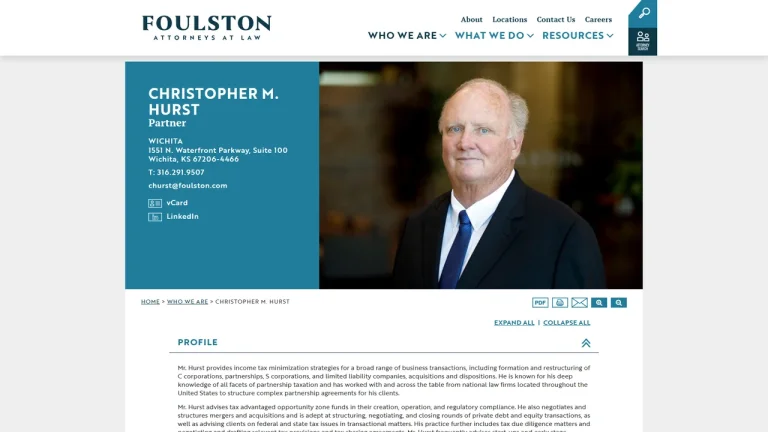
Christopher M. Hurst - Wichita, KS

Adams Cross, LLC - Olathe, KS

Patton & Dean, LLC - Kansas City, KS
Jeffrey L. Wagoner - Olathe, KS
Kansas Legal Services - Topeka, KS

Wellman Law LLC - Overland Park, KS

Prelle Eron & Bailey, P.A. - Wichita, KS

Fisher Patterson Sayler Smith - Topeka, KS
Gary E. Hinck, P.A. - Wichita, KS

Triad Legal - Wichita, KS
Lazzo Law - Wichita, KS

Eric W. Lomas, Bankruptcy Attorney - Wichita, KS
Riley Don W - Wichita, KS

McCullough Wareheim & Labunker - Topeka, KS
Kansas Bankruptcy Ladies - Wichita, KS

Commercial Finance & Intellectual Property Litigation in Kansas
Protecting intellectual property assets and structuring high-value financial transactions in Kansas involves navigating a combination of state commercial codes and federal regulatory courts. Intellectual property matters involving patent infringement, federal trademark registrations under the Lanham Act, and copyright protections fall under the jurisdiction of the United States District Court for the District of Kansas, which maintains active federal courthouses in Wichita, Kansas City, and Topeka.
Simultaneously, Kansas District Courts exercise broad authority over state-level commercial finance litigation, security interest enforcement, and trade secret disputes. Business litigation is centered in key economic hubs: the 10th Judicial District in Johnson County (Olathe), the 18th Judicial District in Sedgwick County (Wichita), the 3rd Judicial District in Shawnee County (Topeka), and the 29th Judicial District in Wyandotte County (Kansas City). State commercial litigation and Uniform Commercial Code (UCC) financing statements are processed electronically through the Kansas Courts eFiling system and the Kansas Secretary of State. Practicing financial and IP attorneys must be licensed by the Kansas Supreme Court and the Kansas Bar Association (KBA), with patent attorneys registered before the United States Patent and Trademark Office (USPTO).
Retaining local Kansas financial and IP counsel ensures that your corporate innovations, customer lists, and debt structures remain legally sound. Skilled attorneys structure commercial loan agreements, draft non-disclosure and intellectual property assignment covenants, and prosecute trademark and patent infringement actions to protect commercial enterprise value across the state.
Kansas Financial & IP Legal Fee Structures & Project Estimates
| Case Scenario | Fee Structure | Estimated Cost (USD) | Key Cost Determinants |
|---|---|---|---|
| Federal Trademark Search & USPTO Registration | Flat Fee ($1,000 - $2,500) | $1,000 - $2,500 | Number of trademark classes, likelihood of confusion clearance, responding to USPTO Office Actions. |
| Non-Provisional Patent Application Drafting | Flat / Hourly ($325 - $575/hr) | $5,000 - $14,000 | Mechanical vs. software complexity, prior art search results, formal patent illustration preparation. |
| Trade Secret Misappropriation Litigation (KUTSA) | Hourly Retainer ($350 - $650/hr) | $12,000 - $45,000+ | Temporary restraining order (TRO) hearings, digital forensics discovery, proof of reasonable secrecy measures. |
| Commercial Loan Structuring & UCC-1 Security Filings | Hourly / Blended ($300 - $500/hr) | $3,500 - $12,000 | Collateral complexity, perfected security interests under UCC Article 9, personal guaranty enforcement terms. |
Critical Legal Deadlines & Statutes in Kansas
Financial and intellectual property claims in Kansas are strictly controlled by statutory filing periods. Under the Kansas Uniform Trade Secrets Act (KUTSA), codified at Kan. Stat. Ann. § 60-3320, misappropriation occurs when proprietary business information is acquired through improper means. An action for misappropriation under KUTSA must be brought within three (3) years after the misappropriation is discovered or by the exercise of reasonable diligence should have been discovered, pursuant to Kan. Stat. Ann. § 60-3325.
Commercial breach of contract actions founded upon written financing instruments, promissory notes, or licensing agreements must be commenced within five (5) years under Kan. Stat. Ann. § 60-511. Secured commercial transactions, perfection of security interests, and priority disputes are governed by Article 9 of the Kansas Uniform Commercial Code, codified at Kan. Stat. Ann. § 84-9-101. At the federal level, trademark infringement actions proceed under the Lanham Act pursuant to 15 U.S. Code § 1114, while patent infringement claims are litigated under 35 U.S. Code § 271, with damages recovery limited to the six-year period preceding the complaint under 35 U.S. Code § 286.
Small Claims Limitations vs. District Court Commercial Litigation
Under Kan. Stat. Ann. § 61-2703, the Kansas Small Claims Procedure is strictly limited to actions where the amount in controversy does not exceed $4,000. Small claims courts operate on simplified rules without formal discovery and have no legal power to grant injunctive relief, issue protective orders, or decide patent and trademark claims.
Commercial disputes, IP infringement, and financial debt enforcement require substantial discovery and equitable remedies available only in the regular civil divisions of Kansas District Courts or the U.S. District Court for the District of Kansas. Attempting to protect trade secrets or enforce complex loan agreements without counsel creates severe exposure to contractual loopholes and forfeited rights. Retaining skilled financial and IP counsel ensures that security interests are perfected with the Kansas Secretary of State, preliminary injunctions are secured to halt IP theft, and complex corporate balance sheets are defended.
Red Flags to Avoid When Selecting a Kansas Financial & IP Attorney
- Attorneys offering patent prosecution services who are not officially registered to practice before the United States Patent and Trademark Office (USPTO).
- Failure to act within the strict three-year statute of limitations for trade secret misappropriation under Kan. Stat. Ann. § 60-3325.
- Commercial transaction lawyers who neglect to properly perfect security interests under the Kansas UCC Article 9 framework (Kan. Stat. Ann. § 84-9-101).
- Unclear billing terms regarding USPTO government filing fees, trademark search vendor costs, and expert witness expenses.
Frequently Asked Questions
What is the statute of limitations for trade secret theft in Kansas?
Under Kan. Stat. Ann. § 60-3325, an action for misappropriation of a trade secret must be brought within three years after the misappropriation is discovered or should have been discovered through reasonable diligence.
Where are patent and federal trademark lawsuits filed in Kansas?
Patent and federal trademark lawsuits fall under exclusive federal jurisdiction and are litigated in the United States District Court for the District of Kansas, which holds proceedings in Wichita, Kansas City, and Topeka.
How does a lender perfect a security interest on business collateral in Kansas?
Pursuant to Article 9 of the Kansas Uniform Commercial Code (Kan. Stat. Ann. § 84-9-101), a lender perfects a security interest by executing an enforceable security agreement and filing a UCC-1 Financing Statement with the Kansas Secretary of State.
What constitutes a trade secret under Kansas law?
Under Kan. Stat. Ann. § 60-3320, a trade secret is information-including formulas, patterns, compilations, or customer lists-that derives independent economic value from not being generally known and is subject to reasonable efforts to maintain its secrecy.
What is the statute of limitations for breach of a written loan agreement in Kansas?
Under Kan. Stat. Ann. § 60-511, an action based on any agreement, contract, or promise in writing must be commenced within five years from the date of the breach.