
Bankruptcy Lawyers in Topeka
Consult experienced bankruptcy lawyers in Topeka to halt home foreclosures, stop wage garnishments, and eliminate unsecured debts under federal bankruptcy law. Seasoned Shawnee County bankruptcy attorneys leverage Kansas homestead exemptions to protect your property and structure viable debt relief solutions. Explore our verified directory below to schedule a confidential consultation with a trusted Topeka bankruptcy attorney today.

Troy A. Berberick - Topeka, KS

The Law Office of Janay Kent, LLC, Topeka, KS

Zimmerman, & Zimmerman P.A. - Topeka, KS
Gary E. Hinck P.A. - Topeka, KS
Coons and Crump - Topeka, KS
Mack & Associates, LLC - Topeka, KS
Stumbo Hanson, LLP, Topeka, KS
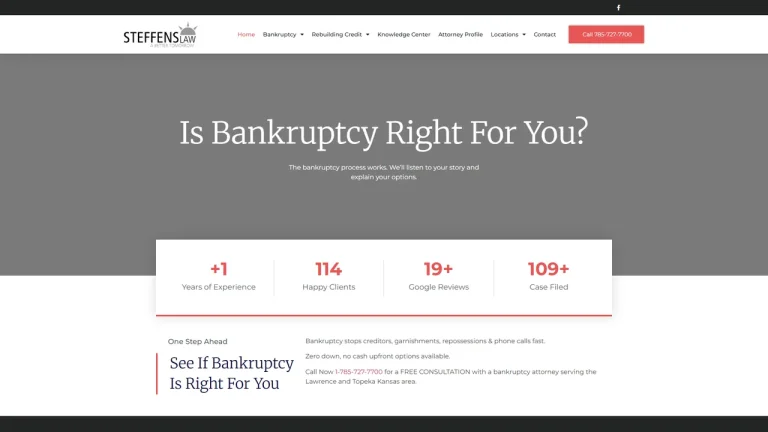
Chris W. Steffens, Attorney at Law - TOPEKA, KS
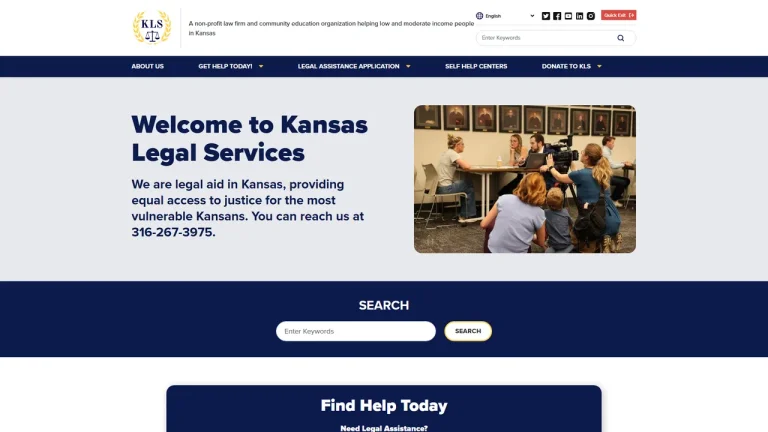
Kansas Legal Services - Topeka, KS
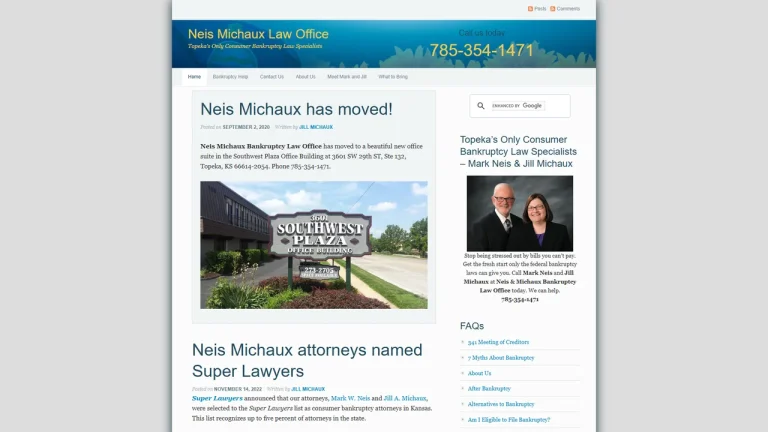
Neis Michaux Law Office - Topeka, KS
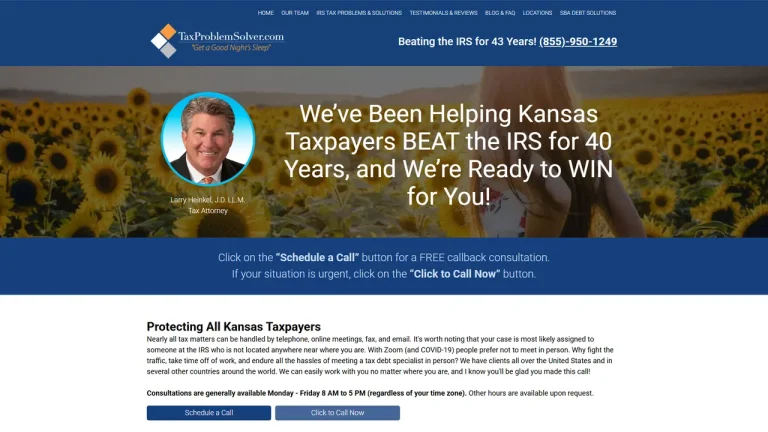
Tax Problem Solver - Topeka, KS

Cary L Standiferd, Attorney At Law, Topeka, KS

Frank D. Taff, J.D. - Topeka, KS

Newman, Hesse and Associates PA Topeka, KS

Federal Bankruptcy Jurisdiction and Venue in Topeka, Kansas
Individuals and commercial enterprises in Topeka facing overwhelming financial distress can obtain legal relief through federal bankruptcy protection. Whether dealing with sudden medical liabilities, corporate downturns along the Wanamaker commercial corridor, or personal debt in Potwin Place and College Hill, bankruptcy provides a structured pathway to financial recovery.
All bankruptcy petitions for Shawnee County residents and businesses are filed with the United States Bankruptcy Court for the District of Kansas. Topeka is home to the court's Topeka Division, housed at the Frank Carlson Federal Building and U.S. Courthouse at 444 SE Quincy Street, where Section 341 meetings of creditors and bankruptcy hearings occur.
State-level creditor collection lawsuits and post-judgment wage garnishments occur across town at the Shawnee County Courthouse at 200 SE 7th Street within the 3rd Judicial District of Kansas. Retaining an established Topeka bankruptcy lawyer provides immediate legal protection, triggering federal statutory stays that halt collections and preserve essential home equity.
Typical Fee Structures for Bankruptcy Lawyers in Topeka, KS
| Case Scenario | Fee Structure | Estimated Cost (USD) | Key Cost Determinants |
|---|---|---|---|
| Chapter 7 Consumer Liquidation Bankruptcy | Flat Fee + Court Filing Fee | $1,250 - $2,400 (plus $338 court fee) | Household income relative to Kansas median, asset exemption complexity, and number of creditors. |
| Chapter 13 Individual Debt Adjustment | Court-Approved Staged Fee | $3,500 - $4,800 (financed in repayment plan) | Monthly disposable income calculations, mortgage arrearage cures, and 3-to-5-year plan administration. |
| Chapter 11 Subchapter V Small Business Reorganization | Retainer + Hourly Rate | $7,500 - $20,000+ ($300 - $475 / hr) | Commercial lease restructurings, secured equipment debt cramdowns, and operational cash flow modeling. |
| Adversary Proceeding / Dischargeability Defense | Retainer + Hourly Rate | $3,500 - $10,000+ ($275 - $425 / hr) | Allegations of fraud, student loan hardship litigation, and pre-trial discovery motions. |
Critical Legal Deadlines & Statutes in Kansas
Federal bankruptcy proceedings are governed by strict procedural deadlines and statutory requirements. Under 11 U.S. Code § 362, the filing of a bankruptcy petition triggers an immediate federal automatic stay that halts all creditor lawsuits, foreclosures, repossessions, and wage garnishments.
Kansas has opted out of federal bankruptcy exemptions pursuant to Kan. Stat. Ann. § 60-2312, requiring debtors to utilize state statutory protections. Most notably, the Kansas homestead exemption codified at Kan. Stat. Ann. § 60-2301 provides unlimited monetary equity protection on an urban home on up to one acre of land within an incorporated city like Topeka, provided federal domicile requirements are satisfied.
To qualify for Chapter 7 liquidation, debtors must satisfy the statutory means test under 11 U.S. Code § 707 if their household income exceeds the Kansas state median. In Chapter 13 proceedings, debtors must commit their projected disposable income to a court-approved repayment plan lasting 36 to 60 months under 11 U.S. Code § 1322 to receive a formal debt discharge under 11 U.S. Code § 1328.
Small Claims Limitations vs. Professional Bankruptcy Representation
The Kansas Small Claims Procedure Act is capped at $10,000 under Kan. Stat. Ann. § 61-2703, where attorneys are generally barred from appearing under Kan. Stat. Ann. § 61-2707. While small claims in Shawnee County can adjudicate minor unpaid promissory notes, state small claims courts have zero authority over federal bankruptcy cases.
Small claims judges cannot discharge debts, enter nationwide automatic stays, or void recorded judicial liens. Filing for bankruptcy requires detailed financial schedules, means test calculations, and strict adherence to the Federal Rules of Bankruptcy Procedure. Mistaken filings or failure to accurately apply Kansas exemption statutes under Kan. Stat. Ann. § 60-2301 can result in the bankruptcy trustee seizing unprotected assets or the court dismissing your case with prejudice. Engaging a dedicated Topeka bankruptcy attorney guarantees your exemptions are maximized and your discharge is legally secured.
Red Flags When Hiring a Topeka Bankruptcy Attorney
- Low-cost petition mills that process bankruptcy forms using non-attorney paralegals without attorney oversight or representation at the 341 meeting of creditors.
- Practitioners who fail to understand the nuances of the Kansas exemption opt-out statute and inadvertently expose client property to trustee liquidation.
- Attorneys who demand immediate full payment for Chapter 13 representation rather than folding allowable attorney fees into the court-approved payment plan.
- Firms that advise clients to transfer real estate or bank accounts to family members prior to filing, which constitutes bankruptcy fraud.
Frequently Asked Questions
Will I lose my home if I file for bankruptcy in Topeka, KS?
Under the Kansas homestead exemption, your home equity is protected up to one acre within city limits, allowing you to keep your primary residence as long as mortgage payments remain current.
What is the difference between Chapter 7 and Chapter 13 bankruptcy in Kansas?
Chapter 7 discharges qualifying unsecured debts in roughly four months without repayment, while Chapter 13 reorganizes debts into a court-supervised 3-to-5-year repayment plan to catch up on mortgages or vehicle loans.
How quickly does the automatic stay stop wage garnishments in Shawnee County?
The federal automatic stay takes effect immediately upon filing your bankruptcy petition, legally requiring creditors and payroll departments to halt ongoing wage garnishments and collection suits.
Can tax debt be discharged through bankruptcy in Topeka?
Older income tax debts can be discharged in Chapter 7 if they meet strict federal timing rules (generally filed more than three years ago and assessed at least 240 days prior), but recent taxes and trust fund penalties cannot be discharged.
Where do I attend my 341 meeting of creditors in Topeka?
Section 341 meetings for Shawnee County debtors are administered through the U.S. Bankruptcy Court for the District of Kansas, typically conducted virtually or at the Frank Carlson Federal Building in Downtown Topeka.