
Business Formation Lawyers in Topeka
Launch your business with trusted business formation lawyers in Topeka, KS. Experienced Shawnee County attorneys structure durable LLCs, partnerships, and corporations tailored for long-term protection. Retaining qualified local legal counsel guarantees regulatory compliance with the Kansas Secretary of State and resolves governance disputes before operations begin. Explore our verified directory below to schedule an initial consultation with a corporate startup lawyer.
Stumbo Hanson, LLP, Topeka, KS

Urbom Law Office Chartered Topeka, KS
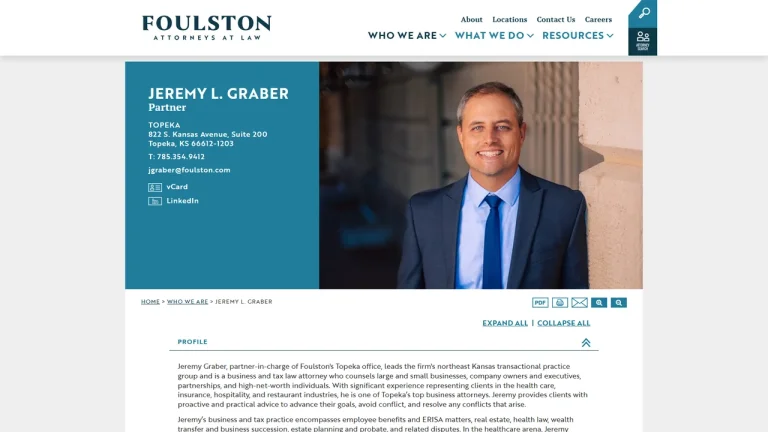
Jeremy L. Graber - Topeka, KS
Patton Law Office, LLC - Topeka, KS

Riordan, Fincher & Mayo, PA - TOPEKA, KS

Stevens and Brand LLP Topeka, KS

Snyder & Snyder - Topeka, KS

Willard Law Office LLC - Topeka, KS

Frieden & Forbes, LLP - Topeka, KS
Alderson, Alderson, Conklin, Crow & Slinkard, L.L.C. - Topeka, KS

Woner, Reeder & Girard, P.A., Topeka, KS

Washburn Law Office, Topeka, KS

Enterprise Formation in Topeka and Shawnee County
Forming a new commercial entity in Topeka demands a solid legal foundation to shield personal assets and facilitate future expansion. As the capital of Kansas, Topeka hosts vital state regulatory bodies, healthcare institutions, and expanding commercial corridors along SW Wanamaker Road, Downtown Topeka, and North Topeka. Retaining an experienced Topeka business formation attorney ensures that your enterprise complies fully with Kansas corporate statutes from inception.
Selecting the appropriate entity structure-such as a limited liability company (LLC), C-corporation, S-corporation, or limited liability partnership-directly influences tax liabilities, management flexibility, and investor options. Topeka attorneys prepare and submit Articles of Organization or Articles of Incorporation directly with the Kansas Secretary of State, located right in downtown Topeka. Local counsel drafts customized operating agreements, corporate bylaws, and buy-sell agreements that prevent governance stalemates between partners.
Beyond basic state filings, local corporate counsel advises on local licensing, state tax registrations with the Kansas Department of Revenue, and initial contract structures. Addressing these foundational matters proactively protects business owners from personal liability and prepares the enterprise for commercial loans and growth.
Business Formation Legal Fees and Entity Structuring Costs
| Case Scenario | Fee Structure | Estimated Cost (USD) | Key Cost Determinants |
|---|---|---|---|
| Single-Member LLC Formation & Operating Agreement | Flat Legal Fee | $750 - $1,800 | Kansas Secretary of State filing fees, custom indemnification terms, EIN registration |
| Multi-Member LLC Structuring with Custom Buy-Sell Terms | Flat Fee or Hourly | $1,500 - $4,200 | Capital call rules, equity vesting schedules, deadlock resolution procedures |
| C-Corp / S-Corp Incorporation with Bylaws | Flat Fee or Hourly | $2,200 - $5,500 | Share class structures, board governance policies, IP assignment agreements |
| Professional Association (PA) / Professional LLC (PLLC) | Flat Legal Fee | $1,400 - $3,200 | Kansas state licensing board compliance, ethical liability firewalls, ownership criteria |
Critical Kansas Business Entity Deadlines & Statutory Standards
Kansas statutes provide comprehensive rules governing business entity creation. Limited liability companies are formed under the Kansas Revised Limited Liability Company Act, specifically Kan. Stat. Ann. § 17-7673, while operating agreements are authorized under Kan. Stat. Ann. § 17-7663. Corporations must file formal Articles of Incorporation in compliance with Kan. Stat. Ann. § 17-6002.
Maintaining legal corporate standing requires observing ongoing statutory filing deadlines. Under Kan. Stat. Ann. § 17-7503, entities must file an annual or biennial business entity information report with the Kansas Secretary of State. Failing to file this mandatory report within ninety days of its due date leads to administrative dissolution and forfeiture of corporate authority. Furthermore, corporations are required to maintain accurate shareholder and governance records under Kan. Stat. Ann. § 17-6515, and written contractual obligations remain actionable for five years under Kan. Stat. Ann. § 60-511.
Small Claims Limitations vs. Professional Corporate Structuring
The Kansas Small Claims Procedure Act, codified at Kan. Stat. Ann. § 61-2701, restricts monetary claims to $4,000 under Kan. Stat. Ann. § 61-2703. Small claims court cannot resolve internal shareholder disputes, dissolve legal partnerships, or determine complex equity splits.
Using generic online templates to establish an LLC or corporation often leaves critical ambiguities in internal governance documents. When creditor claims or partner disagreements arise, defective formation documents can expose personal assets to business liabilities in the 3rd Judicial District Court. Retaining an accomplished Topeka business formation attorney ensures that your personal wealth remains protected behind an unyielding corporate liability shield.
Red Flags to Avoid When Selecting Business Formation Counsel
- One-size-fits-all generic templates: Avoid services that deliver standardized forms without tailoring operating agreements to your capitalization and governance needs.
- Omitting buy-sell provisions: Failing to structure partner buyout procedures and transfer restrictions creates severe deadlock risks if an owner departs.
- Ignoring Kansas tax registration: Counsel should advise on registering with the Kansas Department of Revenue for sales, withholding, and corporate taxes.
- Lack of registered agent services: Sponsoring counsel should offer reliable registered agent representation and provide timely annual report reminders to prevent forfeiture.
Frequently Asked Questions
Should I form an LLC or a corporation in Topeka, KS?
An LLC provides operational flexibility and pass-through taxation, whereas a corporation is ideal for businesses seeking venture capital, issuing stock options, or reinvesting earnings.
Where are business formation documents filed in Kansas?
Formation documents, including Articles of Organization and Articles of Incorporation, are filed directly with the Kansas Secretary of State in downtown Topeka.
Why is an LLC operating agreement necessary if not required to be filed?
While not filed publicly, an operating agreement is vital because it establishes ownership shares, management rights, profit distribution rules, and protects your limited liability status.
How does an attorney protect a business owner's personal assets?
An attorney crafts compliant governance instruments, maintains formal corporate boundaries, and ensures adequate capitalization to prevent creditors from piercing the corporate veil.