
Employment & Labor Lawyers in Topeka
Resolving employment disputes in Topeka requires decisive action under Kansas labor statutes and administrative frameworks. Experienced employment counsel protects against wrongful termination, recovers unpaid wages, and navigates state civil service proceedings. Review our directory below to consult an established Shawnee County labor and employment attorney today.
Fisher Patterson Sayler Smith - Topeka, KS
Kansas Legal Services - Topeka, KS
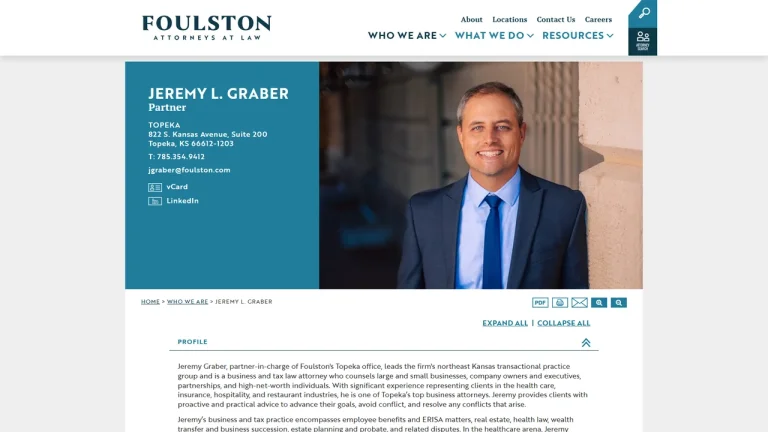
Jeremy L. Graber - Topeka, KS

Liesmann Law - Topeka, KS
Eric Kjorlie - Topeka, KS
Duncan Whittier Attorney at Law - Topeka, KS
Dietrick Law - Topeka, KS
Cavanaugh, Biggs & Lemon P.A. - Topeka, KS

Henson, Hutton, Mudrick, Gragson & Vogelsberg, LLP - TOPEKA, KS

Foulston Siefkin LLP - TOPEKA, KS
Navigating Workplace and Labor Disputes in Topeka, KS
As the capital of Kansas, Topeka features a unique employment landscape dominated by state governmental agencies, major healthcare networks, manufacturing centers, and regional distribution facilities along the Interstate 70 corridor. While Kansas is an at-will employment state, workers and employers across Shawnee County are bound by comprehensive state and federal labor laws that strictly prohibit discrimination, retaliation, and unlawful wage theft.
Labor and employment controversies in Topeka frequently require exhausting administrative remedies before stepping into a courtroom. Administrative discrimination complaints are filed directly with the Kansas Human Rights Commission (KHRC), which is headquartered in downtown Topeka on Southwest Jackson Street. In addition, state civil service employees dispute adverse disciplinary actions before the Kansas Civil Service Board, while wage claims are reviewed by the Kansas Department of Labor on Southwest Topeka Boulevard.
When disputes escalate to civil litigation, matters are heard in the 3rd Judicial District Court of Kansas at the Shawnee County Courthouse, or in the U.S. District Court for the District of Kansas at the Frank Carlson Federal Building on Southeast Quincy Street. Retaining a local employment attorney ensures that your claims are correctly investigated, administratively perfected, and effectively argued before local tribunals.
Typical Employment Legal Costs and Retainer Structures
| Case Scenario | Fee Structure | Estimated Cost (USD) | Key Cost Determinants |
|---|---|---|---|
| Severance Review & Non-Compete Evaluation | Flat Fee or Hourly ($250-$450/hr) | $750 - $2,500 | Review of restrictive covenants, release of claims, and executive compensation negotiation. |
| Wage & Overtime Violations (KWPA / FLSA) | Contingency (25% - 35%) / Statutory Fees | $0 upfront (Statutory Recovery) | Payroll audits, number of uncompensated hours, misclassification claims, and liquidated damage calculations. |
| Workplace Discrimination & Retaliation | Contingency (33.3% - 40%) + Expenses | $0 upfront or Retainer | KHRC and EEOC administrative proceedings, witness depositions, front/back pay damages, and emotional distress evidence. |
| Civil Service Appeals & Federal Litigation | Hourly Billing ($300-$500/hr) | $10,000 - $40,000+ | Administrative board hearings, federal motion practice, electronic discovery, and trial days at Frank Carlson Courthouse. |
Critical Legal Deadlines & Statutes in Kansas
Workplace claims in Kansas are subject to strict statutory notice windows and statutes of limitations. Under the Kansas Act Against Discrimination, codified at Kan. Stat. Ann. § 44-1005, an administrative complaint detailing workplace discrimination or harassment must be submitted to the Kansas Human Rights Commission within six months (180 days) of the discriminatory act. Missing this mandatory 180-day window permanently extinguishes your right to seek legal remedies under Kansas anti-discrimination law.
For classified state employees in Topeka, disciplinary appeals carry even tighter deadlines. Under the Kansas Civil Service Act, specifically Kan. Stat. Ann. § 75-2949, a permanent employee dismissed, demoted, or suspended must file a written appeal with the Kansas Civil Service Board within strictly 30 calendar days of the effective date of the action.
Wage claims operate under statutory liability time limits. Under the Kansas Wage Payment Act (Kan. Stat. Ann. § 44-313 and enforcement under Kan. Stat. Ann. § 44-324), claims to recover unpaid wages or unauthorized deductions are governed by the three-year statute of limitations in Kan. Stat. Ann. § 60-512. Meanwhile, retaliatory discharge claims under Kansas public policy-such as retaliation for filing a workers' compensation claim-must be filed within two years pursuant to Kan. Stat. Ann. § 60-513.
Small Claims Limitations vs. Formal Labor Law Representation
The jurisdiction of the small claims division of the Shawnee County District Court is capped at $4,000 pursuant to the Kansas Small Claims Procedure Act (Kan. Stat. Ann. § 61-2703). Small claims courts handle simple monetary disputes; they possess no authority to adjudicate wrongful termination, workplace harassment, civil service discipline, or enforce statutory fee-shifting provisions.
Attempting to handle an employment dispute without legal counsel regularly leads to procedural forfeiture. Labor laws require thorough administrative exhaustion before the KHRC or EEOC before a lawsuit can be accepted by the 3rd Judicial District Court or federal court. Furthermore, employers retain aggressive legal teams to defend against claims. An experienced employment lawyer gathers crucial internal communications, protects against retaliatory actions, and calculates statutory damages under state and federal wage laws.
Red Flags When Selecting a Topeka Employment Lawyer
- Guarantees of Substantial Financial Payouts: Reputable employment attorneys cannot promise specific dollar recoveries before reviewing personnel files and administrative findings.
- Skipping Mandatory KHRC/EEOC Exhaustion: Be cautious of counsel who attempts to bypass required administrative filings, which can result in the swift dismissal of your lawsuit.
- Unfamiliarity with Kansas Civil Service Procedures: If you are a state employee, ensure your attorney understands the specialized procedural rules of the Kansas Civil Service Board.
- Opaque Case Cost Accounting: Ensure your contingency fee agreement clearly explains how expenses-such as court reporters, filing fees, and expert depositions-are handled and deducted.
Frequently Asked Questions
What does at-will employment mean in Topeka, KS?
At-will employment means an employer can terminate an employee at any time for any legal reason or no reason at all. However, an employer cannot terminate an employee for illegal discriminatory reasons, in violation of a written contract, or in retaliation for activities protected under Kansas public policy.
How long do I have to file a discrimination complaint in Topeka?
Under Kan. Stat. Ann. § 44-1005, you have 180 days (six months) from the date of the unlawful discriminatory act to file an administrative complaint with the Kansas Human Rights Commission (KHRC). Dual filings under federal law through the EEOC generally provide up to 300 days.
What should I do if my employer fails to pay my final wages?
Under Kan. Stat. Ann. § 44-315, your employer must pay all earned wages by the next regular payday. If they fail to do so, you can file a wage claim with the Kansas Department of Labor or initiate civil litigation under the Kansas Wage Payment Act within three years.
How can a Kansas state employee appeal a disciplinary dismissal?
Under Kan. Stat. Ann. § 75-2949, a permanent classified state employee must file a written appeal with the Kansas Civil Service Board within 30 calendar days of the effective date of dismissal to request a formal evidentiary hearing.
Can an employer fire me for filing a workers' compensation claim?
No. Terminating an employee for exercising their statutory rights under the Kansas Workers Compensation Act constitutes wrongful discharge in violation of Kansas public policy. Claimants have two years to bring a retaliatory discharge action under Kan. Stat. Ann. § 60-513.