
Patent Attorneys in Louisiana
Retaining an experienced Louisiana patent attorney protects your proprietary inventions and industrial innovations before the USPTO. Qualified patent counsel conducts rigorous prior art searches, drafts enforceable claims, and safeguards your intellectual property rights through administrative and judicial channels. Browse our verified directory below to consult with licensed patent lawyers serving creators across Louisiana.

Matt Miller, Registered Patent Attorney - New Orleans, LA
Next IP Law Group LLC - New Orleans, LA
M Breaux Intellectual Property Law - New Orleans, LA
Lemler IP, LLC - New Orleans, LA
The Carver Law Firm - Baton Rouge, LA
Kean Miller LLP - New Orleans, LA
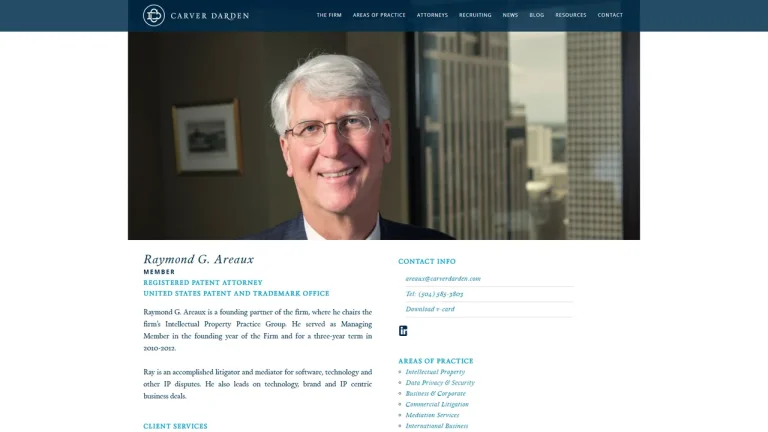
Raymond G. Areaux - Carver Darden - New Orleans, LA

Law Office of Greg Mier, LLC - Lafayette, LA
IPC | Intellectual Property Consulting, LLC - New Orleans, LA
HULSEY P.C. - Shreveport, LA

Holoubek Patent Law LLC - Shreveport, LA

AEON Law - Patent, Trademark, and Copyright Attorneys - New Orleans, LA
DAVID W. NANCE LAW FIRM, LLC - New Orleans, LA
Garvey, Smith & Nehrbass, Patent Attorneys, L.L.C. - New Orleans, LA
Belle Terre Law Firm - Baton Rouge, LA
Roy Kiesel Ford Doody and Thurmon APLC - Baton Rouge, LA

Law Offices of Patrick L. Mixon LLC - Shreveport, LA
Durio, McGoffin, Stagg and Ackermann - Lafayette, LA
Creativa IP Law - New Orleans, LA
Edel Patents LLC - Baton Rouge, LA

Buckley Law Firm - New Orleans, LA
Keaty Patent Firm - New Orleans, LA
Mora Law Office - New Orleans, LA

Safeguarding Inventions Across Louisiana's Innovation Corridors
Louisiana represents a dynamic industrial landscape encompassing offshore engineering, petrochemical manufacturing, advanced agricultural biotechnology, medical research, and maritime logistics. Developing novel mechanical systems, chemical processes, or software applications requires securing robust intellectual property protection. Patent prosecution demands legal practitioners who hold specific registration with the United States Patent and Trademark Office (USPTO) alongside admission to the Louisiana State Bar Association.
Securing a patent involves meticulous drafting of specifications, independent and dependent claims, and formal engineering drawings. From university research institutions in Baton Rouge and New Orleans to industrial fabrication centers in Lafayette, Houma, and Shreveport, inventors rely on patent counsel to establish priority dates and respond to substantive office actions from federal patent examiners.
When patent validity disputes or infringement claims arise, enforcement actions proceed under exclusive federal jurisdiction. Infringement litigation within Louisiana is heard in the United States District Court for the Eastern District of Louisiana in New Orleans, the Middle District of Louisiana in Baton Rouge, or the Western District of Louisiana with divisions in Shreveport, Lafayette, and Lake Charles. Appellate oversight of all patent litigation is vested exclusively in the United States Court of Appeals for the Federal Circuit.
Estimated Costs and Fee Schedules for Louisiana Patent Matters
| Case Scenario | Fee Structure | Estimated Cost (USD) | Key Cost Determinants |
|---|---|---|---|
| Comprehensive Patentability Search & Legal Opinion | Flat Fee | $1,500 - $3,500 | Scope of prior art databases analyzed, technical complexity of the apparatus, and international registry searches. |
| Provisional Patent Application Preparation | Flat Fee | $2,500 - $5,500 | Drafting depth, incorporation of detailed engineering schematics, and claim breadth needed to secure a defensible priority date. |
| Non-Provisional Utility Patent Prosecution | Flat Fee + Hourly | $7,500 - $16,000 | Number of claims drafted, technical complexity, USPTO filing fees, and substantive office action responses. |
| Federal Patent Infringement Litigation | Hourly Retainer | $50,000 - $250,000+ | Markman claim construction hearings, expert witness testimony, electronic discovery volume, and trial duration. |
Critical Legal Deadlines & Statutes for Patent Protection
Under United States patent law, strict statutory timelines govern patentability. The America Invents Act established a first-inventor-to-file framework codified under 35 U.S. Code § 102. Inventors have a strict one-year grace period from the date an invention is first described in a public disclosure, offered for commercial sale, or put into public use to file a patent application; missing this statutory deadline permanently bars patent protection.
When establishing priority through a provisional application, 35 U.S. Code § 119 provides a non-extendable 12-month statutory deadline to file the corresponding non-provisional utility patent application claiming benefit of the provisional filing date. Failure to file within this twelve-month window results in the complete abandonment of the provisional priority claim.
Once an issued patent is asserted against infringers, 35 U.S. Code § 286 restricts financial recovery by imposing a six-year statute of limitations on patent infringement damages incurred prior to the filing of the complaint. Proprietary technological know-how that has not yet been published through the patent process is protected under state law via the Louisiana Uniform Trade Secrets Act, codified at La. R.S. 51:1431, which carries a three-year prescriptive period from discovery of misappropriation under La. R.S. 51:1436.
Self-Filing Dangers vs. USPTO-Registered Patent Representation
Under 28 U.S. Code § 1338, federal courts maintain exclusive jurisdiction over civil actions arising under federal patent statutes. Louisiana state district courts, parish courts, and small claims divisions of city courts possess zero jurisdiction to issue patents, evaluate claim validity, or award infringement damages. Pro se filings by inventors directly with the USPTO routinely result in fatal procedural defects, such as inadvertently narrow patent claims that competitors can design around without consequence.
To represent clients before the USPTO, legal practitioners must pass the comprehensive USPTO Registration Examination (the Patent Bar) and hold an accredited degree in engineering, computer science, or the hard physical sciences under 37 C.F.R. § 11.6. Retaining a registered patent attorney ensures your technological disclosures are translated into legally enforceable patent claims capable of withstanding post-grant reviews and federal litigation.
Red Flags When Selecting an Invention Advocate
- Invention promotion companies and marketing firms that demand upfront payments while promising guaranteed commercial licensing without licensed patent attorney oversight.
- General practice attorneys who offer to file patent applications without holding an active registration number issued by the USPTO Office of Enrollment and Discipline.
- Agencies that fail to execute binding, reciprocal Non-Disclosure Agreements (NDAs) prior to reviewing confidential blueprints, formulas, or prototypes.
- Firms that promise guaranteed patent issuance or claim that the USPTO will not issue substantive rejections during prosecution.
Frequently Asked Questions
What is the difference between a provisional and a non-provisional patent application?
A provisional patent application serves as a temporary, lower-cost placeholder that secures an official filing priority date for 12 months under federal law. It is never reviewed by an examiner and must be converted to a formal non-provisional application with formal claims within one year to mature into an enforceable patent.
Can any licensed Louisiana attorney prepare and file my patent application?
No. While any Louisiana attorney in good standing can handle general legal matters, only attorneys who have demonstrated technical qualifications and passed the federal Patent Bar examination administered by the USPTO are legally authorized to prosecute patent applications before the agency.
Where are patent infringement lawsuits filed in Louisiana?
Patent infringement actions must be brought in federal court. Depending on where the infringement occurred or where the defendant resides, suits are filed in the United States District Court for the Eastern District in New Orleans, the Middle District in Baton Rouge, or the Western District with divisions in Shreveport and Lafayette.
How long does utility patent protection last in the United States?
A United States utility patent granted under federal statute provides exclusive rights for a term of 20 years from the earliest effective filing date of the non-provisional application, subject to the timely payment of statutory USPTO maintenance fees.
What qualifies as public disclosure that triggers the one-year filing clock?
Under federal patent rules, selling your product, offering it for commercial sale, displaying it at an industry trade show, or publishing details online starts the strict one-year grace period. Failure to file an application within one year of that disclosure permanently destroys your right to obtain a patent.