
Wills Lawyers in Maine
Drafting a legally binding will in Maine ensures your estate is distributed according to your wishes while minimizing probate disputes for your beneficiaries. Experienced estate planning attorneys draft customized wills, trusts, and advance directives that comply with the Maine Uniform Probate Code. Explore our directory below to schedule a consultation with verified Maine wills attorneys.

Jessica A Demers Attorney - Portland, ME

Oath - Portland Estate Planning & Investment Attorneys - Portland, ME

PallaSinclair Law Offices - Portland, ME

Teel Law Office - Portland, ME

Stevens & Day, LLP - Augusta, ME
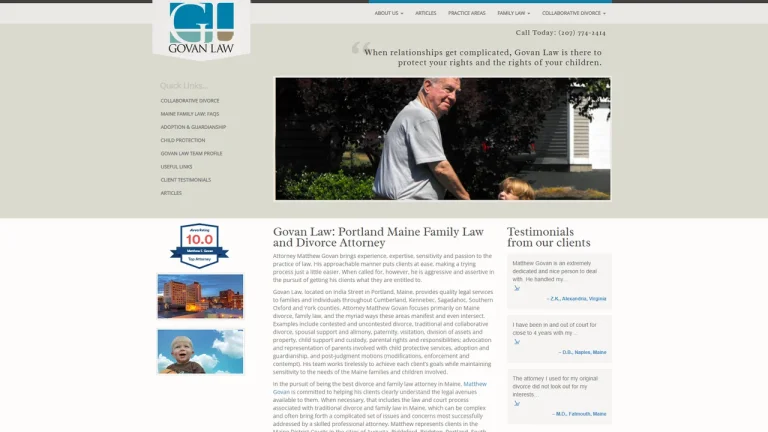
Govan Law Office, P.A. - Portland, ME
CurrierBuchanan - Portland, ME

Bourassa & Petersen - Augusta, ME

Schwartz & Schwartz, P.A. - Portland, ME

McCandless Law - Portland, ME

Drummond & Drummond, LLP - Portland, ME

Robert S. Hark, Attorney at Law - Portland, ME

Law Office of Gary W. Libby - Portland, ME

Hopkinson & Abbondanza - Portland, ME

Port City Legal - Portland, ME

Perkins Thompson, P.A. - Portland, ME

Lisa J. Friedlander - Portland, ME

Farris, Foley & Dick P.A. - Augusta, ME

Jim Mitchell & Jed Davis, P.A. - Augusta, ME

Goodspeed & O'Donnell - Augusta, ME

Carlin & Shapiro, P.A. - Portland, ME

Robert A. Levine, Esq. - Portland, ME
Law Office of N. Seth Levy - Portland, ME

The Importance of Maine Legal Counsel in Will & Estate Planning
Estate planning in Maine involves navigating the statutory provisions of the Maine Uniform Probate Code, codified under Title 18-C of the Maine Revised Statutes. Whether planning for residential real estate in Portland, coastal family holdings in York County, timber acreage in Penobscot County, or small business succession in Bangor, drafting a legally sound will ensures your assets are distributed according to your wishes without prolonged judicial intervention.
Estate administration and will validation are conducted through Maine's 16 county-level Probate Courts, including the Cumberland County Probate Court in Portland, the York County Probate Court in Alfred, and the Kennebec County Probate Court in Augusta. Each county probate court is presided over by an elected probate judge. Retaining a local attorney familiar with county probate procedures and filing requirements helps your personal representative navigate estate administration efficiently.
A comprehensive estate plan coordinated by a Maine lawyer extends beyond a basic last will and testament. Counsel prepares durable financial powers of attorney, designations of healthcare surrogates, advance health care directives, and testamentary or living trusts. Engaging qualified legal counsel licensed by the Maine Board of Overseers of the Bar prevents statutory challenges, preserves multi-generational assets, and minimizes state estate tax liabilities.
Maine Wills & Estate Planning Fee Overview
| Case Scenario | Fee Structure | Estimated Cost (USD) | Key Cost Determinants |
|---|---|---|---|
| Individual Basic Will & Advance Directives | Flat Legal Fee | $600 - $1,400 | Asset simplicity, clear beneficiary designations, and standard healthcare power of attorney. |
| Comprehensive Estate Plan with Testamentary Trust | Flat Legal Fee | $1,500 - $3,500 | Minor child protection provisions, blended family arrangements, and real estate deed transfers. |
| High-Net-Worth Will & Tax Planning Structure | Retainer / Hourly Fee | $3,500 - $8,000 | Maine estate tax thresholds, business succession integration, and multi-property timber or coastal trusts. |
| Contested Will Defense & Probate Litigation | Litigation Retainer | $5,000 - $15,000 | County Probate Court appearances, undue influence claims, capacity evaluations, and evidentiary motions. |
Critical Legal Deadlines & Statutes in Maine
The Maine Uniform Probate Code establishes rigorous statutory deadlines for probating wills and presenting claims against an estate. Under 18-C M.R.S. § 3-108, formal or informal probate proceedings must be commenced within 3 years after the decedent's death. If no will is submitted to the county probate court within this three-year period, the estate is presumed intestate, and assets distribute according to statutory descent rules.
Creditors wishing to file claims against a decedent's estate face clear statutory limitations under 18-C M.R.S. § 3-803. Claims must be presented within 4 months after the date of first publication of notice to creditors, or within 1 year after the decedent's death if notice is not published. For surviving spouses electing to claim a statutory share rather than taking under the will, 18-C M.R.S. § 2-211 mandates that the election must be made within 9 months after the decedent's death or within 6 months after the probate of the will.
DIY Will Kits vs. Retaining a Maine Wills Attorney
Under 18-C M.R.S. § 3-1201, small estates in Maine with a net value of $40,000 or less (excluding liens and encumbrances) may utilize a simplified affidavit process to collect personal property without full probate administration. However, estates involving real property, business ownership, or value exceeding this threshold must proceed through the county probate court system.
Online forms and DIY will templates frequently fail to comply with Maine execution requirements under 18-C M.R.S. § 2-502, which requires a written document signed by the testator and at least two witnessing individuals. Boilerplate forms regularly omit self-proving affidavits under 18-C M.R.S. § 2-504, requiring witnesses to testify in court years later. Working with a Maine wills attorney eliminates drafting ambiguities, coordinates non-probate asset beneficiary designations, and ensures the estate plan withstands judicial review in the local probate court.
Red Flags When Selecting a Maine Estate Planning Lawyer
- Reliance on one-size-fits-all generic templates that fail to reference Title 18-C of the Maine Revised Statutes.
- Attorneys who omit self-proving affidavits, complicating subsequent probate validation for surviving family members.
- Failure to evaluate beneficiary designations on retirement accounts, life insurance policies, or jointly held real estate.
- Attorneys without active registration or verified standing before the Maine Board of Overseers of the Bar.
Frequently Asked Questions
What are the legal requirements for a valid will in Maine?
Pursuant to 18-C M.R.S. § 2-502, a valid will must be in writing, signed by the testator (or in the testator's name by someone in their conscious presence and direction), and signed by at least two individuals who witnessed the signing or the testator's acknowledgment of the signature.
Does having a will avoid probate court in Maine?
No, a will does not avoid probate. A will serves as an instructional legal instrument directing the county Probate Court on how to distribute assets. To transfer property outside of probate, individuals frequently establish revocable living trusts or utilize transfer-on-death beneficiary designations.
What is the small estate limit in Maine?
Under 18-C M.R.S. § 3-1201, if the total value of a decedent's estate (less liens and encumbrances) does not exceed $40,000, surviving successors can collect assets using an affidavit for collection of personal property without initiating formal probate proceedings.
Can I disinherit my spouse in a Maine will?
Under 18-C M.R.S. § 2-202, a surviving spouse has the statutory right to claim an elective share of the decedent's augmented estate, regardless of contrary provisions in the will, unless this right was validly waived through an enforceable prenuptial or postnuptial agreement.
What is a self-proving will under Maine law?
Under 18-C M.R.S. § 2-504, a will is made self-proving by attaching a notarized acknowledgment signed by the testator and witnesses at the time of execution. This allows the county probate court to accept the will without requiring the witnesses to appear and testify.