
Workers' Compensation Lawyers in Massachusetts
Retaining an experienced Massachusetts workers' compensation lawyer ensures your wage replacement and medical benefits are protected after a job injury. Dedicated attorneys manage Department of Industrial Accidents filings, resolve disputed medical treatment, and negotiate lump-sum settlements before formal hearings. Explore our verified statewide directory below to connect with qualified Massachusetts workers' comp counsel.

Law Office of Jeffrey A. Young - Lowell, MA

Feinberg, Dumont & Brennan - Boston, MA

Sokolove Law - Boston, MA

TopDog Law Personal Injury Lawyers - Boston, MA

Parker Scheer LLP - Boston, MA

The Law Office of Russell D. Luiz - New Bedford, MA

Michael Kelly Injury Lawyers - Worcester, MA
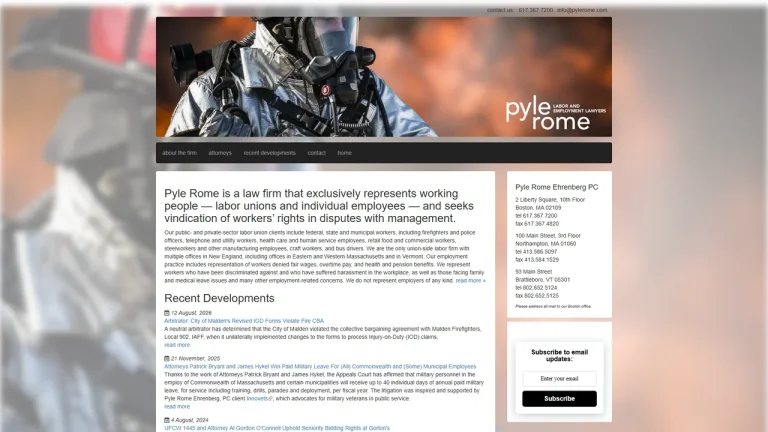
Pyle Rome Ehrenberg PC - Boston, MA

Markey Law Partners - Boston, MA
Carter Mario Injury Lawyers | Springfield Office - MA

Sweeney Merrigan Personal Injury Lawyers - Worcester, MA

Pulgini & Norton, LLP - New Bedford, MA

Jim Glaser Law - Cambridge, MA

The Law Office of John J. Strazzulla - Quincy, MA
Brandon J Broderick, Personal Injury Attorney at Law - Lynn, MA

Finkelstein & Partners, LLP - Boston, MA

Jantzen and Associates, P.C. - Boston, MA

Boston Personal Injury Attorney at Law, Brandon J. Broderick - Boston, MA

Michaud Law Group - Boston, MA

Attorney Jennifer L. Cava-Foreman - Springfield, MA
Law Offices of Morgan J. Gray, P.C. - Quincy, MA
Percy Law Group, PC - Fall River, MA
Leontire & Associates, P.C. - Boston, MA
Navigating the Massachusetts Department of Industrial Accidents (DIA)
Sustaining a disabling injury on a commercial construction site in Boston, an industrial manufacturing plant in Worcester, a logistics facility in Springfield, or a medical center in Cambridge creates immediate financial turmoil. Injured workers face lost wages and escalating medical bills while navigating the specialized administrative procedures of the Massachusetts Department of Industrial Accidents (DIA).
A knowledgeable workers' compensation attorney files formal claims, secures necessary medical records, and defends against insurance efforts to terminate or reduce weekly disability checks. Retaining legal counsel protects workers against adverse independent medical examinations (IMEs) and ensures average weekly wage calculations accurately reflect all overtime and concurrent employment earnings.
Disputed workplace injury claims are managed exclusively by the Massachusetts Department of Industrial Accidents through regional offices located in Boston, Lawrence, Fall River, Worcester, and Springfield. The dispute resolution process progresses through conciliation, judicial conference, and formal evidentiary hearings under administrative judges, with appeals heard by the DIA Reviewing Board and the Massachusetts Appeals Court.
Statutory Benefits and Costs in Massachusetts Workers' Compensation
| Case Scenario | Fee Structure | Estimated Cost (USD) | Key Cost Determinants |
|---|---|---|---|
| Temporary Total Disability (§ 34) Dispute | Insurer-Paid Statutory Fee | $0 Out-of-Pocket (Insurer Pays Legal Fees) | Average weekly wage calculation accuracy, medical off-work documentation, and insurer denials. |
| Partial Disability (§ 35) & Earning Capacity | Insurer-Paid Statutory Fee | $0 Out-of-Pocket (Insurer Pays Legal Fees) | Earning capacity assessments, light-duty availability, and independent medical examiner reports. |
| Lump-Sum Settlement (§ 48 Agreement) | Statutory Contingency (15% - 20%) | $0 Upfront (Deducted from Settlement) | Whether insurer admitted liability (20% fee) or disputed liability (15% fee), and future medical projections. |
| Third-Party Personal Injury Civil Lawsuit | Contingency Fee (33.3% - 40%) | $0 Upfront ($50,000 - $750,000+ recovered) | Negligent general contractor or equipment manufacturer liability, and statutory lien petition approval. |
Critical Legal Deadlines & Statutes in Massachusetts Workers' Compensation
Under M.G.L. c. 152 § 41, an injured worker must give notice of an injury to the employer or insurer as soon as practicable. A formal Employee Claim must be filed with the DIA within four years of the date the worker became aware of the causal connection between the disability and the employment. In fatal workplace injury claims, the four-year limitations period begins on the date of death.
The Massachusetts Workers' Compensation Act establishes distinct statutory benefit categories. Under M.G.L. c. 152 § 34, temporary total incapacity benefits are paid at 60 percent of the employee average weekly wage for up to 156 weeks (three years). Temporary partial incapacity benefits under M.G.L. c. 152 § 35 provide up to 75 percent of the total disability rate for up to 260 weeks (five years). Permanent and total disability is governed by M.G.L. c. 152 § 34A, paying 66.67 percent of average weekly wages for the duration of the incapacity.
Additional compensation for permanent functional loss and disfigurement is provided under M.G.L. c. 152 § 36. Under M.G.L. c. 152 § 13A, the workers' compensation insurer is legally required to pay statutory attorney fees if the employee prevails at a conciliation, conference, or hearing, ensuring no out-of-pocket costs to the worker. Furthermore, M.G.L. c. 152 § 15 authorizes the injured worker to pursue a third-party negligence lawsuit in Massachusetts Superior Court against non-employer parties responsible for the injury.
Small Claims Limits vs. Professional Representation in Workers' Compensation
Massachusetts small claims courts in the District Court and Boston Municipal Court are capped at $7,000 under M.G.L. c. 218 § 21. However, small claims courts have zero legal jurisdiction over workplace injuries. The Massachusetts Workers' Compensation Act vests exclusive original jurisdiction over all employment injury claims in the Department of Industrial Accidents.
Attempting to represent yourself before the DIA leaves you exposed to experienced insurance defense lawyers. The administrative process involves complex medical depositions under M.G.L. c. 152 § 11A, vocational evaluations, and formal evidentiary hearings. Because M.G.L. c. 152 § 13A requires the workers' compensation insurer to pay your attorney statutory fees when you prevail at a conference or hearing, injured workers obtain seasoned legal representation at zero out-of-pocket cost.
Red Flags When Hiring a Massachusetts Workers' Compensation Attorney
- Attorneys who attempt to charge upfront cash retainers or out-of-pocket consultation fees, which is strictly prohibited under Massachusetts workers' compensation law.
- Lawyers who pressure injured employees to accept early, inadequate lump-sum settlements before reaching Maximum Medical Improvement (MMI).
- Practitioners who fail to evaluate third-party tort claims against negligent subcontractors, landowners, or equipment manufacturers under M.G.L. c. 152 § 15.
- Firms lacking regular practice experience before administrative judges at the Department of Industrial Accidents regional offices.
Frequently Asked Questions
How do attorney fees work in Massachusetts workers' compensation cases?
You do not pay upfront attorney fees. Under Massachusetts law, if your lawyer successfully defends your benefits or wins your claim at a DIA conference or hearing, the insurance company is ordered to pay statutory legal fees directly to your attorney.
What weekly wage benefits am I entitled to after a work injury in Massachusetts?
If you are temporarily totally disabled, you are entitled to 60 percent of your average weekly wage under Section 34, subject to state maximums. If you can perform light-duty work, you may receive partial disability benefits under Section 35.
Can I choose my own treating doctor for a Massachusetts work injury?
Yes. While your employer can require you to attend an initial evaluation with their company clinic or preferred occupational doctor for your first visit, you have the statutory right under Massachusetts law to choose your own treating physician thereafter.
What is an impartial medical examination under Section 11A at the DIA?
If a judicial conference decision is appealed to a formal hearing, the DIA appoints an impartial medical physician under Section 11A. The impartial doctor report is considered prima facie medical evidence regarding your disability status and causation.
Can I file a personal injury lawsuit in addition to my workers' compensation claim?
Yes, if your injury was caused by the negligence of a third party (such as a separate subcontractor, equipment manufacturer, or negligent driver) rather than your direct employer. You can pursue a third-party lawsuit in Massachusetts Superior Court while receiving workers' compensation benefits.