
Wrongful Death Lawyers in Massachusetts
Pursuing a wrongful death claim in Massachusetts provides vital financial accountability and justice for surviving family members after a fatal accident. An experienced Massachusetts wrongful death attorney can manage the probate appointment process, establish corporate or individual liability, and maximize statutory recovery. Explore our statewide directory below to consult a compassionate, verified legal advocate in Massachusetts today.

Joel H. Schwartz, P.C. - Boston, MA

Jenkins Bryant & Surrette - Worcester, MA

McGuire & McGuire, P.C. - Worcester, MA

d'Oliveira & Associates, P.C. - Boston, MA

Law Offices of Andrew J Zaroulis - Lowell, MA

Brian R Murphy Law Offices - Lawrence, MA

Facchini & Facchini PC - Springfield, MA

Lubin & Meyer PC - Boston, MA

Law Office of John J. Sheehan, LLC - Boston, MA

Houlihan Law - Boston, MA
Pellegrini, Seeley, Ryan & Blakesley, P.C. - Springfield, MA
Manzi & Seccareccio, P.C. - Lowell, MA

Gillis & Bikofsky, P.C. - Newton, MA

Fogelman Law LLC - Personal Injury and Employment Law Attorneys - Newton, MA

The Fernandez Firm - Boston, MA

Combies Hanson, P.C. - Boston, MA

Dunn & Phillips - Springfield, MA

Haddad Law Firm - Boston, MA

Robert C. Whitcomb, Attorney At Law - Worcester, MA
Law Office of Greg Krikorian LLC - Cambridge, MA
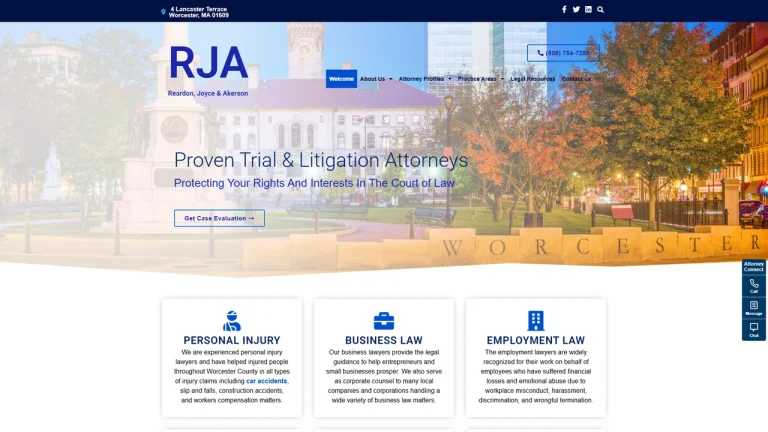
Reardon, Joyce & Akerson, PC - Worcester, MA

Heeg Law, PLLC - Boston, MA

Law Office of David P. Dwork - Boston, MA
Navigating Fatal Accident Litigation Across Massachusetts Courts
Wrongful death litigation in Massachusetts is strictly controlled by state statutory frameworks designed to compensate surviving beneficiaries and hold negligent parties accountable. Under the Massachusetts Wrongful Death Act, claims must be initiated within the Massachusetts Trial Court system. Actions seeking substantial damages are litigated in the Massachusetts Superior Court, with major judicial divisions sitting in Suffolk County (Boston), Middlesex County (Woburn and Cambridge), Worcester County, Essex County (Salem and Lawrence), and Norfolk County (Dedham). Multi-state or federal claims are adjudicated in the United States District Court for the District of Massachusetts in Boston, Worcester, or Springfield, with all state filings managed electronically through the eFileMA portal.
Unlike ordinary personal injury claims, a wrongful death lawsuit cannot be filed directly by individual family members. Under Massachusetts law, only the formally appointed executor or administrator (personal representative) of the decedent's estate possesses legal standing to commence an action. This requires an initial proceeding in the Massachusetts Probate and Family Court of the county where the deceased resided to secure official Letters of Authority before filing the civil complaint in Superior Court.
Retaining an experienced Massachusetts wrongful death attorney is vital to managing this dual-court process. Dedicated legal counsel conducts thorough accident investigations, issues preservation letters for electronic logging devices and surveillance video, coordinates with forensic reconstruction specialists, and ensures that damages for both conscious pain and suffering and wrongful death are fully presented.
Typical Wrongful Death Legal Fees & Case Structures in Massachusetts
| Case Scenario | Fee Structure | Estimated Cost (USD) | Key Cost Determinants |
|---|---|---|---|
| Commercial Vehicle & Trucking Fatal Collision | Contingency Fee | 33.3% - 40% of Recovery | Electronic logging device (ELD) analysis, federal safety violations, multi-policy coverage |
| Fatal Workplace or Construction Site Accident | Contingency Fee | 33.3% - 40% of Recovery | Third-party tort liability, OSHA investigation findings, workers' compensation lien negotiation |
| Medical Malpractice Resulting in Fatal Complications | Contingency Fee | Statutory / Contingency | Medical malpractice tribunal review, multiple expert physician reviews, hospital liability |
| Fatal Premises Liability & Inadequate Security | Contingency Fee | 33.3% - 40% of Recovery | Foreseeability evidence, commercial property insurance limits, municipal crime statistics |
Critical Legal Deadlines & Statutes in Massachusetts
Wrongful death claims in Massachusetts operate under unforgiving statutory timelines. Pursuant to M.G.L. c. 229, § 2, a wrongful death lawsuit must be commenced within three years from the date of the decedent's death, or within three years from the date when the executor or administrator knew, or should have known, the factual basis for the claim.
In addition to wrongful death damages, an estate can recover for the decedent's conscious pain and suffering prior to death under the Massachusetts survival statute codified at M.G.L. c. 228, § 1, which is governed by the three-year tort statute of limitations under M.G.L. c. 260, § 2A. If the fatal injury was caused by the Commonwealth of Massachusetts, the MBTA, or a local municipality, a formal written presentment letter must be served within two years of the incident under M.G.L. c. 258, § 4 before any lawsuit can be instituted. Under M.G.L. c. 229, § 2, punitive damages of not less than $5,000 may be awarded if the death was caused by malicious, willful, wanton, or reckless conduct, or by gross negligence. Any appeal of a final Superior Court judgment must be noted within thirty days under Mass. R. App. P. 4.
Probate Standing Requirements vs. Skilled Trial Advocacy
While Massachusetts District Courts and the Boston Municipal Court adjudicate small claims up to $7,000 under M.G.L. c. 218, § 21, wrongful death claims are barred from informal handling. Individual heirs or family members cannot proceed pro se in a representative capacity. Attempting to manage a fatal injury claim without legal counsel creates severe procedural vulnerabilities, including potential dismissal if the three-year statute of limitations expires before a personal representative is formally appointed by the Probate and Family Court.
Insurance defense firms aggressively challenge liability, dispute whether conscious suffering occurred, and seek to allocate fault to the decedent under Massachusetts modified comparative negligence rules. Furthermore, wrongful death proceeds under M.G.L. c. 229, § 1 are designated exclusively for statutory beneficiaries and are protected from the decedent's general estate creditors. A skilled Massachusetts wrongful death attorney shields these funds from unlawful healthcare or creditor liens, retains economists to project lifetime lost support, and presents compelling evidence to secure maximum compensation.
Red Flags When Selecting a Massachusetts Wrongful Death Lawyer
- Failing to immediately open an estate in the Probate and Family Court to secure formal personal representative appointment under M.G.L. c. 190B, § 3-103.
- Demanding upfront out-of-pocket litigation retainers from grieving families rather than operating on a standard contingency fee arrangement.
- Overlooking the separate survival claim for conscious pain and suffering under M.G.L. c. 228, § 1, leaving substantial potential damages unasserted.
- Out-of-state lead generation operations that solicit fatal accident claims online without having Massachusetts bar admission or active Superior Court trial practice.
Frequently Asked Questions
Who has the legal right to file a wrongful death lawsuit in Massachusetts?
Under M.G.L. c. 229, § 2, only the formally appointed personal representative (executor or administrator) of the decedent's estate has legal standing to file a wrongful death lawsuit in Massachusetts. Individual family members cannot file the civil action in their own personal names.
What compensation can be recovered in a Massachusetts wrongful death action?
Recoverable damages include the reasonably expected net income, services, companionship, comfort, guidance, and advice the decedent would have provided to surviving beneficiaries, along with reasonable funeral expenses under M.G.L. c. 229, § 2, conscious pain and suffering under M.G.L. c. 228, § 1, and punitive damages for gross negligence.
What is the statute of limitations for wrongful death in Massachusetts?
Pursuant to M.G.L. c. 229, § 2, a wrongful death claim must be filed within three years from the date of the decedent's death, or within three years from when the personal representative knew or should have known of the factual basis for the claim.
Are wrongful death settlement proceeds taken by the decedent's creditors?
No. Under M.G.L. c. 229, § 1, wrongful death damages pass directly to statutory next of kin (such as surviving spouses and children) and do not become general estate assets subject to ordinary creditor claims, unlike survival damages for conscious suffering.
Can punitive damages be awarded in Massachusetts wrongful death cases?
Yes. Massachusetts law specifically authorizes punitive damages under M.G.L. c. 229, § 2 if the defendant's conduct was malicious, willful, wanton, reckless, or constituted gross negligence. The statute establishes a mandatory minimum punitive damages award of $5,000 where applicable.