
Employment & Labor Lawyers in Detroit
Facing an employment or labor dispute in Detroit? Retaining an experienced employment lawyer protects your workplace rights and career under Michigan statutes. Qualified legal counsel frequently resolves complex workplace conflicts through negotiation, collective bargaining, and mediation, avoiding prolonged courtroom litigation. Explore our directory below to consult with top-rated Wayne County employment attorneys today.

Joel B. Sklar Law - Detroit, MI

UAW Legal Services Plan - Detroit, MI
Lugosi Law Firm - Detroit, MI
The Miller Law Firm, P.C. - Detroit, MI

IG360 - Detroit, MI
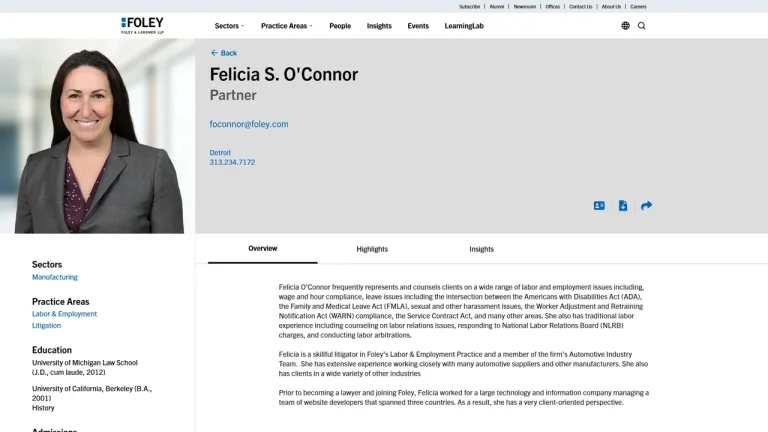
Felicia O'Connor - Foley and Lardner LLP - Detroit, MI

Lewis & Munday, P.C. - Detroit, MI
Barris, Sott, Denn & Driker, P.L.L.C. - Detroit, MI
Goodman Hurwitz & James, P.C. - Detroit, MI

Donald B. Miller - Detroit, MI

Sowell Law Partners PLLC - Detroit, MI

Hertz Schram PC - Detroit, MI (Penobscot Office)

Berry Moorman PC - Detroit, MI
D.C. Taylor Attorney and Associates - Detroit, MI

The Allen Law Group, P.C. - Detroit, MI
Southwest Legal Clinic - Detroit, MI
Taft Detroit (Downtown) - Detroit, MI
Clark Hill - Detroit, MI

Law Office of Marshall Goldberg - Detroit, MI
Edwards and Jennings PC - Detroit, MI

Juan A. Mateo - Detroit, MI

Butzel Long - Detroit, MI
John H. Willems - Detroit, MI
Navigating Employment and Labor Law in Detroit
Detroit stands as an industrial and corporate center with a workforce deeply anchored in automotive manufacturing, advanced engineering, healthcare systems, municipal services, and burgeoning tech ventures across Downtown, Midtown, Corktown, and New Center. The complex balance between management and unionized or at-will labor creates intricate legal dynamics under Michigan labor law. When employment disputes arise-whether involving wrongful discharge, non-compete agreements, executive compensation, or union grievances-retaining seasoned local counsel is critical.
Employment litigation in Detroit is handled across distinct state and federal venues. State-level claims under Michigan statutes are filed in the Wayne County 3rd Judicial Circuit Court, centered at the Coleman A. Young Municipal Center at 2 Woodward Avenue. Federal employment actions involving Title VII, the Family and Medical Leave Act, or the Fair Labor Standards Act proceed to the United States District Court for the Eastern District of Michigan, Southern Division, located at the Theodore Levin U.S. Courthouse on West Lafayette Boulevard.
Public sector and union disputes involve specialized regional bodies, such as the Michigan Employment Relations Commission (MERC) headquartered at Cadillac Place in Detroit, or the National Labor Relations Board (NLRB) Region 7 Detroit office. Local attorneys utilize Michigan's MiFILE portal for circuit actions and federal CM/ECF systems, bringing invaluable insight into local administrative procedures and judicial temperaments across Wayne County.
Common Fee Structures for Detroit Employment & Labor Matters
| Case Scenario | Fee Structure | Estimated Cost (USD) | Key Cost Determinants |
|---|---|---|---|
| Executive Contract & Severance Package Review | Flat Fee or Hourly Retainer | $1,500 - $4,500 | Review of non-compete clauses, deferred compensation plans, and corporate equity provisions. |
| Wrongful Termination & Civil Rights Litigation | Contingency Percentage | 33.3% - 40% of recovery | Evidence of retaliatory animus, employer size, wage loss calculations, and statutory fee-shifting. |
| Union Grievance & Labor Arbitration Hearing | Hourly Retainer | $4,000 - $12,500 | Collective bargaining agreement interpretation, witness preparation, and formal hearing duration. |
| Unfair Labor Practice Charge (NLRB / MERC) | Staged Hourly Retainer | $3,500 - $10,000 | Investigation scope, position paper drafting, and administrative law judge hearings. |
Critical Legal Deadlines & Statutes in Michigan
Employment rights in Detroit are strictly governed by statutory limitation periods. Civil rights actions under the Michigan Elliott-Larsen Civil Rights Act, codified at Mich. Comp. Laws § 37.2101, must be commenced within three years from the date of the adverse action pursuant to Mich. Comp. Laws § 600.5805. Administrative claims through the Michigan Department of Civil Rights require filing within 180 days under Mich. Comp. Laws § 37.2602.
Labor organizing and union practices involve shorter statutory windows. Under the Michigan Public Employment Relations Act, codified at Mich. Comp. Laws § 423.201, an unfair labor practice charge must be filed with MERC within six months of the alleged violation pursuant to Mich. Comp. Laws § 423.216. Parallel federal private-sector charges filed with the NLRB face an identical six-month limitations cutoff under 29 U.S. Code § 160. Wage disputes handled through the Michigan Department of Labor and Economic Opportunity must be filed within 12 months under Mich. Comp. Laws § 408.481. Missing these deadlines permanently bars legal relief.
Small Claims Limitations vs. Professional Employment Representation
The 36th District Court in Detroit, situated at 421 Madison Avenue, operates a Small Claims Division subject to a statutory jurisdictional cap of $7,000 under Mich. Comp. Laws § 600.8401. By Michigan statute, attorneys are prohibited from appearing on behalf of litigants during small claims hearings, and remedies are restricted strictly to modest monetary damages.
Employment and labor disputes are largely incompatible with small claims procedures. Issues such as wrongful termination, whistleblowing retaliation, or enforcement of non-disclosure covenants require discovery tools, including depositions, electronic records preservation, and forensic financial audits. Moreover, small claims courts lack equitable authority to order job reinstatement or invalidate unlawful contractual restrictive covenants. Retaining an attorney allows claims to proceed in the Wayne County 3rd Circuit Court or federal court, where full compensatory, punitive, and statutory attorney fees can be pursued.
Red Flags When Hiring a Detroit Employment Lawyer
- Attorneys who guarantee an immediate six-figure severance settlement without first analyzing the company employee handbook, performance evaluations, or corporate arbitration agreements.
- Lawyers advising union-represented workers to file external civil lawsuits without first exploring and exhausting mandatory collective bargaining grievance steps.
- Firms demanding large non-refundable upfront cash retainers for civil rights or wage disputes without providing clear written fee agreements.
- Counsel lacking direct litigation experience in the Eastern District of Michigan or the Wayne County Circuit Court Business and Civil Divisions.
Frequently Asked Questions
Is Michigan an at-will employment state?
Yes. Michigan operates under the at-will employment doctrine, meaning an employer may terminate an employee for any reason or no reason, provided the termination does not violate public policy, statutory civil rights protections, or an explicit employment or collective bargaining contract.
Are non-compete agreements enforceable in Detroit?
Under Michigan law, non-compete agreements are enforceable only to the extent they protect an employer's reasonable competitive business interests, such as trade secrets, and are strictly limited in duration, geographic area, and the type of employment restricted.
What is the difference between filing with MERC and the NLRB?
MERC (Michigan Employment Relations Commission) resolves labor relations and unfair labor practice charges for public-sector workers in Michigan, including teachers and municipal staff. The NLRB handles private-sector collective bargaining and unfair labor practices across private enterprises.
What protections exist for whistleblowers in Michigan?
The Michigan Whistleblowers' Protection Act protects employees who report or are about to report a suspected violation of local, state, or federal law to a public body. Lawsuits must be filed within 90 days of the retaliatory action.
How do attorney fees work in wrongful termination cases?
Most wrongful termination cases are taken on a contingency fee basis, where the attorney receives a percentage of the financial recovery. In civil rights cases, Michigan statutes also provide fee-shifting mechanisms where the losing employer may be ordered to pay your reasonable legal fees.