
Wage & Hour Lawyers in Detroit
Retaining a seasoned Detroit wage and hour attorney protects your earnings against unlawful overtime withholding, employee misclassification, and tip skimming. Skilled employment lawyers resolve compensation disputes through out-of-court negotiations or federal litigation to recover back wages and statutory liquidated damages. Explore our directory below to consult an experienced Wayne County wage rights advocate.

The Miller Law Firm, P.C. - Detroit, MI

Littler Mendelson P.C. - Detroit, MI
Schulz Ghannam P.L.L.C. - Detroit, MI

The Allen Law Group, P.C. - Detroit, MI
VanOverbeke Michaud and Timmony - Detroit, MI

Beverly Hall Burns - Detroit, MI
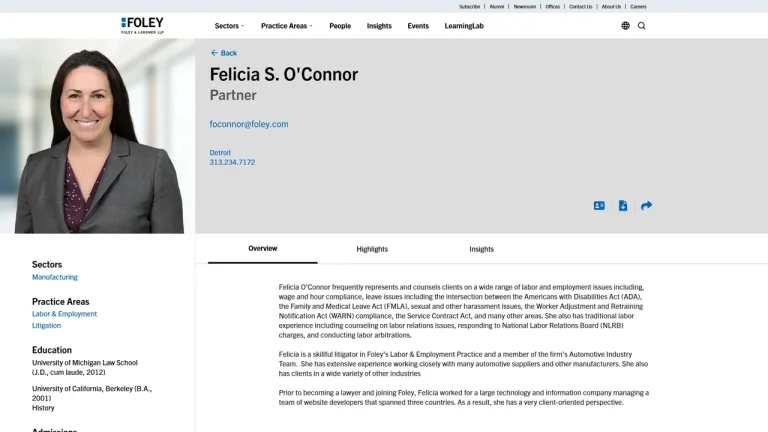
Felicia O'Connor - Foley and Lardner LLP - Detroit, MI
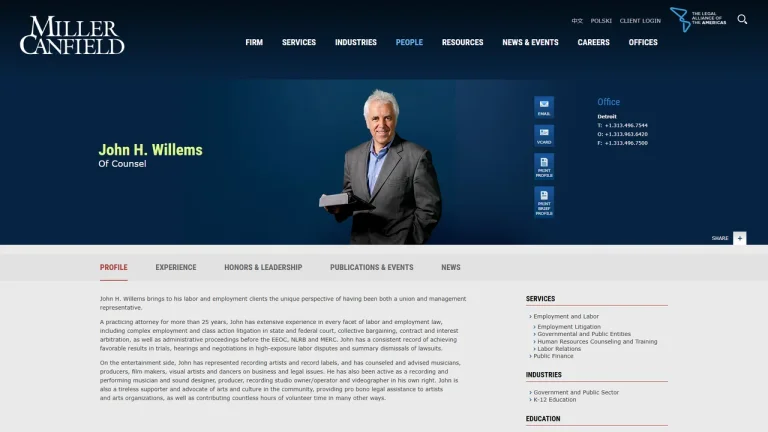
John H. Willems - Detroit, MI

A|Squared Legal Group, PLC - Detroit, MI
Sommers Schwartz, P.C. - Detroit, MI
Taft Detroit (Downtown) - Detroit, MI
Enforcing Fair Compensation & Judicial Oversight in Detroit
Detroit's diverse industrial and service-oriented economy spans automotive manufacturing plants, healthcare networks, logistics warehousing, corporate business parks, and an extensive hospitality footprint across Downtown, Midtown, and Corktown. Despite strict statutory compensation mandates, wage theft remains prevalent, including unpaid overtime, misclassifying workers as exempt salaried employees or independent 1099 contractors, and unlawful deductions from service industry tips.
Civil wage and hour actions involving extensive employee classes or individual claims exceeding $25,000 are adjudicated in the 3rd Judicial Circuit Court of Wayne County at the Coleman A. Young Municipal Center on Woodward Avenue. When asserting collective violations under the Fair Labor Standards Act (FLSA), cases fall under the jurisdiction of the United States District Court for the Eastern District of Michigan at the Theodore Levin U.S. Courthouse on West Lafayette Boulevard.
Early consultation with an experienced Detroit wage lawyer allows workers to secure computerized timeclock records, payroll audit logs, and electronic tip records before employer record retention cycles or software transitions erase vital evidence.
Legal Fee Structures for Wage & Hour Enforcement
| Case Scenario | Fee Structure | Estimated Cost (USD) | Key Cost Determinants |
|---|---|---|---|
| Individual Unpaid Overtime Recovery | Statutory Fee-Shifting / Contingency | 33 1/3% (or Paid by Employer) | Timeclock record clarity, employer compliance history, hours disputed |
| Misclassification & Collective Action (FLSA) | Contingency / Court-Awarded | Court-Approved Fee Percentage | Class size, company-wide payroll auditing complexity, trial length |
| Administrative Wage Claim (LEO Filing) | Hourly / Flat / Contingency | $1,000 - $3,500 | Disputed fringe benefits, administrative hearing representation |
| Initial Payroll Audit & Case Evaluation | Complimentary Consultation | $0 Out-of-Pocket Retainer | Review of pay stubs, W-2 forms, and exemption classifications |
Critical Legal Deadlines & Statutes in Michigan
Wage and hour enforcement is governed by precise statutory frameworks that define overtime eligibility, minimum wage, and filing limitations. At the federal level, the Fair Labor Standards Act (FLSA) mandates under 29 U.S. Code § 201 that non-exempt employees receive overtime pay at one and one-half times their regular rate for hours worked exceeding 40 hours per workweek pursuant to 29 U.S. Code § 207.
Under 29 U.S. Code § 255, the statute of limitations for filing an FLSA lawsuit is 2 years from the date the unpaid wages accrued, which extends to 3 years if the employee demonstrates that the employer's violation was willful. Additionally, 29 U.S. Code § 216 entitles successful employees to recover an equal amount in liquidated damages (double damages), as well as mandatory attorney fees and litigation costs. Under Michigan law, the Workforce Opportunity Wage Act governs state wage standards under Mich. Comp. Laws § 408.931, enforcing overtime rights under Mich. Comp. Laws § 408.934a and providing a 3-year limitations window under Mich. Comp. Laws § 408.941. For disputed wage deductions, commissions, or fringe benefits, the Michigan Payment of Wages and Fringe Benefits Act applies under Mich. Comp. Laws § 408.471, but claims submitted to the Michigan Department of Labor and Economic Opportunity (LEO) must be filed within an unforgiving 12-month deadline pursuant to Mich. Comp. Laws § 408.481.
36th District Small Claims Limitations vs. Circuit Court Representation
The 36th District Court in Detroit presides over small claims disputes capped at $7,000 pursuant to Mich. Comp. Laws § 600.8401. By Michigan statute, attorneys cannot represent litigants in small claims proceedings. While an individual employee might contemplate filing in small claims for a single withheld paycheck under $7,000, doing so strips the worker of statutory advantages available under federal and state wage laws.
Small claims court cannot award mandatory double damages (liquidated damages) available under federal statute, nor can it order class certification or compel extensive payroll forensic audits across an entire company. Resolving systemic misclassification or multi-year overtime withholding requires formal legal action in the 3rd Judicial Circuit Court or federal court, where fee-shifting provisions require the non-compliant employer to pay your attorney fees upon prevailing.
Red Flags When Hiring a Detroit Wage & Hour Attorney
- Attorneys who fail to seek liquidated damages (100% double damages) under the FLSA, leaving substantial financial recovery on the table.
- Law firms charging workers heavy upfront hourly fees instead of utilizing statutory fee-shifting and contingency models.
- Missing the strict 12-month filing window for administrative complaints before the Michigan Department of Labor and Economic Opportunity.
- Lack of federal class or collective action experience in the U.S. District Court for the Eastern District of Michigan.
Frequently Asked Questions
What is the statute of limitations for recovering unpaid overtime in Detroit?
Under the federal Fair Labor Standards Act, you have 2 years to file a lawsuit, which extends to 3 years if the employer committed a willful violation. Michigan state wage claims under the Workforce Opportunity Wage Act also provide a 3-year limitations period.
Can my employer avoid paying overtime by giving me a salary?
No. Being paid a salary does not automatically make you exempt from overtime. To be legally exempt, your job duties must satisfy specific legal tests (such as executive, administrative, or professional duties) and meet statutory salary thresholds set under federal and state regulations.
What damages can I recover in a successful Michigan wage theft lawsuit?
You can recover all unpaid wages and overtime, plus an equal amount (100%) in statutory liquidated damages under the FLSA, interest, and mandatory reimbursement of your attorney fees and court costs paid by the employer.
Can I be fired for reporting unpaid wages or filing an overtime claim in Detroit?
No. Both federal and Michigan statutes strictly prohibit employer retaliation. Terminating, disciplining, or demoting a worker for asserting wage rights constitutes an unlawful retaliatory discharge, exposing the employer to substantial additional damages.
How are attorney fees handled in Detroit wage and hour claims?
Under federal and state fee-shifting statutes, the employer is legally obligated to pay the employee's reasonable attorney fees and court costs if the employee prevails. Most wage attorneys take cases on a contingency or fee-shifting basis with no upfront costs.