
Divorce & Family Law Lawyers in Lansing
Retaining a skilled Lansing divorce and family law lawyer protects your parental custody rights and personal assets under Michigan domestic statutes. Dedicated family attorneys facilitate constructive out-of-court dispute resolution through Friend of the Court mediation to minimize emotional distress. Explore our directory below to consult an experienced Ingham County family law attorney.

The Woolley Law Firm, PLLC - Lansing, MI

Norton Law Office PLLC - Lansing, MI

The Law Office of Kareem Johnson PLLC - Lansing, MI

Wilson & Brown Law Offices, PLLC - Lansing, MI

Michael D Staake Law Office - Lansing, MI
LaFave Smith Law - Lansing, MI

Frederick J Blackmond PC - Lansing, MI
Addison & Conklin - Lansing, MI

G. Michael Hocking - Lansing, MI
Lane Legal Services - Lansing, MI

Speaker Law Firm, PLLC - Lansing, MI

Basiga Law Firm, PC - Lansing, MI

Sixty Plus, Inc. Elder Law Clinic - Lansing, MI

Mallory, Lapka, Scott & Selin, PLLC - Lansing, MI
Law Offices of Anthony J. Szilagyi, PLLC - Lansing, MI
Greater Lansing Legal Services PLLC - Lansing, MI

OAKES LAW GROUP PLLC - Lansing, MI
Addison Family Law - Lansing, MI
Patrick Law Office - Lansing, MI
Attorney Jennipher Martinez - Lansing, MI
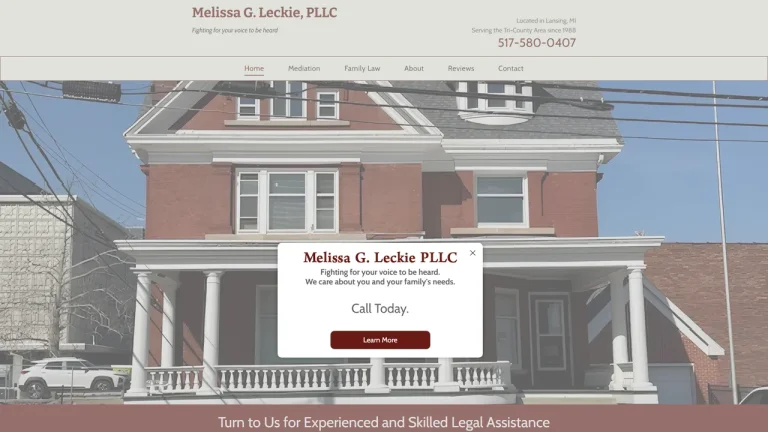
Melissa G. Leckie, PLLC - Lansing, MI

Heisler Law Office - Lansing, MI

Sonnenberg Law Offices, PLLC - Lansing, MI
Domestic Relations & Judicial Authority in Ingham County
Resolving family law disputes-whether navigating divorce, child custody determinations, or parenting time schedules-presents profound financial and emotional hurdles. In Lansing and surrounding Ingham County communities such as East Lansing, Mason, and Okemos, family law matters require seasoned legal representation that understands the specific policies of the local judiciary and regional administrative support offices.
All domestic relations proceedings in Lansing fall under the exclusive jurisdiction of the 30th Judicial Circuit Court Family Division, held at the Veterans Memorial Courthouse on West Kalamazoo Street in downtown Lansing. The court works in close collaboration with the Ingham County Friend of the Court (FOC), an agency that conducts custody and parenting time investigations, calculates recommended child support, and provides dispute mediation services.
Michigan is an equitable distribution state rather than a community property jurisdiction, meaning marital assets and debts are divided fairly based on statutory criteria rather than an automatic equal split. Securing experienced local counsel ensures your business holdings, retirement pensions, and parental interests are forcefully defended before Ingham County family court referees and judges.
Legal Fee Structures for Family Law Representation
| Case Scenario | Fee Structure | Estimated Cost (USD) | Key Cost Determinants |
|---|---|---|---|
| Uncontested Divorce without Minor Children | Flat Fee / Retainer | $1,500 - $3,500 | Agreement clarity, marital property simplicity, waiver of discovery |
| Contested Child Custody & Parenting Time | Hourly Retainer ($225 - $450/hr) | $4,500 - $15,000 | FOC custody evaluations, psychological evaluations, contested hearings |
| High-Asset Property & Business Division | Hourly Retainer ($300 - $550/hr) | $15,000 - $50,000+ | Forensic financial auditing, business valuations, pension QDROs |
| Initial Confidential Case Consultation | Hourly / Flat Consultation | $150 - $350 Review | Complexity of marital estate, temporary child support considerations |
Critical Legal Deadlines & Statutes in Michigan
Initiating and concluding family law proceedings in Lansing requires navigating clear statutory conditions. Michigan operates strictly under a no-fault divorce system pursuant to Mich. Comp. Laws § 552.6, requiring a party to testify that there has been a breakdown of the marriage relationship to the extent that the objects of matrimony have been destroyed and there remains no reasonable likelihood of preservation.
Jurisdictional prerequisites under Mich. Comp. Laws § 552.9 mandate that at least one spouse must have resided in Michigan for 180 continuous days, and in Ingham County for at least 10 days, immediately preceding the filing of the divorce complaint. Michigan law also imposes mandatory statutory cooling-off periods under Mich. Comp. Laws § 552.9f: a judgment of divorce cannot be entered until 60 days have elapsed from filing in cases without minor children, and 6 months in cases involving minor children (unless waived by the circuit judge upon proof of severe hardship). Marital property and debts are divided under the equitable principles of Mich. Comp. Laws § 552.19 and Mich. Comp. Laws § 552.401. For child custody determinations, the 30th Circuit Court applies the 12 statutory best interests of the child factors set forth in the Michigan Child Custody Act under Mich. Comp. Laws § 722.23. Spousal support evaluations are guided by statutory criteria codified at Mich. Comp. Laws § 552.23.
Small Claims Limitations vs. Professional Family Court Counsel
The 54-A District Court in Lansing manages small claims limited to $7,000 pursuant to Mich. Comp. Laws § 600.8401. By Michigan statute, attorneys are prohibited from appearing in small claims court. More crucially, small claims courts and standard municipal district courts possess zero subject-matter jurisdiction over domestic relations cases. Divorce, child support modifications, parenting time enforcement, and alimony are exclusively handled by the 30th Judicial Circuit Court Family Division.
Attempting to negotiate family agreements pro se frequently results in defective Qualified Domestic Relations Orders (QDROs), inequitable debt distribution, or flawed child support calculations under the Michigan Child Support Formula (MCSF). Retaining experienced legal counsel ensures access to structured mediation, formal discovery of concealed assets, and compliant filings through the MiFILE portal.
Red Flags to Avoid When Selecting a Lansing Family Lawyer
- Attorneys who promise an absolute 50/50 division of assets, disregarding Michigan's equitable distribution doctrine and separate property rules.
- Churning billable hours by provoking hostile conflict instead of seeking cost-effective mediation through the Ingham County Friend of the Court.
- Inexperience in addressing state government or public university employee pensions, 401(a) accounts, and deferred compensation plans.
- Complete absence of courtroom appearances before 30th Judicial Circuit Court family referees and judges.
Frequently Asked Questions
How long does a divorce take to finalize in Ingham County?
For couples without minor children, Michigan law imposes a minimum 60-day waiting period from the date of filing. Divorces involving minor children require a 6-month statutory waiting period, although an Ingham County judge may shorten this timeframe upon a showing of unusual hardship.
Does Michigan require either party to prove fault to grant a divorce?
No. Michigan is a no-fault divorce state. You do not need to prove misconduct, abandonment, or infidelity to obtain a divorce. However, judges may still consider fault when making equitable decisions regarding spousal support and property division.
What role does the Ingham County Friend of the Court play in family disputes?
The Ingham County Friend of the Court assists the 30th Circuit Court by conducting custody and parenting time investigations, calculating child support under the state formula, and providing alternative dispute resolution services to help parties resolve custody conflicts.
How are retirement pensions and state employee benefits divided in a Lansing divorce?
Retirement benefits accrued during the marriage-including Michigan state employee pensions (SERS), university retirement plans, and private 401(k) accounts-are treated as marital assets and divided through court-approved Qualified Domestic Relations Orders (QDROs) or Eligible Domestic Relations Orders (EDROs).
How is child support determined under Michigan law?
Child support in Michigan is calculated using the mandatory Michigan Child Support Formula (MCSF). The formula considers both parents' net incomes, the number of overnights each parent spends with the child, childcare costs, and health insurance premiums.