
Patent Attorneys in Lansing
Retaining a licensed Lansing patent attorney secures your inventions, ensures rigorous prior art vetting, and defends your rights before the USPTO. Qualified patent practitioners draft resilient patent claims, manage university tech transfers, and avoid costly statutory bars. Explore our verified directory below to schedule a consultation with a registered patent attorney in Lansing.
Honigman LLP - Lansing, MI
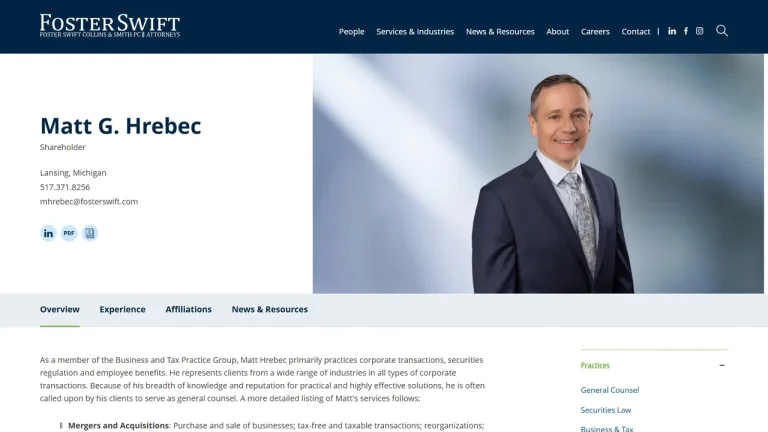
Matt G. Hrebec, Attorney - Lansing, MI
Miller Canfield PLC - Lansing, MI

Lindsey M. Mead - Lansing, MI

Safeguarding Innovation in Lansing and Mid-Michigan
Lansing serves as a primary hub for technological research, agricultural biotechnology, advanced automotive engineering, and clean-energy development in Mid-Michigan. Fueled by university collaborations through the Michigan State University Innovation Center in nearby East Lansing, along with regional research parks and manufacturing enterprises across Ingham and Eaton counties, local inventors require dedicated patent counsel to transform technical concepts into proprietary assets.
Patent prosecution is governed federally before the United States Patent and Trademark Office (USPTO). When patent litigation occurs-such as infringement actions or declaratory judgment claims-exclusive subject-matter jurisdiction resides with the federal courts pursuant to 28 U.S. Code § 1338. For Lansing-based inventors, federal patent disputes are tried in the United States District Court for the Western District of Michigan, which convenes at the Charles E. Chamberlain Federal Building & Post Office at 315 West Allegan Street in Downtown Lansing. State-level contract or trade secret matters proceed at the 30th Judicial Circuit Court of Ingham County.
Working with a registered patent attorney in Lansing provides vital strategic guidance. Unlike general practitioners, patent lawyers must pass the rigorous USPTO registration examination and hold accredited scientific or engineering backgrounds. Local patent counsel coordinates prior art searches, drafts utility and design applications, responds to USPTO Office Actions, and manages patent portfolio licensing.
Lansing Patent Drafting & Prosecution Fee Structures
| Case Scenario | Fee Structure | Estimated Cost (USD) | Key Cost Determinants |
|---|---|---|---|
| Comprehensive Patentability Search & Opinion | Flat Legal Fee | $1,500 - $3,200 | Prior art complexity, global database scope, claim scope analysis |
| Provisional Patent Application Filing | Flat Legal Fee | $2,500 - $5,500 | Technical disclosure detail, engineering schematics, USPTO filing tier |
| Non-Provisional Utility Patent (Mechanical / Software) | Staged Flat Fee | $7,500 - $16,000+ | Number of independent claims, technical complexity, formal drafting hours |
| USPTO Office Action Response & Amendment | Hourly / Tiered Flat Fee | $2,000 - $5,000 | Examiner rejection basis, prior art distinguishing brief, claim amendments |
Critical Legal Deadlines & Statutes in Michigan
Patent prosecution in Lansing is governed by federal statutes administered by the USPTO. Under 35 U.S. Code § 101, an invention must constitute patent-eligible subject matter. Under the America Invents Act framework of 35 U.S. Code § 102, the United States operates on a strict first-inventor-to-file rule; an inventor has a maximum grace period of one year following their own public disclosure, commercial sale, or public use to file a patent application before forfeiting domestic patent rights forever.
When utilizing a provisional patent application under 35 U.S. Code § 111, the non-provisional application must be filed within exactly 12 months to claim priority to the provisional filing date. Missing this deadline forfeits the provisional priority date entirely. Furthermore, for patent infringement actions brought in federal court, 35 U.S. Code § 286 limits monetary damages to infringement committed no more than six years prior to the complaint. For pre-filing proprietary data, protections are governed under the Michigan Uniform Trade Secrets Act, MCL § 445.1901, with a three-year statute of limitations under MCL § 445.1907.
Small Claims Court Limitations vs. Federal Patent Prosecution
The 54A Judicial District Court in Lansing handles local small claims disputes up to $7,000 under MCL § 600.8401, where attorneys are barred from appearance. However, state district courts have zero jurisdiction over patent prosecution, patent validity, or infringement disputes. Under 28 U.S. Code § 1338, federal courts possess exclusive jurisdiction over patent litigation.
Attempting to draft a patent application pro se or relying on unregulated automated form generators regularly results in fatally narrow claims, premature public forfeiture, or costly USPTO rejections. Only a USPTO-registered patent practitioner possesses the technical credentials and legal training required under 37 C.F.R. § 11.7 to structure enforceable claims that survive inter partes review and commercial competitor scrutiny.
Red Flags to Avoid When Selecting a Lansing Patent Attorney
- Invention Promotion Companies: Beware of non-lawyer invention marketing companies that charge high upfront fees without providing registered patent attorney representation or confidentiality protections.
- Attorneys Not Registered with the USPTO: General litigators cannot legally file or prosecute patent applications before the USPTO; verify their registration on the USPTO Office of Enrollment and Discipline roster.
- Guaranteed Patent Issuance: Ethical patent attorneys never guarantee that a patent will issue, as patent examiners maintain sole authority over patentability assessments.
- Unclear Fee Disclosures: Ensure your engagement agreement itemizes search costs, professional drafting fees, USPTO government application fees, and expected post-filing Office Action response expenses.
Frequently Asked Questions
What is the difference between a patent attorney and a patent agent?
Both patent attorneys and patent agents must pass the USPTO patent bar examination and hold scientific degrees. However, only a patent attorney is a licensed lawyer who can draft non-disclosure agreements, negotiate IP licensing contracts, and litigate infringement claims in federal court.
Where are patent infringement lawsuits filed in Lansing?
Patent infringement claims originating in Lansing are litigated in the United States District Court for the Western District of Michigan at the Charles E. Chamberlain Federal Building & Post Office located at 315 West Allegan Street.
What is the difference between a provisional and non-provisional patent application?
A provisional application establishes an early filing date and allows you to use the term patent pending for 12 months without formal claims. A non-provisional application undergoes formal examination by the USPTO and is required to obtain an enforceable patent.
How long does it take to obtain a patent from the USPTO?
Obtaining an issued patent typically takes between 18 to 36 months, depending on the technological classification and backlog at the USPTO. Expedited examination can reduce this timeline for an additional fee.