
Wage & Hour Lawyers in Lansing
Retaining an experienced Lansing wage and hour lawyer ensures your earned income and overtime rights are aggressively protected under Michigan labor laws. Dedicated legal advocates negotiate unpaid wage settlements and recover statutory penalties through administrative proceedings or court action to resolve pay disputes efficiently. Explore our verified directory below to schedule a confidential wage assessment with trusted local counsel.
White Schneider PC - Lansing, MI
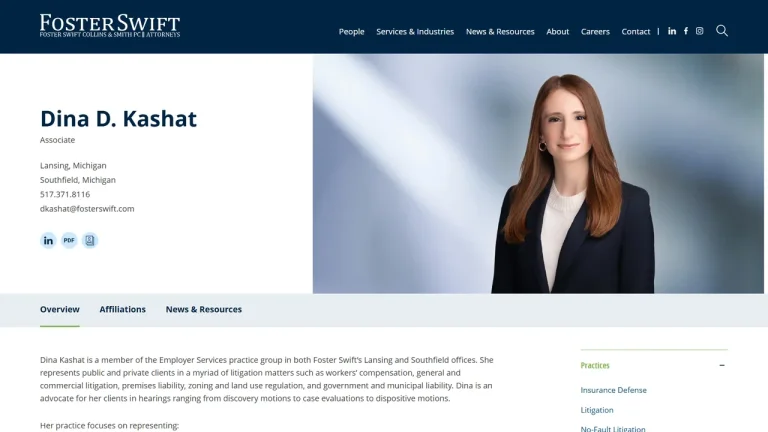
Foster Swift Collins & Smith, PC (Dina D. Kashat) - Lansing, MI
Enforcing Fair Compensation in Lansing and Ingham County
As the center of Michigan state government and a bustling hub for healthcare, manufacturing, education, and logistics, Lansing employs a diverse regional workforce. When employers unlawfully withhold compensation, misclassify workers as exempt, or fail to pay mandatory overtime, employees must enforce their rights through local administrative agencies and judicial venues in Ingham County.
State-level wage litigation and contract-based pay disputes exceeding $25,000 are adjudicated in the 30th Judicial Circuit Court of Ingham County, situated in the Veterans Memorial Courthouse in Lansing. Claims under $25,000 fall within the jurisdiction of the 54A District Court located inside Lansing City Hall. Multi-plaintiff collective actions and federal Fair Labor Standards Act lawsuits are filed in the United States District Court for the Western District of Michigan.
The Michigan Department of Labor and Economic Opportunity (LEO) Wage and Hour Division is headquartered right in Lansing. Experienced local wage attorneys coordinate with state investigators, conduct payroll audits, utilize the MiFILE electronic system, and pursue statutory remedies against employers violating state compensation codes.
Wage & Hour Case Profiles and Legal Fee Structures
| Case Scenario | Fee Structure | Estimated Cost (USD) | Key Cost Determinants |
|---|---|---|---|
| Unpaid Overtime & Salary Misclassification | Contingency / Statutory Fee-Shifting | 33 1/3% - 40% (Recovered from Employer) | Off-the-clock shift hours, managerial exemption scrutiny, timecard tampering, and employer size. |
| Minimum Wage & Illegal Tip Pool Offsets | Contingency / Statutory Fee-Shifting | $0 upfront (Statutory fees paid by employer) | Tip credit compliance, mandatory manager tip participation, and unauthorized uniform deductions. |
| LEO Administrative Wage Claim Representation | Hourly or Flat Fee | $750 - $2,500 (or $250 - $450/hr) | Written commission contracts, earned fringe benefit verification, and department informal conferences. |
| FLSA Collective Action Overtime Litigation | Contingency (Court-Approved) | 33 1/3% Net Settlement | Western District of Michigan conditional certification, opt-in volume, and forensic accounting fees. |
Critical Legal Deadlines & Statutes in Michigan Wage Law
Navigating wage violations requires strict adherence to statutory deadlines. Under the Michigan Improved Workforce Opportunity Wage Act (Mich. Comp. Laws § 408.931), an employee seeking unpaid minimum wage or overtime compensation has three years from the date the violation occurred to file a civil lawsuit pursuant to Mich. Comp. Laws § 408.939.
For fringe benefits, earned commissions, and unauthorized payroll deductions, the Michigan Payment of Wages and Fringe Benefits Act (Mich. Comp. Laws § 408.471) controls. Under Mich. Comp. Laws § 408.481(1), a formal administrative complaint must be filed with the Michigan Department of Labor and Economic Opportunity within strictly 12 months after the alleged violation occurred.
Under the federal Fair Labor Standards Act, claims for back wages must be brought within two years under 29 U.S. Code § 255(a), which expands to three years if the employer violation was willful. Prevailing employees can recover 100% liquidated damages and mandatory attorney fees under 29 U.S. Code § 216(b) and civil penalties under Mich. Comp. Laws § 408.488.
Small Claims Limitations vs. Professional Wage Representation
The 54A District Court in Lansing operates a Small Claims Division capped at a maximum monetary recovery of $7,000 under Mich. Comp. Laws § 600.8401. By statute, attorneys are prohibited from appearing in small claims hearings pursuant to Mich. Comp. Laws § 600.8408.
While an individual worker might consider small claims court for a small final paycheck deduction, systemic wage violations are poorly suited for self-representation. Small claims courts cannot certify collective actions, issue court orders compelling company-wide payroll disclosure, or award statutory attorney fees under Michigan wage protection statutes.
Lansing employers retain defense counsel when facing wage claims. Retaining a dedicated wage and hour lawyer allows workers to file in the 54A District Court general civil division, the 30th Judicial Circuit Court, or federal court. Legal counsel leverages statutory fee-shifting provisions so that workers pursue full liquidated damages without funding expensive litigation out of pocket.
Red Flags When Hiring a Lansing Wage & Hour Attorney
- Demanding large upfront non-refundable retainers for strong unpaid overtime or minimum wage claims that qualify for statutory fee-shifting.
- Missing the strict 12-month administrative deadline for filing wage and fringe benefit complaints with the Lansing LEO office under MCL 408.481.
- Lack of litigation experience in the U.S. District Court for the Western District of Michigan for complex FLSA collective actions.
- Failing to demand statutory liquidated damages and mandatory interest in addition to the base amount of unpaid wages.
Frequently Asked Questions
What is the statute of limitations for unpaid wages in Michigan?
Under Mich. Comp. Laws § 408.939, employees have three years to sue for minimum wage and overtime violations. However, administrative claims for fringe benefits or unlawful deductions filed with LEO must be submitted within 12 months under Mich. Comp. Laws § 408.481(1).
Can an employer in Lansing automatically deduct pay for register shortages?
No. Under Mich. Comp. Laws § 408.477, an employer cannot deduct money from an employee paycheck for cash shortages, damages, or uniform expenses without the worker written, voluntary consent obtained at each transaction.
Can a salaried employee qualify for overtime pay in Lansing?
Yes. Earning a salary does not automatically exempt an employee from overtime. Under both Michigan law and the federal FLSA, the position must meet specific duties tests (executive, administrative, or professional) and satisfy salary thresholds to be truly exempt.
Who pays my legal fees in a successful Michigan wage lawsuit?
Under 29 U.S. Code § 216(b) and Michigan statutory enforcement rules, an employer who violates wage laws is legally required to pay the prevailing employee reasonable attorney fees and litigation costs.
Where are Lansing wage disputes litigated?
Claims up to $25,000 are filed in the 54A District Court in Lansing City Hall, claims exceeding $25,000 are heard in the 30th Judicial Circuit Court of Ingham County, and federal FLSA collective lawsuits are filed in the U.S. District Court for the Western District of Michigan.