
Wills Lawyers in Lansing
Connect with experienced Lansing wills lawyers to craft legally sound last wills, designate guardians, and protect your estate for future generations. A dedicated Ingham County estate attorney can help avoid statutory probate disputes and structure your final wishes through precise legal drafting. Browse our directory below to consult verified estate planning counsel serving Lansing, East Lansing, and surrounding communities.
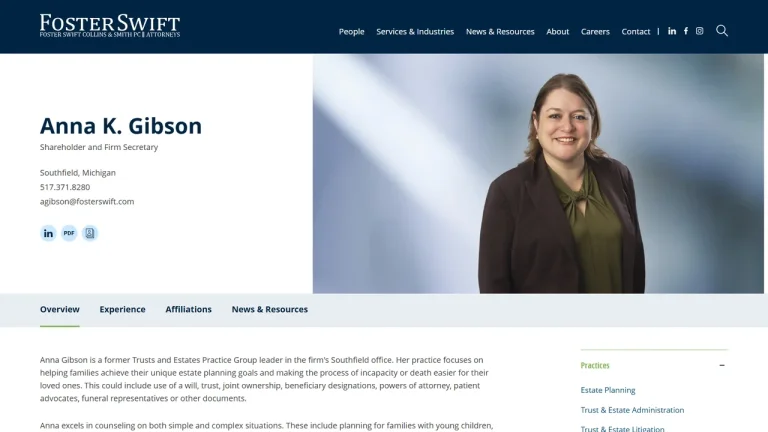
Anna K. Gibson, Attorney - Lansing, MI
Sixty Plus, Inc. Elder Law Clinic - Lansing, MI

Howard ”Jack” Weyers Jr. Attorney and Counselor - Lansing, MI

Sonnenberg Law Offices, PLLC - Lansing, MI

Family Wills & Trusts, PLC - Lansing, MI

The People's Firm PLLC - Lansing, MI

Babbitt Legal Group, PC - Lansing, MI

Law Office of Samantha Sprague - Lansing, MI

Bohnhoff and Mahoney, PLC - Lansing, MI

Grace Legal Services, PLC - Lansing, MI

Melvin S McWilliams PC - Lansing, MI

Elias Kafantaris, Attorney At Law - Lansing, MI

Charles A. Janssen, Attorney - Lansing, MI

Ingham County Probate Jurisdiction & Wills Practice in Lansing
Planning for the future through a comprehensive last will and testament is vital for residents across the Greater Lansing area. Whether you own a home in Westside, Moores Park, or Groesbeck, or manage private business assets in Ingham County, executing enforceable testamentary documents ensures that your property passes according to your personal instructions rather than arbitrary statutory rules.
Wills, estate administration, and protective proceedings in Michigan are governed by the Estates and Protected Individuals Code (EPIC) under MCL § 700.1101. Following a testator's death, formal probate proceedings, testamentary interpretations, and estate accountings fall under the exclusive jurisdiction of the Ingham County Probate Court, located at the Veterans Memorial Courthouse on West Kalamazoo Street in Lansing, with additional facilities at the historic Ingham County Courthouse in Mason.
Dying without a valid will triggers Michigan's laws of intestate succession under MCL § 700.2101, distributing your assets strictly according to statutory formulas that may exclude non-marital partners, stepchildren, or charities. Working with a dedicated Lansing wills attorney ensures that your estate planning documents are properly executed, avoiding expensive probate litigation for your surviving family members.
Common Wills & Estate Planning Scenarios & Legal Fees in Lansing
| Case Scenario | Fee Structure | Estimated Cost (USD) | Key Cost Determinants |
|---|---|---|---|
| Individual Last Will & Testament with Guardian Nomination | Flat Fee | $450 - $1,200 | Number of specific devises, nomination of testamentary guardians, and self-proving affidavits. |
| Comprehensive Estate Package (Will, Trust, Financial & Medical POA) | Flat Fee | $1,200 - $3,500 | Inclusion of revocable living trust, real estate deed preparation, and pour-over will drafting. |
| Unsupervised Ingham County Probate Administration | Hourly / Flat Fee | $2,000 - $5,000 | Value of estate assets, publication of creditor notices, and Ingham County Probate Court inventory fees. |
| Contested Will Litigation (Capacity or Undue Influence) | Hourly Retainer | $5,000 - $18,000+ | Medical record subpoenas, expert psychiatric testimony, depositions, and courtroom trials. |
Critical Legal Deadlines & Statutes in Michigan
To ensure validity, a will must satisfy the strict statutory execution requirements of MCL § 700.2502. The document must be in writing, signed by the testator (or in the testator's name by another person in their conscious presence and direction), and signed by at least two individuals who witnessed either the signing or the testator's acknowledgment. Holographic wills are recognized under MCL § 700.2502(2) if the signature and material portions are in the testator's own handwriting.
When an estate is opened in the Ingham County Probate Court, statutory creditor notice rules take effect. Under MCL § 700.3801 and MCL § 700.3803, the personal representative must publish a notice to creditors in an approved county legal publication. Creditors have four months from the date of publication to submit formal claims against the estate; claims that are not filed within this four-month window are forever barred.
Surviving spouses in Michigan are protected against disinheritance through the elective share statute at MCL § 700.2202. A surviving spouse must file their election to take against the will within 63 days after receiving the estate inventory or 63 days after the creditor claim deadline, whichever is later. Incapacity planning is established through Patient Advocate Designations under MCL § 700.5506, which become active when two physicians certify that the individual is unable to make medical decisions.
Small Claims Limitations vs. Professional Estate Planning Counsel
The Small Claims Division of the 54A District Court in Lansing has a monetary limit of $7,000 under MCL § 600.8401. However, small claims courts have zero legal authority over testamentary documents, probate administrations, or guardianship petitions. Under MCL § 700.1302, the Ingham County Probate Court possesses exclusive jurisdiction over all decedent estates and trust proceedings.
Additionally, under MCL § 600.8408, attorneys are prohibited from appearing in Small Claims Division hearings. Drafting an enforceable will involves appointing personal representatives, designating legal guardians for minor children under MCL § 700.5202, and structuring asset distributions to prevent expensive family litigation. Retaining an experienced Lansing wills lawyer ensures that your documents comply with Michigan law and pass title to your heirs without administrative complications.
Red Flags & Vetting Local Legal Counsel
Entrusting an attorney with your estate planning requires thorough evaluation of their qualifications and experience. Confirm that prospective counsel is an active member of the State Bar of Michigan with substantial probate practice in Ingham County. Watch for these common warning signs during your search:
- Generic Online Document Templates: Automated forms often omit Michigan-specific self-proving affidavits or fail to satisfy the two-witness requirement under MCL § 700.2502, rendering the will vulnerable to challenge.
- Failing to Address Incapacity Directives: A comprehensive estate plan must include financial durable powers of attorney and patient advocate designations under MCL § 700.5506 alongside the will.
- Ignoring Non-Probate Asset Designations: Wills do not override designated beneficiaries on life insurance or retirement accounts; an experienced attorney will audit beneficiary forms to ensure harmony with your will.
- Unfamiliarity with Ingham County Probate Court Procedures: Probate rules and inventory fee structures at the Veterans Memorial Courthouse are specialized; counsel must understand local scheduling and filings to avoid delays.
Frequently Asked Questions
What are the legal requirements for a valid will in Lansing, Michigan?
Under MCL § 700.2502, a valid will must be in writing, signed by a testator who is at least 18 years old and of sound mind, and signed by at least two competent witnesses who observed the signing or acknowledgment.
What is the difference between a will and a revocable trust in Michigan?
A will takes effect only upon death and must go through probate court before assets are distributed. A revocable living trust takes effect immediately, manages assets during incapacity, and transfers property to beneficiaries outside of probate court.
How does the Ingham County Probate Court process a will after death?
The nominated personal representative submits the original will and an application for informal probate to the Ingham County Probate Court. Once letters of authority are issued, the representative inventories assets, pays valid creditor claims, and distributes property.
Can I designate a legal guardian for my minor children in a Michigan will?
Yes. Under MCL § 700.5202, a parent may nominate a testamentary guardian for minor children in their will. The probate court gives substantial weight to this nomination when formal guardianship proceedings are finalized.
What happens if an Ingham County resident dies without a will?
If a person dies intestate, their property is distributed according to Michigan's statutory succession hierarchy under MCL § 700.2101, distributing assets strictly to surviving spouses, children, or closest biological relatives rather than friends or preferred charities.