
Wrongful Termination Lawyers in Lansing
Retaining an experienced Lansing wrongful termination lawyer protects your career reputation and legal remedies under Michigan employment statutes. Skilled workplace attorneys evaluate severance packages and negotiate comprehensive out-of-court settlements, resolving unlawful discharge claims before trial. Explore our verified directory below to schedule a confidential consultation with trusted Ingham County counsel.
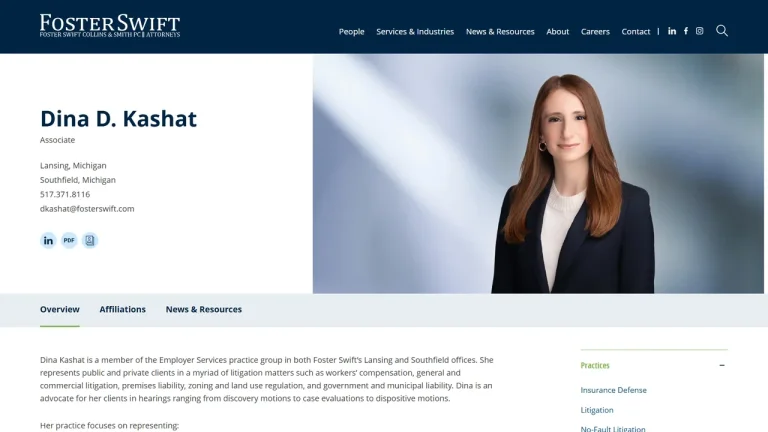
Foster Swift Collins & Smith, PC (Dina D. Kashat) - Lansing, MI
Jeffrey S. Theuer, Attorney at Loomis Law Firm - Lansing, MI

Otis P.C. - Lansing, MI
Brandon W. Zuk, Attorney at Fraser Trebilcock - Lansing, MI

Otis P.C. - Lansing, MI
Brandon W. Zuk, Attorney at Fraser Trebilcock - Lansing, MI
White Schneider PC - Lansing, MI
Wrongful Termination Jurisdiction & Public Sector Employment in Lansing
Lansing serves as Michigan's state capital and a primary hub for public sector governance, healthcare networks like University of Michigan Health-Sparrow, automotive manufacturing facilities including GM Lansing Grand River and Delta Township, and regional insurance headquarters. While Michigan is predominantly an at-will employment state, terminating an employee in violation of public policy, anti-retaliation statutes, or civil rights guarantees constitutes illegal wrongful discharge.
Legal actions challenging wrongful discharge in Lansing are filed according to employer classification and claim amount. Actions exceeding $25,000 against private employers proceed before the Ingham County 30th Circuit Court at the Veterans Memorial Courthouse on West Kalamazoo Street. For the vast workforce employed by the State of Michigan, wrongful discharge actions against state departments must be filed in the Michigan Court of Claims on West Ottawa Street or appealed through the Michigan Civil Service Commission. Federal statutory claims are docketed in the U.S. District Court for the Western District of Michigan on West Allegan Street.
Partnering with a dedicated Lansing wrongful termination lawyer levels the playing field against corporate defense counsel and state administrative boards. Seasoned attorneys review separation agreements, examine employment contracts for just-cause provisions, file statutory whistleblower claims, and negotiate substantial severance packages without subjecting clients to years of public trial proceedings.
Lansing Wrongful Termination Legal Fees & Case Valuations
| Case Scenario | Fee Structure | Estimated Cost (USD) | Key Cost Determinants |
|---|---|---|---|
| Severance Agreement Review & Negotiation | Flat Fee or Hourly ($300 - $450/hr) | $750 - $2,500 | Severance payout size, non-disparagement clauses, and non-compete release terms. |
| Whistleblower Retaliation Pre-Suit Demand | Contingency Fee (33.3% - 40%) or Hybrid | $0 Upfront (Contingency basis) | Strength of reporting documentation, compliance with the 90-day deadline, and employer willingness to mediate. |
| Ingham County Circuit Court Unlawful Discharge Litigation | Contingency Fee (33.3% - 40%) | $0 Upfront (Litigation costs advanced) | Electronic discovery volume, deposition scheduling, and lost wage valuation. |
| Michigan Court of Claims / Civil Service State Employee Hearing | Hourly ($325 - $550/hr) with Retainer | $5,000 - $18,000+ | Administrative civil service hearing levels, collective bargaining agreements, and tenure rights. |
Critical Legal Deadlines & Statutes in Michigan Employment Law
Wrongful termination claims in Michigan are controlled by rigid statutory windows that bar late filings:
- Michigan Whistleblowers' Protection Act (WPA): Lawsuits alleging termination for reporting or participating in an investigation regarding a suspected violation of law must be filed within 90 days under Mich. Comp. Laws § 15.363.
- Elliott-Larsen Civil Rights Act (ELCRA): Claims alleging discriminatory discharge based on race, sex, age, disability, or other protected classes must be filed within 3 years under Mich. Comp. Laws § 600.5805.
- Workers' Compensation Retaliation: Discharges resulting from an employee filing a lawful workers' compensation claim violate public policy under Mich. Comp. Laws § 418.301(13) and must be filed within 3 years under Mich. Comp. Laws § 600.5805.
- Michigan Court of Claims Notice: Actions against the State of Michigan require filing either a claim or written notice of intent within 1 year under Mich. Comp. Laws § 600.6431.
Small Claims Court Limits vs. Professional Employment Representation
Lansing's 54A District Court operates a Small Claims Division capped at $7,000 under Mich. Comp. Laws § 600.8401. In this division, attorneys are statutorily prohibited from appearing in hearings under Mich. Comp. Laws § 600.8408. Small claims court can occasionally be used by a former employee to recover an unpaid final paycheck or unpaid expense reimbursement under $7,000. However, wrongful termination claims should never be pursued pro se in small claims court.
Wrongful discharge actions involve complex legal burdens of proof, front pay and back pay calculations, pension and fringe benefit losses, and statutory attorney fee shifting. Small claims judges cannot issue injunctions, order reinstatement, or award emotional distress damages. Navigating an employer's pretextual defenses requires formal discovery, subpoenaing personnel files under the Bullard-Plawecki Employee Right to Know Act (Mich. Comp. Laws § 423.501), and litigating before the Ingham County 30th Circuit Court.
Red Flags When Hiring a Lansing Wrongful Termination Lawyer
- Lawyers unfamiliar with the strict 90-day filing deadline mandated by the Michigan Whistleblowers' Protection Act under Mich. Comp. Laws § 15.363.
- Practitioners who guarantee substantial monetary recoveries without evaluating Michigan's strong at-will employment presumption or the employee's signed arbitration agreements.
- Firms demanding massive upfront non-refundable retainers for routine statutory claims that are typically handled on contingency.
- Attorneys lacking experience handling state employee hearings before the Michigan Civil Service Commission or the Michigan Court of Claims.
Frequently Asked Questions
What qualifies as wrongful termination under Michigan law?
Wrongful termination occurs when an employer discharges an employee in violation of civil rights laws under Mich. Comp. Laws § 37.2202, in retaliation for whistleblowing under Mich. Comp. Laws § 15.362, or in breach of an explicit just-cause employment contract.
How quickly must I file a whistleblower termination lawsuit in Lansing?
Under the Michigan Whistleblowers' Protection Act (Mich. Comp. Laws § 15.363), you must file a civil action within 90 days of the occurrence of the alleged violation. Missing this deadline permanently bars your claim.
Can state government employees in Lansing sue for wrongful discharge?
State of Michigan civil service employees generally must exhaust administrative grievance procedures through the Michigan Civil Service Commission. Contractual or statutory claims against state agencies are filed in the Michigan Court of Claims under Mich. Comp. Laws § 600.6419.
Does Michigan require an employee to file with an administrative agency before suing for wrongful termination?
Under Michigan's Elliott-Larsen Civil Rights Act, you do not have to exhaust administrative remedies with the Michigan Department of Civil Rights; you can file a lawsuit directly in Ingham County Circuit Court. However, federal Title VII claims require filing an EEOC charge first.
What damages can I recover in an Ingham County wrongful discharge lawsuit?
Recoverable damages include back pay, front pay for future lost earnings, reinstatement, compensation for emotional distress, and statutory attorney fees under Mich. Comp. Laws § 37.2802.