
Wage & Hour Lawyers in Michigan
Resolving unpaid wages or overtime disputes in Michigan requires strategic advocacy under state and federal wage acts to secure earned compensation. Qualified employment attorneys help workers recover unpaid earnings, statutory penalties, and liquidated damages through administrative filings and court action. Explore our directory below to connect with verified Michigan wage and hour lawyers.

Hurwitz Law PLLC - Ann Arbor, MI

Warner Norcross + Judd LLP - Grand Rapids, MI
Mika Meyers PLC - Grand Rapids, MI

The Allen Law Group, P.C. - Detroit, MI

Scott E. Dwyer - Grand Rapids, MI
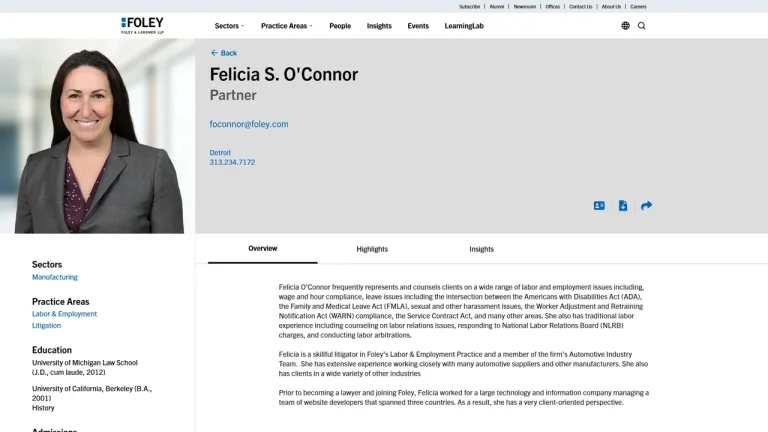
Felicia O'Connor - Foley and Lardner LLP - Detroit, MI
Varnum LLP - Grand Rapids, MI
Croson, Taub, & Michaels, PLLC - Ann Arbor, MI

Pinsky Smith, PC - Grand Rapids, MI
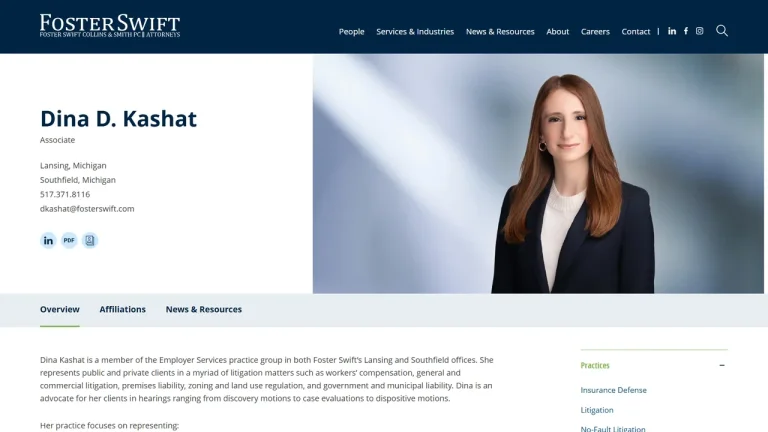
Foster Swift Collins & Smith, PC (Dina D. Kashat) - Lansing, MI

Nikole L. Canute - Grand Rapids, MI
Jackson Lewis PC - Grand Rapids, MI
White Schneider PC - Lansing, MI

Oscar A. Rodriguez, Attorney at Law - Ann Arbor, MI

Kreis Enderle - Grand Rapids, MI
Jerold Lax, Attorney at Law - Ann Arbor, MI

Saba Law, PLLC - Dearborn, MI

Migrant Legal Aid - Grand Rapids, MI
Bodman PLC - Grand Rapids, MI
VanOverbeke Michaud and Timmony - Detroit, MI
David M. Blanchard, Esq. - Ann Arbor, MI
Cunningham Dalman (formerly Bos & Glazier) - Grand Rapids, MI
Consumer Justice Law Firm - Dearborn, MI
Enforcing Worker Compensation & Wage Protections Across Michigan
Michigan's industrial and corporate economy-spanning automotive engineering in Metro Detroit, logistics corridors across Grand Rapids, healthcare networks in Ann Arbor, and agriculture in West Michigan-demands rigorous compliance with statutory compensation standards. Wage disputes are governed concurrently by the Michigan Improved Workforce Opportunity Wage Act under MCL § 408.931 and the Michigan Payment of Wages and Fringe Benefits Act under MCL § 408.471, alongside federal standards under the Fair Labor Standards Act.
Wage and hour claims are adjudicated either through administrative complaints with the Wage and Hour Division of the Michigan Department of Labor and Economic Opportunity (LEO) or through civil lawsuits filed in Michigan Circuit Courts (such as the 3rd Circuit in Wayne County, 6th Circuit in Oakland County, and 17th Circuit in Kent County) and federal district courts across the Eastern and Western Districts of Michigan. Determining the proper venue depends on the size of the claim, the presence of collective employee classes, and whether federal liquidated damages are sought.
Retaining experienced Michigan wage and hour counsel ensures that statutory penalties and mandatory attorney fee-shifting provisions are fully leveraged. Skilled attorneys conduct forensic payroll audits, challenge improper independent contractor classifications, and recover unpaid overtime premiums for non-exempt workers. Professional representation insulates employees from workplace retaliation while enforcing statutory standards.
Michigan Wage & Hour Legal Fee Structure
| Case Scenario | Fee Structure | Estimated Cost (USD) | Key Cost Determinants |
|---|---|---|---|
| Unpaid Overtime & Off-the-Clock Work | Contingency / Fee-Shifting | 33 1/3% - 40% of Recovery | Time card records, employer willful violation proof, and liquidated damages under FLSA and IWOWA. |
| Independent Contractor Misclassification | Contingency / Hourly Hybrid | 33 1/3% or $300 - $550/hr | Economic realities test, multi-worker collective action, and payroll tax audit documentation. |
| Unlawful Wage Deductions & Fringe Benefits | Flat Legal Fee / Contingency | $1,500 - $4,000 (or Contingency) | LEO administrative exhaustion, written policy documentation, and Act 390 statutory civil penalties. |
| Collective & Class Action Wage Litigation | Pure Contingency | 33 1/3% of Common Fund | Number of impacted employees, Circuit Court class certification, and discovery across facilities. |
Critical Legal Deadlines & Statutes in Michigan
Strict statutory timeframes dictate the viability of wage and hour claims across Michigan. Under the Michigan Payment of Wages and Fringe Benefits Act (MCL § 408.481), administrative wage claims filed with the Department of Labor and Economic Opportunity (LEO) must be submitted within strictly 12 months after the date of the alleged violation. Missing this one-year administrative cutoff bars state agency enforcement.
For civil lawsuits filed directly in court under the Improved Workforce Opportunity Wage Act, MCL § 408.942 establishes a 3-year statute of limitations. Under federal law, 29 U.S. Code § 255 imposes a 2-year statute of limitations for standard wage violations, which extends to 3 years if the employer acted willfully. Non-exempt employees working more than 40 hours in a standard workweek are entitled to overtime pay at 1.5 times their regular rate pursuant to MCL § 408.934a, while unauthorized paycheck deductions are prohibited under MCL § 408.477 without express written consent.
Small Claims Limitations vs. Professional Wage Representation
Under MCL § 600.8401, Michigan Small Claims Courts operate with a jurisdictional monetary limit of $7,000. Crucially, attorneys are strictly barred by law from representing parties during Small Claims hearings. While a simple claim for an unpaid final paycheck under $7,000 might be addressed through Small Claims, complex disputes involving years of misclassification, off-the-clock labor, or systemic overtime denial must be pursued in District or Circuit Court where legal representation is allowed.
Navigating wage disputes without counsel places workers at an extreme disadvantage against corporate defense firms. A skilled Michigan employment attorney utilizes formal discovery to obtain electronic punch records and internal communications. Furthermore, under both MCL § 408.942 and 29 U.S. Code § 216, prevailing employees are entitled to statutory attorney fees and court costs paid directly by the employer, enabling workers to secure top-tier legal representation without paying out-of-pocket hourly rates.
Red Flags When Selecting a Michigan Wage Lawyer
- Demanding substantial upfront hourly fees from wage earners when fee-shifting statutes are available to require employer payment upon recovery.
- Failing to advise clients on the distinct 12-month LEO administrative deadline under Act 390 versus the 3-year court filing statute of limitations.
- Guarantees of specific settlement figures before analyzing electronic payroll data, W-2s, and employer job descriptions.
- Lack of courtroom trial experience in Michigan Circuit Courts or before the U.S. District Courts in Detroit and Grand Rapids.
Frequently Asked Questions
What is Michigan's overtime pay rule?
Under MCL § 408.934a, non-exempt employees must be paid overtime at a rate of 1.5 times their regular hourly rate for all hours worked over 40 in a single workweek. Salaried employees may also qualify for overtime unless they meet specific statutory executive, administrative, or professional exemptions.
Can an employer deduct pay for cash register shortages or damage in Michigan?
No. Under MCL § 408.477, an employer cannot make deductions from an employee's wages for cash shortages, damaged equipment, or customer non-payment without the employee's full, free, and written consent obtained at the time the deduction is made.
What is the deadline to file an unpaid wage claim in Michigan?
Administrative claims filed with the Michigan Department of Labor and Economic Opportunity (LEO) must be lodged within 12 months under MCL § 408.481. Lawsuits filed directly in court under state or federal wage statutes must generally be filed within 2 to 3 years.
What damages can I recover in a Michigan wage lawsuit?
A successful claimant can recover 100% of unpaid wages and overtime, an additional equal amount as statutory liquidated damages under federal law, reasonable attorney fees, court costs, and civil penalties under MCL § 408.488.
How does independent contractor misclassification affect overtime pay?
Employers frequently mislabel workers as 1099 independent contractors to avoid paying overtime. Michigan courts apply the economic realities test; if the company directs your daily tasks and schedule, you are legally an employee entitled to retroactive overtime premiums and benefits.