
Workplace Discrimination Lawyers in Michigan
Standing up against workplace discrimination in Michigan requires strategic legal intervention under the Elliott-Larsen Civil Rights Act and state disability protections. An accomplished Michigan workplace discrimination attorney can bypass administrative backlogs, file direct Circuit Court lawsuits, and secure full compensation for economic and emotional harm. Explore our statewide directory below to consult an experienced Michigan civil rights lawyer today.

McDonald Pierangeli Macfarlane, PLLC - Grand Rapids, MI
GODWIN LEGAL SERVICES, PLC - Dearborn, MI

Tishkoff PLC - Ann Arbor, MI

Fett & Fields, P.C. - Ann Arbor, MI

Roumel Law - Ann Arbor, MI

Marko Law Firm - Detroit, MI
Drew Cooper & Anding - Grand Rapids, MI
NachtLaw, P.C. - Ann Arbor, MI
Meroueh & Hallman LLP - Dearborn, MI

Miller Cohen, P.L.C. - Detroit, MI

Cunningham Dalman (formerly Bos & Glazier) - Grand Rapids, MI

Cohl, Stoker and Toskey, P.C. - Lansing, MI
Schulz Ghannam P.L.L.C. - Detroit, MI
Edwards and Jennings PC - Detroit, MI
Joel B. Sklar Law - Detroit, MI
Otis P.C. - Lansing, MI
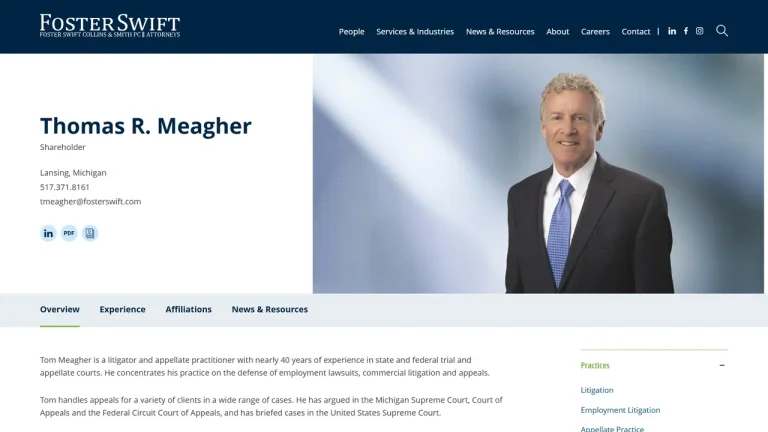
Thomas R. Meagher - Lansing, MI
Barnes & Thornburg LLP - Grand Rapids, MI

Miller Canfield PLC - Lansing, MI

Blanchard & Walker PLLC - Ann Arbor, MI
Consumer Justice Law Firm - Dearborn, MI

Kitch Attorneys & Counselors, PC - Detroit, MI

Migrant Legal Aid - Grand Rapids, MI
Protecting Civil Rights Across Michigan Employment Jurisdictions
Workplace discrimination litigation in Michigan is anchored by some of the most comprehensive civil rights statutes in the United States. Claims are litigated primarily under the Elliott-Larsen Civil Rights Act (ELCRA) and the Persons with Disabilities Civil Rights Act (PWDCRA). Employment lawsuits are filed within county Circuit Courts, including high-volume divisions such as the 3rd Circuit Court in Wayne County (Detroit), the 6th Circuit Court in Oakland County (Pontiac), the 17th Circuit Court in Kent County (Grand Rapids), the 22nd Circuit Court in Washtenaw County (Ann Arbor), and the 30th Circuit Court in Ingham County (Lansing). Federal civil rights actions proceed before the United States District Court for the Eastern District of Michigan or the Western District of Michigan, with state court filings managed via MiFILE.
Michigan provides expansive protections that surpass standard categories. Under ELCRA, employers are prohibited from discriminating on the basis of religion, race, color, national origin, age, sex, height, weight, familial status, or marital status. Michigan is one of the rare jurisdictions that explicitly protects workers against height and weight discrimination in hiring, compensation, and promotion. In addition, the PWDCRA prohibits discrimination against qualified individuals with disabilities and requires employers to provide reasonable accommodations upon proper statutory notice.
Unlike federal law, Michigan does not require employees to exhaust administrative remedies through the Michigan Department of Civil Rights (MDCR) or the EEOC before filing a lawsuit under ELCRA. An experienced Michigan workplace discrimination lawyer can file an action directly in Circuit Court, initiating formal discovery, taking depositions, and demanding statutory damages.
Typical Workplace Discrimination Legal Fees & Case Structures in Michigan
| Case Scenario | Fee Structure | Estimated Cost (USD) | Key Cost Determinants |
|---|---|---|---|
| ELCRA Protected Trait Discrimination Action | Contingency Fee | 33.3% - 40% of Recovery | Direct vs circumstantial evidence, comparator wage data, back pay calculations |
| Disability Discrimination & Accommodation Failure | Contingency Fee | 33.3% - 40% of Recovery | PWDCRA 182-day written notice compliance, interactive accommodation records |
| MDCR Administrative Investigation & Conciliation | Retainer / Hybrid | $2,000 - $5,500 | Witness affidavit drafting, position statement rebuttals, administrative conciliation |
| Complex Pattern-or-Practice & Class Action | Contingency Fee | 33.3% - 40% of Recovery | Statistical regression analysis, class certification scope, federal jury trial duration |
Critical Legal Deadlines & Statutes in Michigan
Employment discrimination claims in Michigan are governed by specific statutory procedures and limitation periods. Core workplace protections are codified in the Elliott-Larsen Civil Rights Act under MCL 37.2202. Pursuant to MCL 37.2801, an aggrieved individual may file a lawsuit directly in Circuit Court without filing with an administrative agency, subject to a three-year statute of limitations under MCL 600.5805.
Disability discrimination is governed by the Persons with Disabilities Civil Rights Act under MCL 37.1101. Crucially, under MCL 37.1210, an employee must provide written notice to the employer of the need for an accommodation within 182 days after the employee knew or reasonably should have known that an accommodation was needed; failure to give this written notice bars claims based on failure to accommodate. A civil lawsuit under the PWDCRA carries a three-year limitations period under MCL 600.5805. If a worker chooses to file an administrative complaint with the Michigan Department of Civil Rights (MDCR), it must be filed within 180 days of the discriminatory act. Any appeal from a final Circuit Court judgment to the Michigan Court of Appeals must be claimed within twenty-one days under MCR 7.204.
Administrative Intake vs. Aggressive Circuit Court Litigation
While Michigan District Courts handle minor monetary disputes up to $7,000 under MCL 600.8401, workplace discrimination involves fundamental constitutional and statutory rights that warrant formal Circuit Court intervention. Employees often submit unrepresented complaints to the Michigan Department of Civil Rights (MDCR), but state administrative investigations are frequently delayed by substantial agency backlogs and budget constraints.
Because Michigan does not require administrative exhaustion under ELCRA, hiring private counsel enables immediate Circuit Court litigation. A dedicated Michigan discrimination attorney conducts formal depositions of supervisors, subpoenas internal corporate communications, and counters defense arguments that an adverse employment decision was based on legitimate business factors. In addition, ELCRA and PWDCRA authorize mandatory attorney fee awards against non-compliant employers, allowing workers to secure experienced representation on a contingency basis.
Red Flags When Selecting a Michigan Discrimination Lawyer
- Delaying court filings by incorrectly advising that an employee must exhaust administrative remedies with the MDCR before filing an ELCRA action in Circuit Court.
- Overlooking the strict 182-day written accommodation notice requirement under the Persons with Disabilities Civil Rights Act (MCL 37.1210).
- Unfamiliarity with Michigan's unique statutory protections against height, weight, and marital status discrimination under MCL 37.2202.
- Demanding upfront hourly legal fees when statutory attorney fee-shifting is available under state civil rights statutes.
Frequently Asked Questions
Does Michigan law prohibit height and weight discrimination in the workplace?
Yes. Under the Elliott-Larsen Civil Rights Act codified at MCL 37.2202, Michigan explicitly prohibits employers from discriminating against individuals based on height or weight regarding hiring, firing, compensation, or terms of employment.
Do I have to file with an administrative agency before filing an ELCRA lawsuit?
No. Under MCL 37.2801, an aggrieved worker can file a civil lawsuit directly in Michigan Circuit Court without first filing a charge with the Michigan Department of Civil Rights (MDCR) or the EEOC.
What is the statute of limitations for workplace discrimination in Michigan?
The statute of limitations for filing an employment discrimination lawsuit under the Elliott-Larsen Civil Rights Act and the PWDCRA is three years from the date of the discriminatory action pursuant to MCL 600.5805.
What is the 182-day accommodation notice rule in Michigan?
Pursuant to MCL 37.1210, an employee must notify their employer in writing of the need for a disability accommodation within 182 days after the need becomes known. Failure to provide written notice within this window bars subsequent failure-to-accommodate claims.
What remedies can I recover in a Michigan workplace discrimination lawsuit?
Under MCL 37.2801, prevailing plaintiffs can recover back pay, front pay, lost employee benefits, damages for emotional distress and mental anguish, injunctive relief such as reinstatement, and reasonable attorney fees.