
Probate Lawyers in Minneapolis
Navigating Hennepin County probate requires dedicated legal guidance to protect estate assets and resolve complex beneficiary disputes efficiently. Experienced Minneapolis probate lawyers guide personal representatives through statutory creditor notices, formal inventory filings, and asset distributions. Explore our directory below to consult verified local probate attorneys and secure your loved one's legacy.
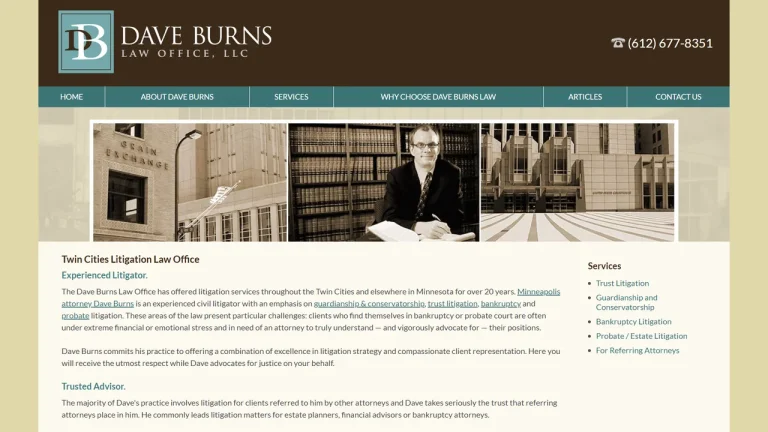
Dave Burns Law Office, LLC - Minneapolis, MN

Stone Arch Law Office, PLLC - Minneapolis, MN
Biglow Law Office - Minneapolis, MN

Primus Law Office, P.A. - Minneapolis, MN

Metropolitan Law Group - Minneapolis, MN

Elder Legal Services - Minneapolis, MN

Strootman Law Office - Minneapolis, MN

Engel Law Firm PLLC - Minneapolis, MN

Schnobrich & Streit LLC - Minneapolis, MN

Full Circle Law - Minneapolis, MN

Hennepin County Probate Administration & Judicial Procedures
The probate process in Minneapolis involves the court-supervised distribution of a deceased individual's estate, the validation of testamentary instruments, and the orderly settlement of legitimate creditor claims. In Hennepin County, all probate proceedings fall under the exclusive jurisdiction of the Fourth Judicial District Court, centralized within the Probate and Mental Health Division at the Hennepin County Government Center in Downtown Minneapolis.
Administering an estate requires a personal representative to adhere strictly to the Minnesota Uniform Probate Code. Whether handling residential real estate in Southwest Minneapolis, condominium properties in the Mill District, or commercial holdings across Bloomington and Plymouth, the personal representative bears personal fiduciary liability for managing estate assets prudently, giving public notice to statutory heirs, and liquidating liabilities in the correct legal priority.
Retaining a qualified Minneapolis probate attorney ensures that personal representatives fulfill their statutory obligations without incurring personal liability. Legal counsel oversees the electronic filing of inventories, defends against exaggerated creditor demands, coordinates with the Minnesota Department of Revenue, and ensures distributions to heirs comply with Minnesota statutes.
Minneapolis Probate Administration & Litigation Costs
| Case Scenario | Fee Structure | Estimated Cost (USD) | Key Cost Determinants |
|---|---|---|---|
| Affidavit Collection for Small Estates (Under $75,000) | Flat Fee / Limited Scope | $850 - $2,200 | Number of financial institutions, debt verification, vehicle title transfers. |
| Uncontested Informal Probate Administration | Tiered Flat Fee / Hourly | $3,500 - $8,000 | Real property sale logistics, creditor resolution, heir location, tax clearances. |
| Formal Supervised Probate (Real Estate or Heir Disagreements) | Hourly Retainer ($325 - $525/hr) | $6,500 - $15,000 | Court hearing appearances at Hennepin County Government Center, judicial orders. |
| Contested Probate Litigation & Will Contests | Hourly Retainer | $12,000 - $40,000+ | Undue influence claims, lack of capacity disputes, depositions, expert witnesses. |
Critical Legal Deadlines & Statutes in Minnesota
Minnesota statutes govern the probate administration timetable with uncompromising deadlines. Under Minn. Stat. § 524.3-108, formal or informal probate proceedings must be commenced within three years of the decedent's death, after which the estate can generally only be resolved through decree of descent proceedings. Following appointment, the personal representative must prepare and file an accurate estate inventory within six months pursuant to Minn. Stat. § 524.3-706.
Creditor notification and resolution schedules require vigilant management. Under Minn. Stat. § 524.3-801, notice must be published in a legal newspaper in Hennepin County, and under Minn. Stat. § 524.3-803, general creditors have precisely four months from the date of the first published notice to submit claims against the estate or their claims become permanently barred. Furthermore, where an estate qualifies for summary collection under Minn. Stat. § 524.3-1201, personal property totaling $75,000 or less may be gathered via affidavit, but only after thirty days have elapsed since the decedent's death.
Conciliation Court Limitations vs. District Court Probate
While the Hennepin County Conciliation Court adjudicates small financial controversies up to $15,000 under Minn. Stat. § 491A.01, it is entirely stripped of jurisdiction over decedent estates, wills, letters of appointment, or fiduciary accountings. All probate matters, whether uncontested or litigated, must proceed through the Probate Division of the Hennepin County District Court.
Fiduciaries who attempt to navigate probate without representation risk personal liability under Minnesota law. If an executor pays lower-priority debts before satisfying high-priority obligations such as family maintenance allowances or Minnesota Medical Assistance claims, the executor can be held personally liable for the deficit. Engaging seasoned legal counsel shields personal representatives, guarantees statutory compliance, and facilitates prompt closing of the estate.
Red Flags When Selecting a Minneapolis Probate Lawyer
- Practitioners charging arbitrary percentage-based fees tied to total estate value instead of transparent hourly rates or flat-fee arrangements.
- Law firms lacking regular courtroom experience in the Probate Division of the Hennepin County District Court.
- Lawyers who cannot clearly explain the procedural differences between informal and formal probate proceedings under the Minnesota Uniform Probate Code.
- Failing to advise the personal representative on potential Medical Assistance (MA) estate recovery claims from the Minnesota Department of Human Services.
Frequently Asked Questions
What is the difference between informal and formal probate in Minnesota?
Informal probate is an administrative process completed through the probate registrar without court hearings when the will is uncontested and straightforward. Formal probate requires judicial hearings before a judge in the Hennepin County District Court, which is necessary if there are will disputes, missing heirs, or complex real estate titles.
How long does the probate process take in Minneapolis?
An uncontested informal probate in Hennepin County typically takes six to twelve months, largely due to the mandatory four-month creditor claim window required by statute. Complex or contested estates involving asset liquidation, tax clearances, or litigation often take twelve to twenty-four months.
What assets bypass probate in Hennepin County?
Assets with designated beneficiaries (such as life insurance policies, IRAs, and 401ks), property held in joint tenancy with rights of survivorship, real estate with a valid recorded Transfer on Death Deed, and assets titled in a revocable living trust pass directly to beneficiaries without probate.
Can a personal representative be held personally liable in Minnesota?
Yes. Personal representatives in Minnesota owe a strict fiduciary duty to the estate. If a representative mismanages assets, fails to pay statutory taxes, or distributes funds to heirs before resolving legitimate creditor claims, they can be held personally liable for the resulting damages.
What is a Minnesota Medical Assistance estate recovery claim?
The Minnesota Department of Human Services or Hennepin County may file a claim against a deceased individual's estate to recover funds paid for Medicaid/Medical Assistance benefits, including nursing home care. These claims hold a high statutory payment priority before heirs receive distributions.