
Wills Lawyers in Saint Paul
Drafting an enforceable will in Saint Paul ensures your assets are distributed according to your wishes while shielding your heirs from lengthy probate disputes. Working with an experienced Ramsey County wills attorney allows families to navigate statutory execution formalities and designate trusted guardians with confidence. Review our verified directory below to consult leading Saint Paul wills lawyers.

Courtney Law Office - St Paul, MN

Schromen Law, LLC - Saint Paul, MN

Schmitz, Schmidt & Anderson, P.A. - St Paul, MN

Schneider Peterson Law, LLC - St Paul, MN

Decoro Law - St Paul, MN

Debra J. Hilstrom Attorney at Law, PLLC - St Paul, MN

Law Office of Craig E. Shriver - St Paul, MN

The Law Office of Stacey Keenan - Saint Paul, MN

Lukasik Law LLC - Saint Paul, MN

Tarrant & Liska, PLLC - St Paul, MN

Libby Law Office, P.A. - Saint Paul, MN

Safe Harbor Estate Law - Saint Paul, MN

Sullivan & Tarnowski P.L.L.P. - St. Paul, MN

Spangler and de Stefano, PLLP - St Paul, MN

Mary Szondy Attorney at Law, LLC - St Paul, MN

Heltzer Law Office LLC - Saint Paul, MN

Law Offices of Clarence Patterson III - St Paul, MN
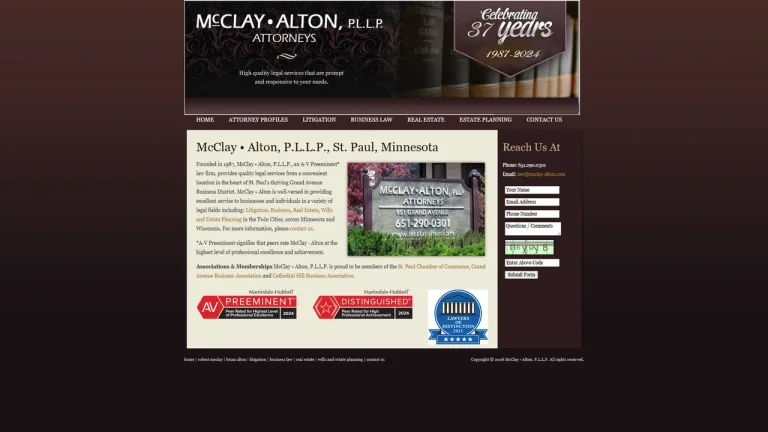
McClay-Alton, PLLP Attorneys - St Paul, MN

The Role of a Saint Paul Wills Lawyer in Ramsey County Probate
Executing a legally binding will in Saint Paul is the primary measure to ensure the orderly distribution of your estate and protect your heirs from statutory intestacy rules. Whether your property includes a historic residence in Summit Hill, a bungalow in Macalester-Groveland, or assets in Highland Park and Como Park, estate governance must comply strictly with the Minnesota Uniform Probate Code. Without a valid will, the State of Minnesota determines how your wealth is divided, regardless of your personal intentions.
Estate matters and probate disputes in Saint Paul fall under the exclusive jurisdiction of the Second Judicial District Court of Minnesota, centered at the historic Ramsey County Courthouse and Saint Paul City Hall on Kellogg Boulevard. The Probate Court oversees informal probate proceedings, formal testacy hearings, and will construction petitions. Having seasoned local counsel ensures your testamentary instruments are recorded properly through Odyssey eFile & Serve and adhere to Minnesota evidentiary standards.
A dedicated Saint Paul wills attorney prepares self-proved testamentary instruments, names personal representatives, and establishes testamentary trusts for minor children. Early legal counsel resolves family disagreements prior to probate, averts contested hearings, and prevents expensive litigation over estate administration in Ramsey County courts.
Saint Paul Will Drafting & Probate Administration Costs
| Case Scenario | Fee Structure | Estimated Cost (USD) | Key Cost Determinants |
|---|---|---|---|
| Simple Last Will & Testament Package | Flat Legal Fee | $750 - $1,800 | Number of specific devises, guardianship designations for minor dependents, and execution of self-proving affidavits. |
| Complex Will with Testamentary Trusts | Flat Fee or Hourly Rate | $1,800 - $4,200 | Blended family provisions, special needs trust integration, business succession clauses, and multi-beneficiary distributions. |
| Uncontested Informal Probate Administration | Hourly or Staged Flat Fee | $2,500 - $6,000 | Ramsey County court filing fees, publication costs, asset liquidation, creditor claim resolution, and estate accounting. |
| Contested Will Litigation / Undue Influence | Hourly Retainer | $8,000 - $25,000+ | Testamentary capacity challenges, medical record discovery, expert witness depositions, and trial length in Second Judicial District. |
Critical Legal Deadlines & Statutes in Minnesota
Wills in Minnesota are governed by stringent statutory requirements to guarantee validity and prevent post-death invalidation. Under Minn. Stat. § 524.2-502, a valid will must be in writing, signed by the testator or in the testator's name by some other individual in the testator's conscious presence and by the testator's direction, and signed by at least two individuals who witnessed either the signing or the testator's acknowledgment of the signature.
For estate administration, the Minnesota Uniform Probate Code sets an absolute statute of limitations. Under Minn. Stat. § 524.3-108, formal or informal probate proceedings must be commenced within three years after the decedent's death. If a will is not submitted to the Ramsey County Probate Court within three years, the estate is generally barred from probate, and property passes according to Minnesota statutory intestacy laws.
Once probate is opened, creditors are subject to prompt filing constraints under Minn. Stat. § 524.3-803. Known and unknown creditors must present their claims within four months following the date of the first published notice to creditors, or within 60 days of personal service, whichever is later. Any claim not presented within this statutory timeframe is barred forever.
Ramsey County Conciliation Court vs. Formal Probate Representation
The Ramsey County Conciliation Court provides a simplified forum for monetary claims up to $15,000, but it possesses zero jurisdictional authority over probate matters, estate distributions, or wills. Conciliation Court referees cannot validate testamentary instruments, appoint personal representatives, or supervise estate distributions. All will proceedings belong exclusively to the Second Judicial District Court Probate Division.
While individuals may attempt to draft a will independently or handle informal probate pro se, navigating probate court without legal representation poses substantial risks. Errors in execution formalities invalidate documents, subjecting assets to statutory intestacy. An experienced Saint Paul wills lawyer ensures the instrument includes an enforceable self-proving clause under Minn. Stat. § 524.2-504, prepares clean estate inventories, and protects the personal representative from personal fiduciary liability.
Red Flags When Selecting a Saint Paul Wills Lawyer
- Using Generic Online Templates: Automated forms frequently fail to comply with Minnesota execution formalities and do not address specific state tax codes or spousal elective share statutes under the Minnesota Uniform Probate Code.
- Omitting Self-Proving Affidavits: A wills lawyer who neglects to execute a notarized self-proving affidavit under section 524.2-504 forces your witnesses to testify in court decades later to validate the instrument.
- Failing to Align Non-Probate Beneficiary Designations: A will does not supersede beneficiary designations on life insurance, retirement accounts, or Transfer on Death Deeds; an effective attorney reviews all title records across Ramsey County.
- Lack of Second Judicial District Courtroom Experience: Contested wills require intimate knowledge of Ramsey County Probate Court procedures, local judicial preferences, and mediation protocols.
Frequently Asked Questions
What makes a will legally valid in Saint Paul, Minnesota?
Under Minnesota Statutes section 524.2-502, a testator must be at least 18 years old and of sound mind. The will must be in writing, signed by the testator (or by someone in their conscious presence and direction), and signed by at least two individuals who witnessed the testator signing or acknowledging the document.
Does a will prevent my estate from going through probate in Ramsey County?
No. A will actually serves as the instructional guide for probate. If a decedent owns solely held real property or personal property exceeding $75,000 in Minnesota, the will must be probated through the Second Judicial District Court to transfer legal title.
Are handwritten wills legal in Minnesota?
Minnesota does not recognize holographic (unwitnessed handwritten) wills unless the document meets all statutory execution requirements under section 524.2-502, including having the signatures of two qualified witnesses who observed the testator sign the document.
Where is the probate court located in Saint Paul?
Probate matters in Saint Paul are adjudicated at the Second Judicial District Court Probate Court Division, located in the Ramsey County Courthouse at 15 West Kellogg Boulevard in Downtown Saint Paul.
Can a spouse be completely disinherited in a Minnesota will?
No. Under Minnesota Statutes section 524.2-202, a surviving spouse has the statutory right to an elective share of the decedent spouse's augmented estate, regardless of the terms written in the will, unless this right was validly waived through an antenuptial or postnuptial agreement.